



Mini Facelift vs. Facelift Surgery in Korea: Choose the Best Technique for Your Face
INIQUE Plastic Surgery Hospital
Some people may notice that even without significant weight gain, their face begins to look different over time. The cheeks may start to sag, the once-defined jawline may appear softer or less sculpted, and the nasolabial folds around the mouth may become deeper, making the face look more tired or older than it actually is.
These changes are often related to facial aging, skin laxity, loss of facial elasticity, shifting facial fat, and weakening of the underlying facial tissues, rather than weight gain alone. As facial sagging progresses, the cheeks and lower face may gradually descend, leading to a less defined facial contour and more noticeable folds. For people experiencing these signs of aging, treatments such as a mini facelift, facelift surgery, facial lifting, or anti-aging facial rejuvenation may be considered depending on the degree of sagging, facial structure, skin condition, and individual needs.Once you start researching facial lifting and anti-aging treatments, you will likely come across options such as a mini facelift and facelift surgery, both of which are surgical procedures designed to lift and reposition different areas of the face. Depending on the individual’s concerns, lifting procedures may also include areas such as the forehead and eyebrows, through techniques like a forehead lift or brow lift.
This often raises an important question: How much lifting does your face actually need? Should you consider a mini facelift for mild facial sagging, or is a more comprehensive facelift surgery better suited to your degree of skin laxity, facial aging, and overall facial structure?
The right choice depends on several factors, including the location and severity of sagging, skin elasticity, facial anatomy, age-related changes, and the specific areas you want to improve. A personalized consultation with an experienced plastic surgeon specializing in facelift surgery can help determine which facial rejuvenation and lifting technique is most appropriate for your individual face.The answer is not simply about how old you are or which facelift technique is better. What matters most is where the facial sagging begins and how extensive it has become.
Choosing between a mini facelift and a more comprehensive facelift surgery should therefore start with a detailed assessment of your actual facial condition. The surgeon needs to evaluate the degree of skin laxity, facial tissue descent, jawline definition, cheek sagging, and overall facial aging to determine whether a localized correction is enough or whether a wider lifting area is more appropriate.
In other words, the right facial rejuvenation and lifting plan should be based on your individual facial anatomy and the extent of sagging, rather than age alone.
Mini Facelift vs. Full Facelift: The Key Difference Is How Much of the Face Needs Lifting
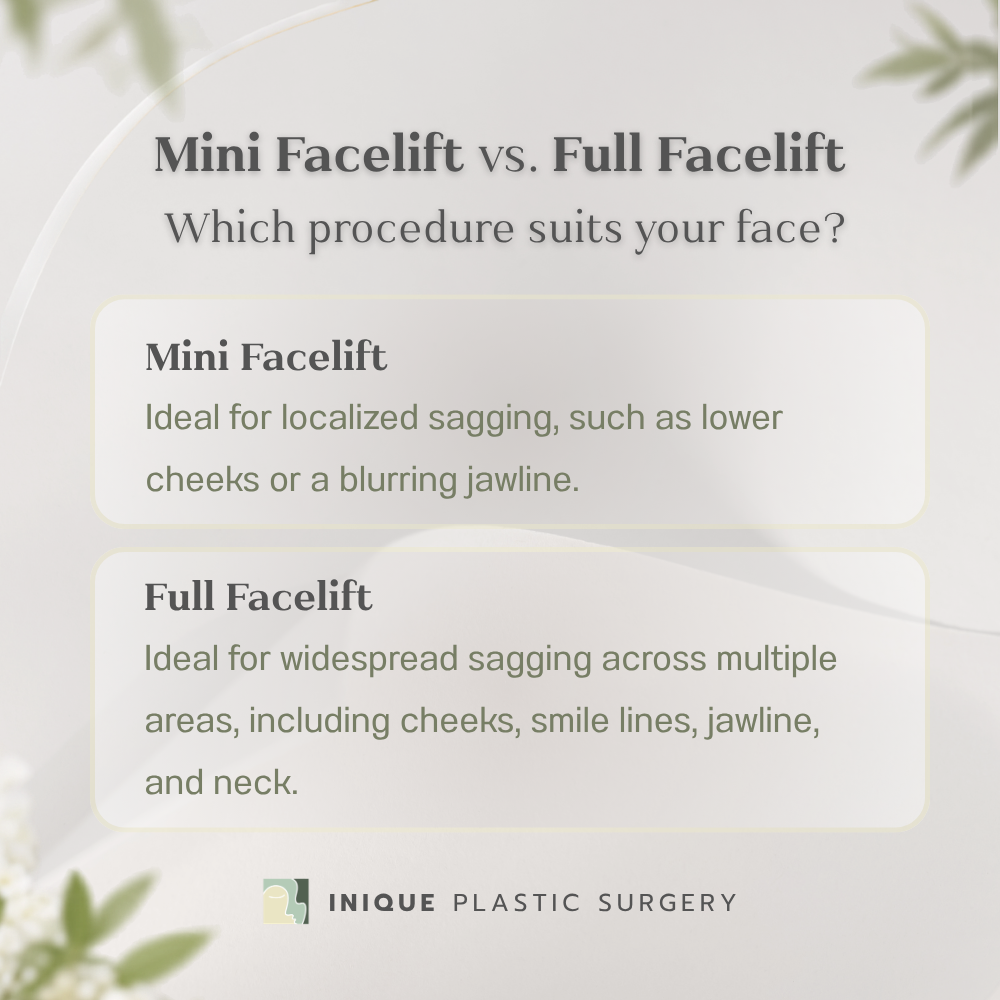
If facial sagging is still limited to specific areas—such as the lower cheeks, lower face, or a jawline that is beginning to lose definition—and has not yet progressed across multiple areas of the face, the concern is considered more localized facial sagging.
In these cases, a mini facelift may be more suitable because it is designed to address a smaller, more targeted area of skin laxity and tissue descent, particularly around the lower face and jawline. For individuals with mild to moderate sagging who do not yet require a more extensive full facelift, a mini facelift can offer a more focused approach to improving jawline definition, lower-face contour, and early signs of facial aging.However, when facial sagging begins to affect multiple areas at the same time—including the cheeks, nasolabial folds, jawline, lower face, and even the neck—a more comprehensive facelift surgery may be more appropriate.
Unlike a mini facelift, a full facelift is designed to address a wider area of skin laxity, tissue descent, and age-related facial changes. It may help improve sagging across the midface, lower face, jawline, and neck, making it a better option when the signs of aging are no longer limited to a single area.
In these cases, a broader facial lifting and rejuvenation approach can provide more balanced correction because the concern involves several connected areas of the face rather than one isolated problem.At INIQUE Plastic Surgery, facial lifting options range from a mini facelift to more targeted lifting procedures for specific areas of the face, including facial lifting, forehead lift, and brow lift, as well as more comprehensive facelift surgery.
Because different individuals experience sagging in different areas, the surgeon can evaluate the location and extent of facial sagging, skin laxity, and tissue descent before determining the most appropriate surgical area. This allows the facelift treatment plan to be tailored to each individual—whether the concern is limited to the lower face, forehead, eyebrows, jawline, or involves a broader area that may benefit from a more extensive facial rejuvenation and lifting procedure.Another important factor that should not be overlooked is your previous plastic surgery and cosmetic procedure history. This is especially important for individuals who have previously undergone facial contouring surgery, facelift surgery, thread lifting, or other facial lifting and anti-aging procedures, as these treatments can affect the tissues, scar formation, anatomy, and surgical approach considered for future procedures.
Before planning a mini facelift or full facelift in Korea, the surgeon should review any previous surgeries or lifting treatments in detail. This information helps determine the safest and most appropriate facelift technique, surgical area, and personalized facial rejuvenation plan for your current condition.So, rather than choosing a mini facelift simply because it may seem to involve an easier or shorter recovery, it is better to start with a more important question: Which areas of your face actually need lifting?
The decision between a mini facelift and a more extensive facelift surgery should be based on the location and severity of facial sagging, skin laxity, jawline changes, cheek descent, and neck laxity, rather than recovery time alone. After evaluating your facial anatomy and the areas that need correction, the surgeon can determine the most appropriate scope of surgery for your individual condition.
Choosing a personalized facelift treatment plan that matches the actual areas of concern can provide a more appropriate, balanced, and safety-focused approach to facial rejuvenation and anti-aging surgery.
Before Your Facelift Consultation: Check What Type of Facial Sagging You Have
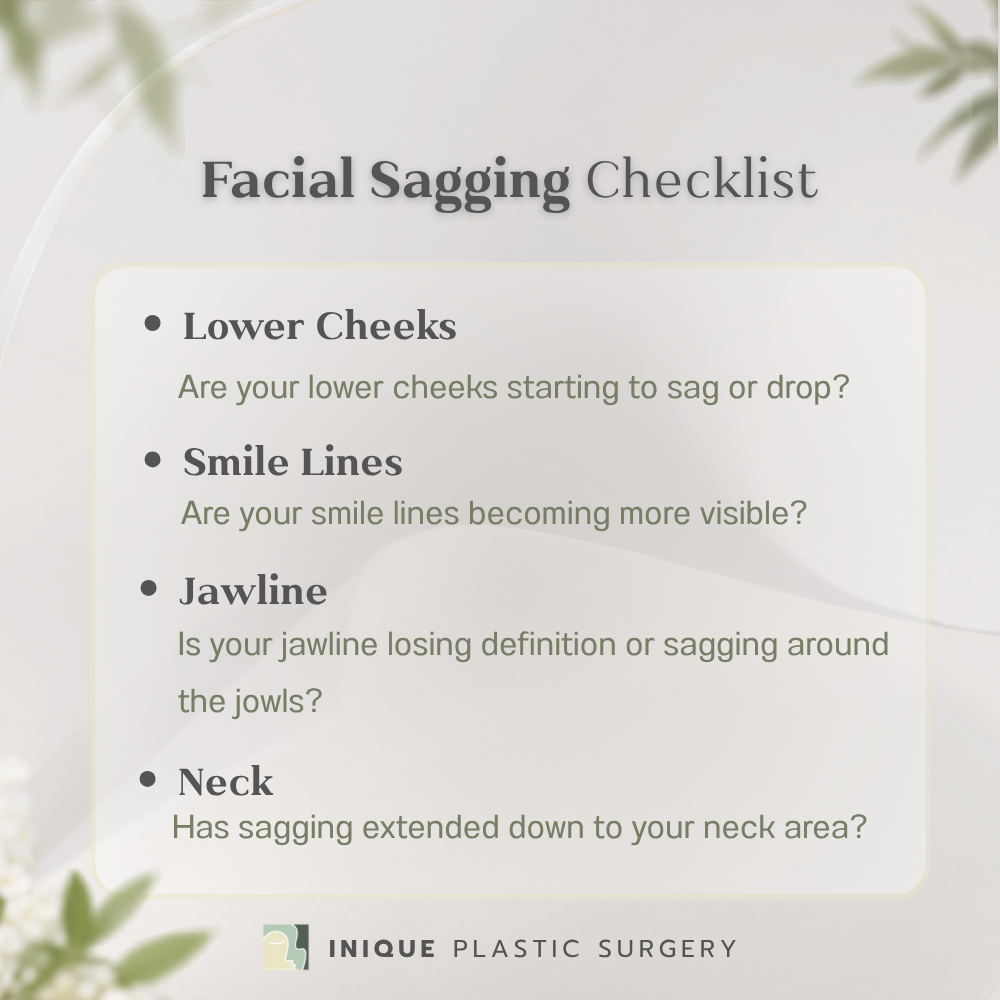
Before sending your photos to a surgeon for a facelift consultation or facial sagging assessment, try standing in front of a mirror and looking at your face from both the front view and a 45-degree angle.
The feeling that your face “is no longer as firm or lifted as before” can mean something different for each person. For some, the concern may be concentrated around the cheeks, while others may notice changes in the jawline, nasolabial folds, lower face, or neck.
Before deciding between a mini facelift and facelift surgery, it can be helpful to identify where the sagging is actually beginning. We recommend paying particular attention to these four key areas of facial aging and skin laxity:
- Lower Cheeks
Check whether the lower cheek tissue has started to descend from its original position or whether the cheeks appear heavier, less lifted, or more sagging than before. Changes in this area can be an early sign of lower-face sagging, facial tissue descent, and loss of facial firmness, which may affect the overall cheek contour and jawline definition.- Nasolabial Folds
Check whether the nasolabial folds have become deeper or more noticeable than before, especially together with cheek sagging or midface tissue descent. More prominent smile lines can be associated with facial aging, loss of skin elasticity, and downward movement of the cheek tissues, which may affect the overall balance of the midface and lower face.- Jawline
Check whether your once-defined jawline has started to look less sharp or uneven, or whether you notice sagging around the corners of the mouth, jowls, or along the jawline. These changes may be signs of lower-face sagging, skin laxity, and facial tissue descent, which can make the facial contour appear less defined.- Neck
Check whether sagging has started to extend beyond the jawline and into the neck area. Changes such as loose neck skin, reduced neck definition, or skin laxity beneath the chin can indicate that facial aging is affecting a broader area rather than the lower face alone.If the main concern is still limited to a relatively small area, a mini facelift may be one of the first options to consider during your facial assessment. It is often more suitable for localized facial sagging, such as mild laxity around the lower cheeks, lower face, or jawline.
However, if sagging has progressed across several connected areas of the face, a more comprehensive facelift surgery may be better suited to the condition. A broader facelift approach can address more extensive skin laxity, tissue descent, jawline changes, cheek sagging, and neck laxity, allowing the treatment area to better match the actual pattern of facial aging.
The most appropriate choice between a mini facelift and full facelift should therefore be based on the extent and location of sagging, rather than the name of the procedure alone.The key is not to look only at how much sagging you have, but also at which areas of the face are actually affected. The pattern of facial sagging and skin laxity can vary significantly from person to person.
For example, some people may notice a clear loss of jawline definition while the cheeks, midface, and neck still remain relatively firm. Others may not have one severely sagging area, but instead experience gradual changes across several regions at the same time, including the cheeks, nasolabial folds, lower face, jawline, and neck.
By identifying where these changes are occurring, you can make a preliminary facial sagging assessment and better understand which areas may need lifting or tightening. This can also help during a mini facelift or facelift consultation, as the surgeon can evaluate whether the concern is localized or spread across multiple areas before recommending the most appropriate facial lifting and rejuvenation plan.
Will Facelift Surgery Make Your Face Look Too Tight or Unnatural? What to Know Before Getting a Facelift in Korea

Another common concern—alongside facelift scars and recovery time—is whether the face will look too tight, pulled, or unnatural after facelift surgery. Many clients also worry that other people will immediately notice that they have undergone a facelift.
In reality, the goal of a well-planned facelift surgery is not to make the face look overly stretched, but to restore a more natural, refreshed, and balanced appearance by repositioning sagging tissues in a way that suits the patient’s facial structure. The final result depends on factors such as the facelift technique, amount of tissue lifting, skin condition, facial anatomy, and the surgeon’s surgical approach.
For individuals considering a facelift in Korea, discussing the desired level of lifting and how natural they want the result to look during consultation is an important part of creating a personalized treatment plan.A well-performed facelift or facial lifting procedure should not make the face look unnatural, overly tight, or visibly pulled. Instead, the goal is to improve facial sagging, skin laxity, and tissue descent while preserving the client’s natural facial proportions and overall balance.
Natural-looking facelift results should enhance the face rather than change its identity. The lifting plan should be tailored to the individual’s facial anatomy, degree of sagging, skin condition, and facial structure, helping restore a firmer and more refreshed appearance without creating an overcorrected or artificial look.At INIQUE Plastic Surgery, the medical team places strong emphasis on achieving natural-looking facelift results while paying close attention to the individual details of each client’s face. Because every person has a different facial structure, tissue volume, skin condition, degree of sagging, and aesthetic concern, the same lifting approach is not suitable for everyone.
The goal is not to simply pull the face as tightly as possible, but to create a personalized facelift and facial rejuvenation plan that suits the client’s unique facial anatomy and proportions. By carefully evaluating where sagging has occurred and how much lifting is actually needed, the surgeon can plan a more balanced and natural-looking result that preserves the client’s original facial characteristics.During a facelift consultation, it is important to clearly explain how you want your face to change. For example, you may want a more defined jawline, a less tired appearance, or a fresher and more youthful look while still looking like yourself.
For facelift surgery, the idea of being “well-balanced” is just as important as being “lifted.” The goal should not be to create an excessively tight or overcorrected appearance, but to improve facial sagging, jawline definition, skin laxity, and overall facial aging in a way that still feels natural.
For many individuals, the ideal natural facelift result is simply looking in the mirror and feeling that the face appears more refreshed, rested, and rejuvenated—without looking obviously pulled or unnaturally tight. This is why discussing your aesthetic goals, preferred level of lifting, and desired facial balance with your plastic surgeon is an essential part of creating a personalized facelift plan.
STM Match: Find the Right Facial Lifting Solution for Your Face

For anyone interested in treatments or surgery for facial sagging, whether you are considering a mini facelift, facelift surgery, or another facial lifting procedure, it is important to first determine which option is actually suitable for your face.
A consultation with an experienced Korean plastic surgeon can help assess your facial structure, skin laxity, tissue descent, jawline, cheeks, neck, and overall degree of sagging before recommending the most appropriate treatment. Rather than choosing a procedure based on age or popularity alone, a personalized facial assessment can help determine whether your concerns are better suited to a mini facelift, full facelift, or another facial rejuvenation approach.STMstyle helps collect your initial information and coordinate directly with a Korean plastic surgery hospital or clinic. Important details may include your main facial concerns, previous injections, lifting treatments, or cosmetic procedures, allergy history, underlying medical conditions, length of stay in Korea, and travel schedule.
This information is used to support a more personalized Korean plastic surgery consultation and case assessment, helping STM Match your case with a Korean plastic surgeon who has relevant experience and expertise in the procedure or concern you are interested in.
Whether you are considering a mini facelift, facelift surgery, facial lifting, anti-aging treatment, or another cosmetic procedure in Korea, reviewing these details in advance can help make the consultation, doctor matching, surgery planning, and overall medical tourism journey in Korea more organized and better suited to your individual needs.Preparing this information in advance can help make your Korean plastic surgery consultation faster, clearer, and more efficient. It allows the medical team to review your concerns before the consultation and reduces the time needed to collect basic information during the assessment.
The final decision regarding which areas should be treated or operated on, which surgical technique or medical technology may be appropriate, and the recommended order of procedures is made by the actual Korean plastic surgeon at the hospital. The surgeon will assess your facial condition, anatomy, previous treatment history, and aesthetic concerns through an online plastic surgery consultation before providing a preliminary recommendation.
This process helps clients receive a more personalized Korean plastic surgery evaluation before traveling to Korea, making it easier to understand the possible treatment plan, suitable procedures, and next steps in advance.
FAQ: Frequently Asked Questions About Mini Facelift and Facelift Surgery
Q. Am I Too Young for a Mini Facelift, or Can Younger Patients Consider Mini Facelift Surgery?
A mini facelift should be considered based primarily on your actual facial condition rather than age alone. Age is only one factor; the location and degree of facial sagging, skin laxity, tissue descent, and overall facial structure are more important when determining whether a mini facelift is appropriate.
A consultation with a plastic surgeon experienced in mini facelift surgery can help assess whether your concerns are localized enough for a mini facelift or whether another facial lifting or rejuvenation treatment would be more suitable for your individual needs.Q. If My Jawline Is Starting to Lose Definition, Do I Need a Full Facelift?
Not necessarily. If the concern is still limited to a specific area, such as early jawline sagging or localized lower-face laxity, the surgeon may consider a less extensive option rather than a full facelift.
Depending on the location and severity of the sagging, a mini facelift or targeted facial lifting procedure may be enough to improve jawline definition and address the problem without treating the entire face. The most appropriate approach should be based on an individual facial assessment by a plastic surgeon.Q. Can a Mini Facelift Help with Sagging Skin After Facial Contouring Surgery?
INIQUE offers personalized mini facelift consultations specifically for clients experiencing facial sagging or skin laxity after facial contouring surgery. Contact us for an initial assessment by the surgeon to determine whether a Korean mini facelift or another face-lifting treatment would be most suitable for your facial structure and concerns.
Choose the Treatment That Matches Your Real Facial Concerns
If facial sagging is limited to a few specific areas, a mini facelift may be a suitable option. However, if multiple areas of the face are affected by sagging and age-related changes at the same time, a more comprehensive full facelift or extended facial lifting procedure may provide a better overall correction.
But there’s no need to rush into a decision.
There’s no need to rush into a decision. Start by sending your facial photos to STMStyle for an initial review. We will then coordinate with INIQUE Plastic Surgery to assess which areas of your face may benefit from lifting and how extensive the treatment should be.
The goal of long-term facial rejuvenation is not to lift the face as much as possible, but to achieve balanced, natural-looking facial lifting that helps you look refreshed while still looking like yourself.
#IniquePlasticSurgery #INIQUEPlasticSurgery #KoreanPlasticSurgery #KoreanPlasticSurgeon #UnderEyeFatRepositioning #UnderEyeBagReduction #DarkCirclesUnderEyes #TiredLookingEyes #UnderEyeLaserTreatment #KoreanPlasticSurgeryReview #KoreanPlasticSurgeryAgency #STMStyle #INIQUE #KoreanMiniFacelift #FaceliftKorea #MiniFacelift #Facelift #FacialLifting #SaggingFaceCorrection #UndefinedJawline #FacialRejuvenationSurgery #KoreanFacelift #MiniFaceliftKorea #FaceLiftingKorea #FacialContouringKorea #KoreanFacialRejuvenation #PlasticSurgeryConsultationKorea