


Is Under-Eye Fat Repositioning Enough? Restoring Volume with Nano Fat
INIQUE Plastic Surgery Hospital
Have you ever noticed that even after getting a full night’s sleep, your face still looks tired, dull, or as if you have not rested enough?
In many cases, this tired appearance may be related to under-eye bags, deep tear troughs, under-eye hollows, dark circles, or volume loss around the lower eyelids, rather than a lack of sleep alone. These under-eye concerns can make the eyes look heavier and the overall face appear more fatigued or older than it actually is.This problem is often caused by prominent under-eye bags or deep tear troughs, which can create stronger shadows when light hits the lower eyelid area. These shadows may make the under-eyes look darker and the entire face appear constantly tired, sunken, or older than it actually is.
Even with concealer, under-eye puffiness, deep tear troughs, and uneven lower-eyelid contours may still remain visible because the issue is not only pigmentation—it can also be related to bulging under-eye fat, under-eye hollows, volume loss, and irregular contours beneath the eyes. As a result, the under-eye area may look uneven, shadowed, and less smooth, contributing to a more fatigued and aged appearance.This concern is not caused by dark circles alone. In many cases, the tired-looking under-eye area results from a combination of prominent under-eye bags and deep tear troughs occurring at the same time.
When bulging under-eye fat sits next to a hollow or sunken tear trough, the contrast between the raised and depressed areas can create visible shadows and uneven contours. This can make the under-eyes look darker, more tired, and less smooth, even when pigmentation itself is not the main problem.If you have both prominent under-eye bags and deep tear troughs, simply removing the excess under-eye fat may not always be enough. In some cases, taking away fat alone can leave the lower eyelid area looking more hollow or uneven, especially when under-eye volume loss is already present.
So which treatment is more appropriate—under-eye fat removal, under-eye fat repositioning, tear trough correction, or Nano Fat grafting? The right approach depends on how the bulging fat, hollowness, skin condition, and lower-eyelid contour interact in each individual case.
Let’s take a closer look with INIQUE Plastic Surgery at how different techniques can be combined to address under-eye bags, deep tear troughs, under-eye hollows, and volume deficiency more precisely.
Why Do Under-Eye Bags and Deep Tear Troughs Appear at the Same Time?
When talking about under-eye concerns, most people tend to describe everything simply as “under-eye bags.” However, if you look closely in the mirror, you may notice that the lower eyelid area is more complex than it seems.
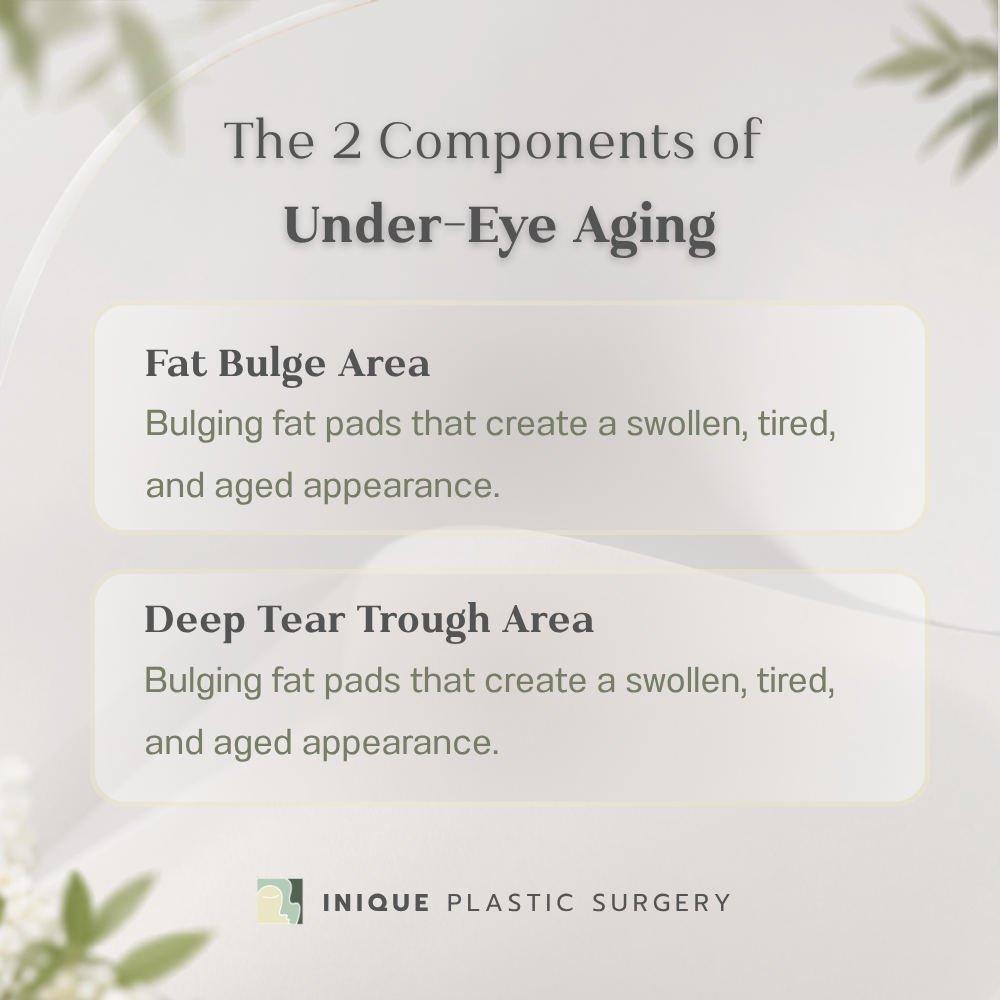
From an aesthetic and anatomical perspective, the under-eye area can generally be divided into two main components. Understanding these two areas is important when evaluating concerns such as under-eye bags, deep tear troughs, under-eye hollows, puffiness, and uneven lower-eyelid contours.
- Under-Eye Fat Bulge
This refers to the fat pads beneath the lower eyelids that protrude forward and create a visible puffiness or bulging contour. When the under-eye fat becomes more prominent, the eyes may look swollen, tired, or older than they actually are.
This type of under-eye bag or lower-eyelid fat bulge can also create stronger shadows around the tear trough area, making the under-eyes appear heavier and less smooth.
- Deep Tear Troughs
This refers to the hollow groove along the orbital bone beneath the eyes, usually located next to the under-eye fat bulge. The area may appear sunken due to volume loss, tissue depression, or reduced collagen support, creating a long, visible indentation beneath the lower eyelid.
Because this hollow sits lower than the surrounding tissue, light can cast a noticeable shadow across the area, making the tear trough look darker, deeper, and more sunken. As a result, the under-eyes may appear tired, hollow, or aged even when actual skin pigmentation is not the main cause.When the under-eye surface is uneven, with raised and hollow areas sitting at different levels, light can create stronger shadows that make the lower eyelid look darker and the tear troughs appear deeper.
Some individuals may also have fine lines, crepey skin, or uneven skin texture around the under-eye area, which can make the overall contour look even less smooth. For this reason, simply removing the under-eye bags or excess fat may not fully address every concern.
A more complete treatment plan may need to consider several factors together, including bulging under-eye fat, deep tear troughs, under-eye hollows, volume loss, fine lines, and skin texture, in order to create a smoother and more balanced lower-eyelid contour.Therefore, before deciding whether to remove under-eye fat, reposition the existing fat, or add volume with fat grafting, it is important to first identify which part of the under-eye structure is actually causing the problem.
The surgeon should evaluate factors such as bulging under-eye fat, deep tear troughs, under-eye hollows, volume loss, lower-eyelid contour, skin thickness, fine lines, and overall under-eye anatomy. This detailed assessment helps determine whether the most appropriate approach is under-eye fat repositioning, tear trough correction, Nano Fat grafting, or a combination of treatments.
In other words, effective under-eye rejuvenation should begin with understanding the individual structure of the lower eyelid rather than choosing a procedure based on the appearance of the under-eye bags alone.
Existing Fat Should Be “Repositioned,” While Lost Volume Should Be “Restored”
Imagine a surface with both a raised area and a hollow sitting right next to each other. If treatment focuses only on reducing the bulging under-eye fat, the surface may not automatically become smooth, because the adjacent deep tear trough or under-eye hollow can still remain.
This is why treating under-eye bags is not always just about removing excess fat. The surgeon also needs to evaluate whether there is volume loss, a sunken tear trough, or an uneven lower-eyelid contour that may need to be corrected at the same time. In some cases, combining under-eye fat repositioning with volume restoration or Nano Fat grafting may create a smoother and more balanced transition between the lower eyelid and cheek.At INIQUE Plastic Surgery, the approach to under-eye fat treatment focuses on repositioning and redistributing the existing fat according to the individual under-eye anatomy, rather than treating all under-eye fat as excess tissue that simply needs to be removed.
This is especially important in individuals who already have deep tear troughs, under-eye hollows, or volume deficiency. If too much fat is removed, the lower eyelid area may become more sunken, hollow, or fatigued-looking than before.
For this reason, under-eye fat repositioning aims to preserve and redistribute useful fat where appropriate, helping create a smoother transition between the lower eyelid, tear trough, and upper cheek while reducing the risk of an over-hollow or overly depleted appearance.However, in cases where there is not enough existing under-eye fat to redistribute, under-eye fat repositioning alone may not be sufficient to correct the hollow or uneven contour.
In these situations, the surgeon may consider adding fat grafting, Nano Fat grafting, or additional volume restoration to areas with deep tear troughs, under-eye hollows, or volume deficiency. By combining fat repositioning with fat transfer, the treatment can address both the bulging and hollow areas more effectively, helping create a smoother and more balanced transition between the lower eyelid and upper cheek.
The need for additional fat grafting depends on each client’s under-eye anatomy, available fat volume, degree of hollowness, skin condition, and overall lower-eyelid contour.So, there are two important questions to ask when evaluating the under-eye area: “Where is the existing fat that needs to be repositioned?” and “Where is volume lacking and needs to be restored?”
These are two different concerns and may require different treatment approaches. Under-eye fat repositioning focuses on redistributing existing fat to smooth bulging areas and improve the contour around the tear trough, while fat grafting or Nano Fat grafting may be considered when additional volume is needed to correct under-eye hollows, deep tear troughs, or volume loss.
Understanding the difference between excess or displaced under-eye fat and true volume deficiency is essential for creating a more personalized and balanced under-eye rejuvenation treatment plan.
INIQUE SAC Technique vs. Traditional Under-Eye Fat Removal: What’s the Difference?
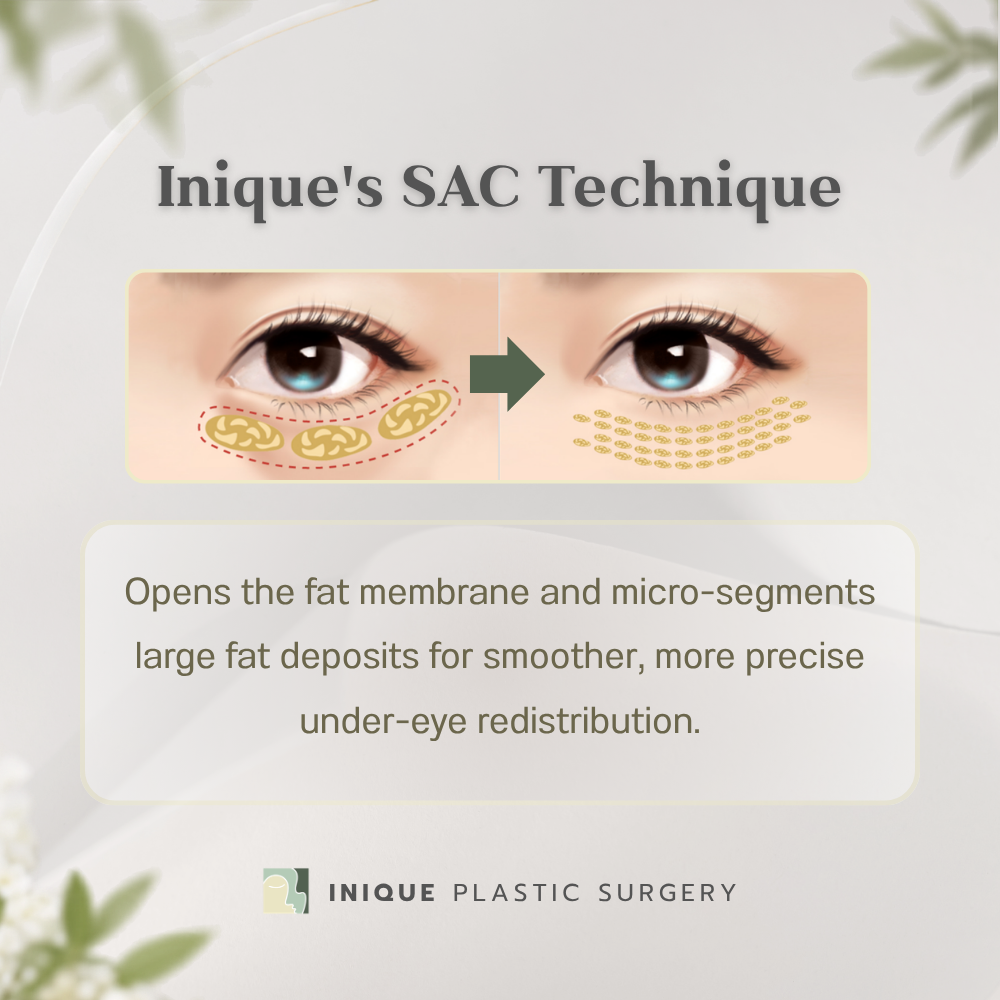
One of the key features of under-eye fat surgery at INIQUE Plastic Surgery is its SAC concept. In INIQUE’s approach, the SAC refers to thin, transparent membrane-like layers surrounding and supporting the under-eye fat pads.
Rather than viewing bulging under-eye fat simply as excess fat that should be removed, the SAC technique focuses on understanding how the fat is contained and distributed within the lower-eyelid structure. This allows the surgeon to plan under-eye fat repositioning and fat redistribution more precisely, with the goal of improving under-eye bags, uneven contours, and deep tear troughs while preserving useful volume where appropriate.Instead of simply removing the under-eye fat or forcefully moving a large fat pad to another area, the INIQUE SAC technique involves opening the surrounding membrane and dividing larger fat deposits into smaller, finer portions.
These smaller fat portions can then be redistributed more precisely across the under-eye area, allowing the surgeon to smooth the transition between bulging areas and hollow regions more carefully. This approach is intended to support more detailed under-eye fat repositioning, fat redistribution, tear trough correction, and lower-eyelid contouring, particularly in individuals with a combination of under-eye bags, deep tear troughs, and uneven under-eye contours.Think of it like a large clump of soil in a pot. When that clump is broken down into smaller particles, the soil can spread out more evenly and fill the surrounding gaps more smoothly and consistently.
The same concept applies to the INIQUE SAC technique: by dividing larger under-eye fat deposits into smaller portions, the fat can be redistributed more precisely to help smooth the transition between under-eye bags, deep tear troughs, and hollow areas.Inique Plastic Surgery
The goal is not to make the under-eye area completely “fat-free.” Instead, the aim is to blend the bulging and hollow areas into a smoother, more continuous contour.
By carefully redistributing under-eye fat, the surgeon can reduce the visible transition between under-eye bags, deep tear troughs, and the upper cheek, helping soften the lines and shadows that make the area look uneven or tired. The objective is a more natural under-eye contour, with a smoother transition from the lower eyelid to the cheek rather than an overly hollow or over-corrected appearance.
How Does Nano Fat Grafting Help Treat Deep Tear Troughs and Under-Eye Volume Loss?
After the existing under-eye fat has been carefully repositioned and redistributed, some individuals may still have residual deep tear troughs or under-eye hollows. This is where Nano Fat Grafting can play an important role.
Nano Fat Grafting may be used to restore volume in areas that remain hollow after under-eye fat repositioning, helping improve the transition between the lower eyelid and upper cheek. By addressing the remaining volume deficiency, it can complement procedures such as the INIQUE SAC technique, especially in cases involving both under-eye bags and deep tear troughs.Nano Fat uses the client’s own fat, which is harvested and processed into a finer fat preparation before being injected to restore volume in areas such as the under-eye region or the anterior cheek.
The role of Nano Fat Grafting is clearly different from under-eye fat repositioning. While fat repositioning focuses on redistributing the existing under-eye fat pads to smooth bulging areas and improve the contour around the tear trough, Nano Fat Grafting is used to add volume where tissue is deficient, such as persistent under-eye hollows, deep tear troughs, or volume loss in the front cheek area.
In other words, under-eye fat repositioning moves the fat you already have, while Nano Fat Grafting restores volume where additional fullness is still needed.
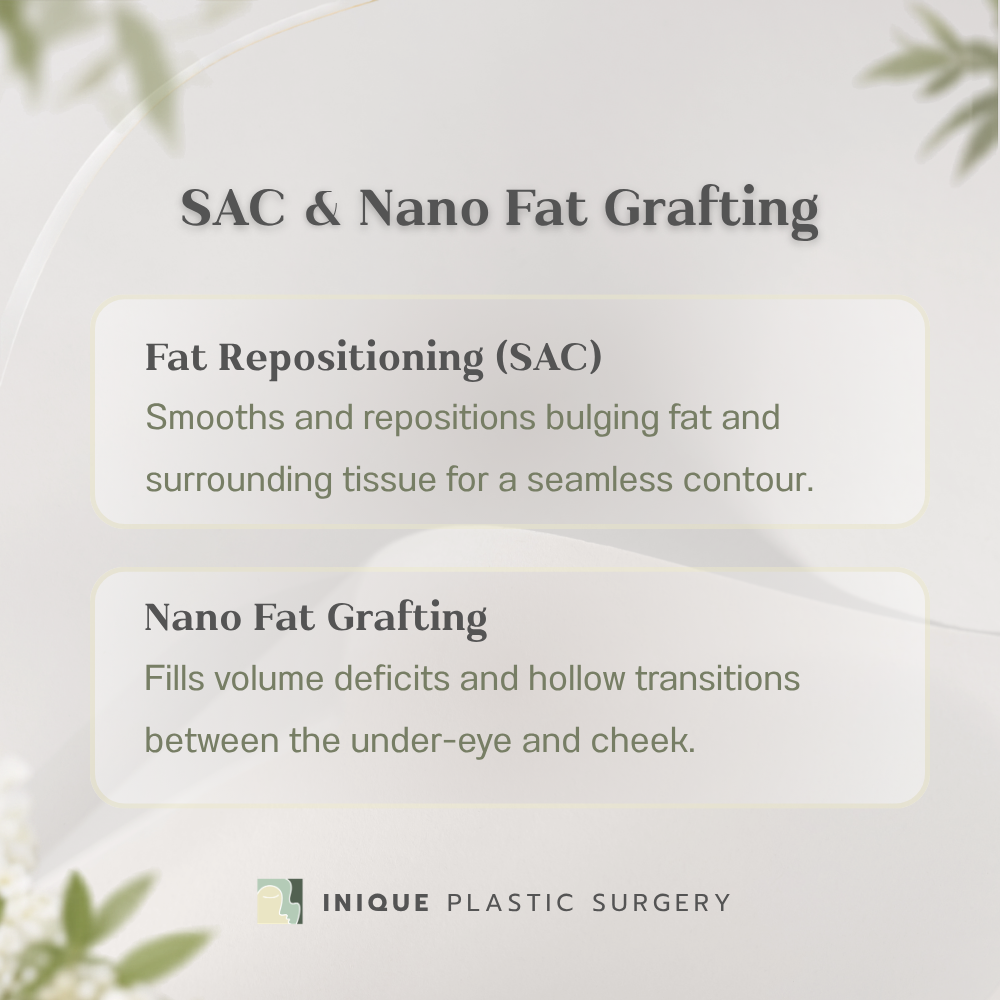
- Under-Eye Fat Repositioning (SAC): Repositions and redistributes the existing bulging under-eye fat and surrounding tissue to create a smoother, more even lower-eyelid contour.
- Nano Fat Grafting: Restores volume in areas that are still hollow or deficient, such as persistent deep tear troughs, under-eye hollows, or sunken transitions between the lower eyelid and cheek.
Think of it this way: after the bulging under-eye area has been smoothed and repositioned, there may still be certain spots that remain hollow or sunken. In those cases, trying to stretch or redistribute the existing under-eye fat to fill every depressed area may not be enough.
This is where targeted Nano Fat Grafting can help. By adding volume only to the areas that are still deficient—such as deep tear troughs, under-eye hollows, or anterior cheek volume loss—the surgeon can refine the contour more precisely and create a smoother transition between the lower eyelid and cheek.
This combination of under-eye fat repositioning and selective Nano Fat Grafting allows for a more detailed and personalized approach to correcting both under-eye bags and volume deficiency at the same time.At INIQUE Plastic Surgery, the surgeon may combine under-eye fat repositioning with Nano Fat Grafting only when additional volume restoration is genuinely needed. The goal is not to overfill the under-eye area or create an unnaturally puffy appearance.
Instead, the treatment focuses on refining the transition between the lower eyelid and the anterior cheek, helping create a smoother, more gradual contour between under-eye bags, deep tear troughs, under-eye hollows, and cheek volume loss.
By using fat repositioning and Nano Fat Grafting selectively, the surgeon can adjust the lower-eyelid contour more precisely while aiming for a natural-looking, balanced, and seamless under-eye-to-cheek transition.
INIQUE Plastic Surgery: What Matters Most for Safety, Post-Operative Care, and Recovery?
The under-eye area is a small and delicate anatomical region, and excessive manipulation of the tissues can increase the risk of post-operative swelling, bruising, and prolonged recovery. For this reason, INIQUE Plastic Surgery places strong emphasis on using a tissue-preserving, minimally traumatic surgical approach whenever possible.
By minimizing unnecessary disruption to the lower-eyelid tissues, fat pads, and surrounding structures, the surgical plan aims to reduce tissue trauma while still addressing concerns such as under-eye bags, deep tear troughs, and uneven under-eye contours. This approach is intended to support a smoother post-operative recovery process and more precise under-eye correction.One of the surgical devices used at INIQUE Plastic Surgery is the Lumenis Encore UltraPulse CO₂ Laser, which allows for precise tissue incision and ablation in targeted areas. UltraPulse CO₂ laser technology delivers energy in very short pulses and is designed to provide controlled tissue treatment with limited excess thermal damage, supporting precise work in delicate anatomical areas such as the lower eyelid and under-eye region.
During under-eye fat repositioning and lower-eyelid surgery, INIQUE also emphasizes minimizing unnecessary repeated tissue manipulation, preserving important supporting structures such as the retaining ligaments, and maintaining careful bleeding control and hemostasis throughout the procedure.
This tissue-conscious approach is intended to reduce unnecessary surgical trauma while allowing the surgeon to work more precisely around the under-eye fat pads, tear troughs, lower-eyelid tissues, and surrounding structures, with the goal of supporting smoother recovery and more controlled correction of under-eye bags and deep tear troughs.When it comes to recovery after under-eye surgery, even if the surgical technique is designed to help minimize swelling and bruising, the recovery process can still vary from person to person.
This is especially important for international clients traveling for plastic surgery in Korea. It is recommended to allow enough time in Korea for post-operative follow-up appointments, wound checks, swelling assessment, and recovery monitoring by the surgeon before flying home.
Planning sufficient recovery time can help ensure that the under-eye fat repositioning, Nano Fat Grafting, or lower-eyelid surgery is properly monitored during the early healing period and that any post-operative concerns can be addressed by the medical team before departure.
STMStyle MATCH: Find the Right Korean Eye Plastic Surgeon for Your Eyelid and Under-Eye Concerns

For anyone looking to improve under-eye bags, puffy lower eyelids, deep tear troughs, or under-eye hollows, treatment options may include under-eye fat repositioning, Nano Fat Grafting, or a combination of both, depending on the individual under-eye structure.
If you are unsure which approach is more suitable for your face, a consultation with a Korean plastic surgeon specializing in eyelid and under-eye surgery can help assess factors such as bulging under-eye fat, tear trough depth, volume loss, lower-eyelid contour, skin condition, and the transition between the under-eye area and cheek.
Based on this assessment, the surgeon can determine whether your case is better suited to under-eye fat repositioning alone, Nano Fat Grafting for volume restoration, or a combined under-eye rejuvenation treatment tailored to your individual facial anatomy.STMstyle helps collect your initial information and coordinate with a Korean plastic surgery hospital or clinic before your consultation. Important details may include your main concerns, previous plastic surgery or cosmetic procedure history, medication or allergy history, underlying medical conditions, length of stay in Korea, and planned travel schedule.
This information helps support a more personalized Korean plastic surgery consultation and case assessment, allowing STMstyle to match your case with a Korean plastic surgeon who has relevant expertise in the procedure or concern you are interested in.
For individuals considering treatments such as under-eye fat repositioning, Nano Fat Grafting, tear trough correction, or eyelid surgery in Korea, this preliminary assessment can help connect you with a doctor who has experience in the appropriate specialty and make the overall medical tourism and plastic surgery planning process in Korea more organized and efficient.Preparing this information in advance can help make your Korean plastic surgery consultation faster, clearer, and more efficient by allowing the medical team to review your case before the appointment.
The final decision regarding which areas should be treated or operated on, which surgical technique or medical technology is appropriate, and the recommended order of procedures is made by the actual Korean plastic surgeon at the hospital. Through an online plastic surgery consultation, the surgeon can review your facial condition, previous surgical history, medical concerns, and aesthetic goals before providing a preliminary treatment recommendation.
For individuals considering under-eye fat repositioning, Nano Fat Grafting, tear trough correction, eyelid surgery, or other plastic surgery procedures in Korea, this online evaluation can help provide a clearer understanding of the possible treatment plan and next steps before traveling to Korea.
FAQ: Frequently Asked Questions About Under-Eye Fat Repositioning and Nano Fat Grafting
Q. Do Under-Eye Bags Always Require Complete Fat Removal, or Is Under-Eye Fat Repositioning Better?
Not necessarily. At INIQUE Plastic Surgery, the focus is on repositioning and redistributing the existing under-eye fat where appropriate, rather than simply removing all of it.
Preserving and redistributing useful fat can help smooth the transition between under-eye bags, deep tear troughs, and the upper cheek, while reducing the risk of creating an overly hollow or sunken appearance. The exact approach should be determined by the surgeon based on your under-eye anatomy, fat distribution, tear tr ough depth, and overall lower-eyelid contour.Q. If I Have Deep Tear Troughs or Under-Eye Hollows, Does Everyone Need Nano Fat Grafting?
Not always. The surgeon should first evaluate whether the existing under-eye fat can be repositioned sufficiently to improve the contour and whether there is any additional volume deficiency, deep tear trough, or under-eye hollow that still needs correction.
If there is enough existing fat to redistribute and smooth the lower-eyelid contour, Nano Fat Grafting may not be necessary. Nano Fat is generally considered only when additional volume is needed to restore areas that remain hollow after under-eye fat repositioning.
The most appropriate treatment depends on each individual’s under-eye anatomy, available fat volume, tear trough depth, degree of hollowness, and lower-eyelid-to-cheek contour.Q. Which Areas Can INIQUE Nano Fat Grafting Be Used to Treat?
Nano Fat Grafting at INIQUE Plastic Surgery may be considered for several areas, including the under-eye region, deep tear troughs, under-eye hollows, and the anterior cheek area, depending on each client’s individual facial structure and volume deficiency.
The exact injection areas are determined by the surgeon after evaluating the under-eye anatomy, tear trough depth, cheek volume, lower-eyelid contour, and transition between the under-eye area and cheek. In some cases, Nano Fat may be used together with under-eye fat repositioning to restore missing volume and create a smoother, more natural-looking contour.Q. If I Have Under-Eye Bags, Deep Tear Troughs, and Fine Lines, Which Treatment Should I Choose?
A comprehensive under-eye assessment by a plastic surgeon is recommended because concerns that appear similar on the surface may have different underlying causes.
For individuals with a combination of under-eye bags, deep tear troughs, under-eye hollows, fine lines, and uneven lower-eyelid contours, a single procedure may not always address every concern. Depending on the individual anatomy, the surgeon may consider a combined treatment approach, such as under-eye fat repositioning, Nano Fat Grafting, tear trough correction, or other under-eye rejuvenation techniques.
The most appropriate treatment plan should be based on the overall condition of the under-eye fat, skin quality, volume loss, tear trough depth, and lower-eyelid-to-cheek contour rather than choosing a procedure based on one visible symptom alone.
A tired-looking under-eye area does not always mean that all under-eye fat needs to be removed, and a deep or hollow under-eye area does not automatically mean that fat grafting or filler should be added immediately.
The right approach depends on the actual cause of the problem—whether it is bulging under-eye fat, deep tear troughs, under-eye hollows, volume loss, uneven lower-eyelid contours, or a combination of several factors. A detailed assessment can help determine whether the area is better suited to under-eye fat repositioning, Nano Fat Grafting, tear trough correction, or a combined under-eye rejuvenation treatment.What matters more is understanding how your existing under-eye fat should be repositioned and where true volume deficiency actually exists.
A precise assessment of fat distribution, tear trough depth, under-eye hollows, lower-eyelid contour, and cheek volume helps determine whether the best approach is under-eye fat repositioning, Nano Fat Grafting, or a combination of both. The goal is to correct the actual structural imbalance rather than simply removing fat or adding volume without first identifying the underlying cause.Understanding how your existing under-eye fat should be repositioned and where true volume loss is present is one of the most important steps in choosing the right treatment for under-eye bags, deep tear troughs, and under-eye hollows.
A detailed assessment of the under-eye fat distribution, tear trough depth, lower-eyelid contour, and volume deficiency can help determine whether your condition is better suited to under-eye fat repositioning, Nano Fat Grafting, or a combination of both techniques.
By identifying the actual structural cause of the problem first, the treatment can be planned more precisely and appropriately, with the goal of achieving a smoother, more natural-looking under-eye contour while prioritizing safety and individualized care.Start by sending your photos to STMstyle for an initial under-eye assessment. Our team will collect the necessary information and forward your case to INIQUE Plastic Surgery in Korea for a preliminary evaluation by the medical team.
Based on your individual under-eye anatomy, fat distribution, tear trough depth, volume loss, and lower-eyelid contour, the surgeon can assess which areas of under-eye fat may need to be removed or repositioned and whether additional volume restoration with Nano Fat Grafting may be appropriate.
This personalized Korean plastic surgery consultation helps determine whether your concerns—such as under-eye bags, deep tear troughs, under-eye hollows, or uneven under-eye contours—may be better addressed with under-eye fat repositioning, Nano Fat Grafting, or a combination of both techniques.
Let STMstyle help coordinate your case with INIQUE Plastic Surgery and find an under-eye treatment approach designed around your individual facial structure, with the goal of creating a brighter, smoother, and naturally refreshed eye area.
#IniquePlasticSurgery #INIQUE #STMStyle #PlasticSurgeryInKorea #KoreanPlasticSurgery #KoreanPlasticSurgeon #KoreanPlasticSurgeryConsultation #KoreanPlasticSurgeryAgency #KoreanPlasticSurgeryReview #PlasticSurgeryClinicKorea #SeoulPlasticSurgery #MedicalTourismKorea #UnderEyeFatRepositioning #UnderEyeFat #UnderEyeBags #UnderEyeBagReduction #UnderEyeSurgery #UnderEyeRejuvenation #LowerEyelidSurgery #LowerBlepharoplasty #DeepTearTroughs #TearTroughCorrection #UnderEyeHollows #UnderEyeVolumeLoss #DarkCirclesUnderEyes #TiredEyesTreatment #NanoFat #NanoFatGrafting #UnderEyeFatGrafting #FatGraftingUnderEyes #UnderEyeVolumeRestoration #EyePlasticSurgery #EyelidSurgeryKorea #KoreanEyeSurgery #NaturalUnderEyeResults #UnderEyeContour #LowerEyelidRejuvenation