First-Time Double Eyelid Surgery: How to Choose the Right Eyelid Crease Shape for Your Eyes Urban Plastic Surgery Hospital
Have you ever scrolled through Korean double eyelid surgery reviews and immediately saved photos of beautiful eyelid crease designs? Some people prefer a low, subtle double eyelid crease for a soft and natural look. Others want a slightly more defined crease that remains visible with eye makeup, while some prefer a bold, Western-inspired double eyelid shape with a sharper and more prominent appearance.
There are several popular double eyelid crease styles, including the Inline, In-Out Line, and Outline. With so many options, it is natural to wonder which double eyelid shape will best suit your eye anatomy, natural eye shape, and overall facial features.
In this guide, Urban Plastic Surgery introduces the three main double eyelid crease type Inline, In-Out Line, and Outline along with essential information about double eyelid surgery in Korea. Understanding the differences can help you choose an eyelid shape that matches your preferences, eye anatomy, and facial balance.
What Is the Difference Between Inline, In-Out Line, and Outline Double Eyelid Creases?
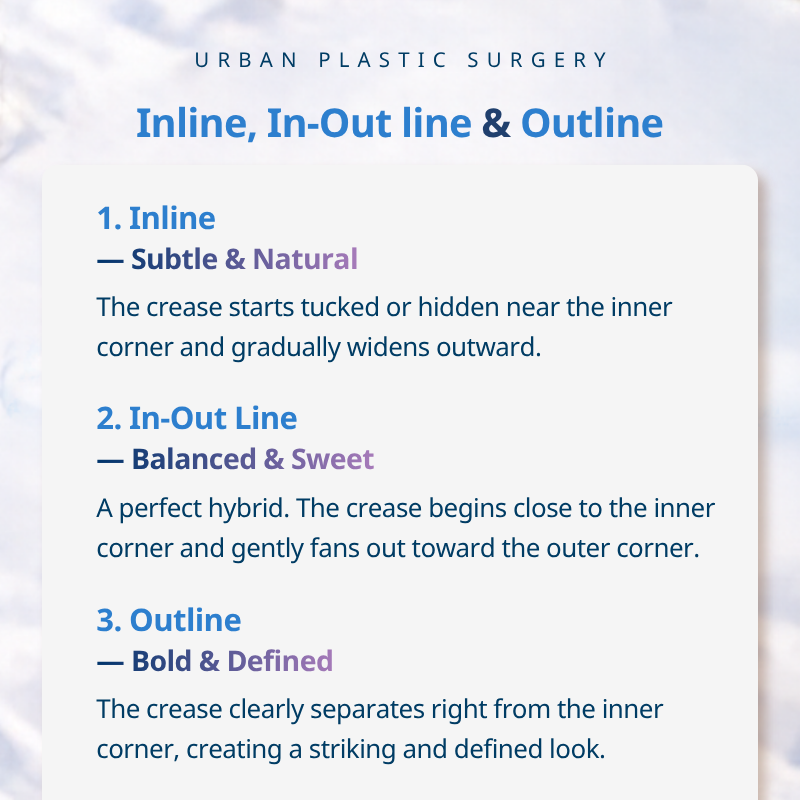
When searching for Korean double eyelid surgery reviews, you will often come across the terms Inline, In-Out Line, and Outline. Although all three are double eyelid crease designs, the main differences are where the eyelid fold begins near the inner corner of the eye (medial canthus) and how the crease extends toward the outer corner. These details can significantly influence the eye’s definition, depth, and overall expression.
1. Inline Double Eyelid — A Low, Soft, and Natural-Looking Eyelid Crease
Characteristics: An Inline double eyelid crease begins hidden within or very close to the inner corner of the eye, then gradually becomes more visible as it extends toward the outer corner. This design keeps the inner eye area from appearing overly open, creating a soft and natural-looking eyelid shape.
Key Features: The Inline double eyelid style creates a soft, subtle crease without making the eyelid fold appear too high or thick. It may be a suitable option for those who prefer a natural Korean double eyelid look or want greater eye definition while preserving their original eye shape and individual appearance.
Points to Consider: If the upper eyelids have thicker tissue, excess skin, or significant eyelid sagging, an Inline crease designed too low may become less visible or partially hidden when the eyes are open. The double eyelid crease height should therefore be carefully planned according to the eyelid thickness, skin condition, and natural eye-opening pattern.
2. In-Out Line Double Eyelid — A Soft Inner Corner with a Naturally Defined Outer Crease
Characteristics: The In-Out Line double eyelid crease sits between the Inline and Outline styles. The fold begins close to the inner corner of the eye and gradually moves farther away from the upper lash line as it extends toward the outer corner, creating a crease that becomes smoothly and progressively more defined.
Key Features: The appeal of the In-Out Line double eyelid style is that it maintains a soft, natural-looking inner corner while adding greater definition across the center and outer eyelid. It may suit those who want a more visible eyelid crease for makeup without having the fold begin too high or prominently at the inner corner.
Points to Consider: The definition and height of an In-Out Line double eyelid crease can be customized according to the natural eye anatomy and existing eyelid structure. Some individuals may achieve a soft, subtle appearance, while others may choose a more visible crease that makes the eyes appear brighter and more defined.
3. Outline Double Eyelid — A Defined Crease from the Inner Corner for a Sharper Eye Shape
Characteristics: An Outline double eyelid crease begins clearly separated from the inner corner and continues toward the outer corner. This design creates a more visible and prominent eyelid fold than the Inline and In-Out Line styles.
Key Features: The Outline style is often chosen by those who prefer sharper, more defined eyes, a clearly visible double eyelid crease, and greater upper eyelid space for applying eyeshadow and eye makeup.
Points to Consider: For individuals with a short brow-to-eye distance or significant skin coverage around the inner corner, such as a prominent epicanthal fold, designing the eyelid crease too high or too open may make the eyes appear unbalanced with the overall facial proportions. Careful assessment is essential before choosing a high Outline double eyelid crease.
Among the three double eyelid crease styles, there is no single design that is universally the most beautiful only the style that best suits your individual features. A natural and balanced result depends not only on choosing an Inline, In-Out Line, or Outline crease, but also on the eyelid crease height, natural eye shape, eyelid anatomy, and overall facial proportions.
Why Can the Same Double Eyelid Crease Style Look Different on Each Person?
Have you ever seen a beautiful Korean double eyelid surgery review and wondered, “If I choose the same eyelid crease design, will it look just as soft, natural, and balanced on my eyes?”
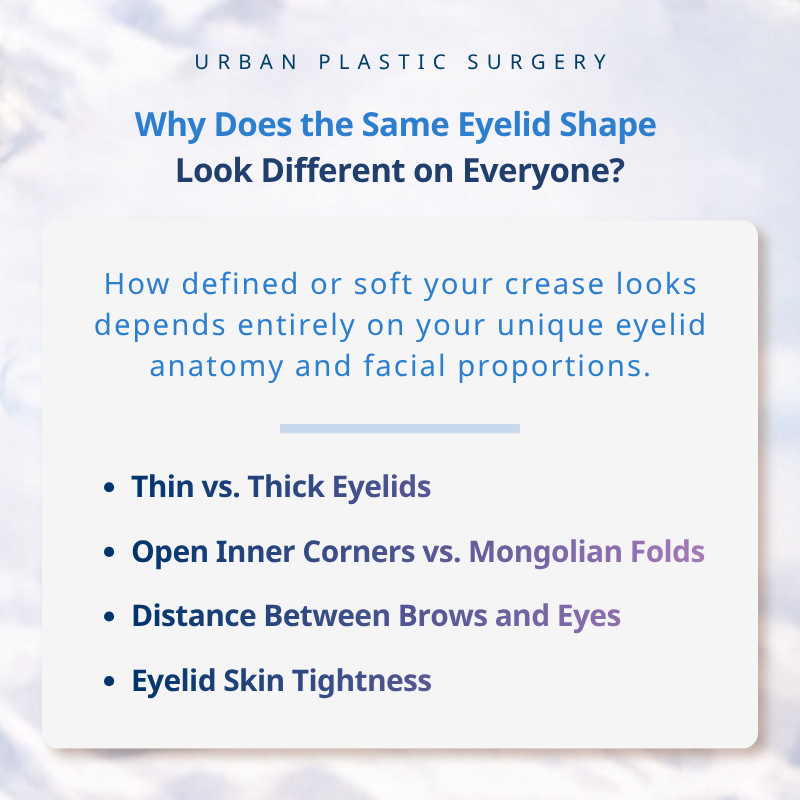
The truth is that choosing the same double eyelid crease design does not produce identical results for everyone. How defined, high, soft, or natural the eyelid fold appears depends on the upper eyelid anatomy, skin thickness, eye shape, and proportions around the eyes. Several individual factors can influence how the final double eyelid shape looks:
Thin vs. Thick Upper Eyelids Even when the double eyelid crease is designed at a similar height, differences in upper eyelid skin and tissue thickness can make the fold appear noticeably different. Thicker eyelid tissue may affect the depth and visibility of the crease, while thinner eyelids may produce a finer or more clearly defined fold.
Open Inner Eye Corners vs. a Prominent Epicanthal Fold (Mongolian Fold) The starting point of the double eyelid crease near the inner corner can appear very different depending on the presence of an epicanthal fold, sometimes called a Mongolian fold. Even with the same In-Out Line double eyelid design, a prominent epicanthal fold may make the inner eye area appear more covered than in someone with naturally open inner corners.
Brow-to-Eye Distance The same double eyelid crease height can look different depending on the distance between the eyebrows and eyes. A wider brow-to-eye distance may make the crease appear naturally proportioned, while a shorter distance can make the same eyelid fold look too high, tight, or prominent.
Upper Eyelid Skin Firmness and Laxity Individuals with sagging upper eyelid skin or eyelid hooding may see less of the double eyelid crease than those with firmer eyelid skin, even when the fold is designed at a similar height. Excess skin can partially cover the crease and make it appear narrower or less defined.
When reviewing double eyelid surgery before-and-after photos, it is also important to check several details: how long the photo was taken after surgery, whether false eyelashes or eyeliner were used, and whether the eyes were looking straight ahead or slightly downward. Postoperative timing, eye makeup, lighting, camera angle, and gaze direction can all make the double eyelid crease appear higher, deeper, or more defined than it does in person.
How Urban Plastic Surgery Designs a Personalized Double Eyelid Crease to Suit Your Eyes
For those planning double eyelid surgery for the first time, the most important consideration is not simply choosing between an Inline, In-Out Line, or Outline style. The eyelid crease line, height, depth, and shape should be carefully customized to complement the natural eye anatomy and existing eyelid structure.
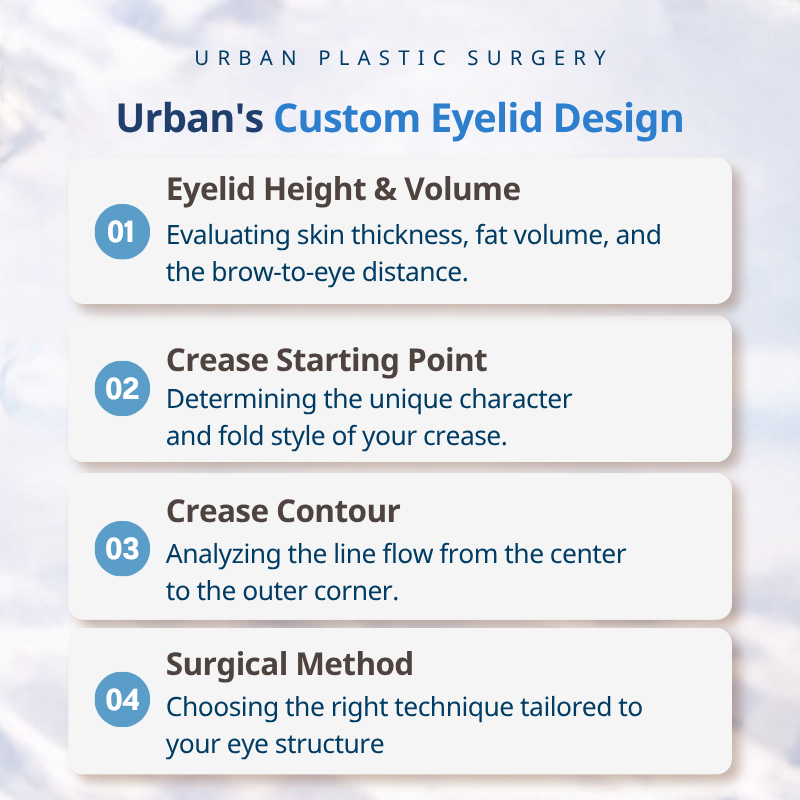
At Urban Plastic Surgery, the double eyelid surgery consultation includes an assessment of four key factors to create a personalized eyelid crease design:
1. Double Eyelid Crease Height — How High Should It Be for a Balanced Look?
A higher double eyelid crease does not always make the eyes appear larger. The ideal eyelid crease height should be determined by evaluating the upper eyelid thickness, amount of eyelid fat, excess skin above the fold, and brow-to-eye distance to maintain balanced and natural-looking eye proportions.
If the double eyelid crease is designed too high without considering these anatomical factors, the fold may appear overly thick, deep, or prominent. In contrast, a crease placed too low may become partially hidden by upper eyelid skin and appear less visible when the eyes are open. Choosing the correct double eyelid crease height is therefore essential for a balanced and natural-looking result.
2. Starting Point of the Double Eyelid Crease — A Small Detail That Can Transform the Eye Shape
The inner corner of the eye plays an important role in defining the overall double eyelid crease style. Whether the fold begins hidden within the inner corner, close to the lash line, or clearly separated from the inner eye determines whether the result appears as an Inline, In-Out Line, or Outline double eyelid crease.
If a prominent epicanthal fold (Mongolian fold) covers the inner corner of the eye, the starting point of the double eyelid crease must be carefully designed according to how the fold appears when the eyes are naturally open. An in-person eye assessment is therefore important for evaluating the inner eye anatomy and selecting the most suitable Inline, In-Out Line, or Outline design.
3. Double Eyelid Crease from the Center to the Outer Corner — Creating a Smooth, Continuous Fold
Another important factor is the continuity and curvature of the double eyelid crease. The distance between the fold and the upper lash line may vary from the center of the eye to the outer corner. Some people prefer a crease that gradually widens toward the outer eye, while others prefer a more even, consistent, or parallel eyelid fold.
4. Choosing the Right Double Eyelid Surgery Technique for Your Eye Anatomy
Once the preferred double eyelid crease design has been selected, the surgeon will determine whether incisional double eyelid surgery or the non-incisional suture method is more appropriate. Each technique has different considerations, including upper eyelid thickness, excess skin or tissue, eyelid fat, and the suitability of the anatomy for creating the desired eyelid fold.
Urban Plastic Surgery’s Customized Double Eyelid Design is based on a detailed assessment of the individual’s natural eye anatomy, including upper eyelid shape, skin thickness, eyelid fat volume, degree of skin laxity, and preferred eyelid crease style. This personalized approach helps the surgeon design an Inline, In-Out Line, or Outline crease that complements the existing features and aims for a balanced, natural-looking result.
Why Does Double Eyelid Surgery Look Unsettled During the Early Recovery Period?
Immediately after double eyelid surgery, it is common to feel surprised when the crease appears higher than the design discussed with the surgeon. The left and right eyelid folds may also look temporarily uneven or asymmetrical during the early recovery period.
During the early double eyelid surgery recovery period, the tissues are still healing. Postoperative swelling can make the eyelid crease appear thicker, higher, deeper, or more defined than the original design. This temporary appearance does not necessarily represent the final double eyelid result.
How Does the Double Eyelid Crease Change During the Recovery Period?
Early Stage After Double Eyelid Surgery Postoperative swelling and bruising may make the eyelid crease appear thicker or higher than expected. The upper eyelids may also feel tight or uncomfortable when opening the eyes during the initial recovery period.
As Postoperative Swelling Begins to Subside The double eyelid crease will gradually appear closer to the intended design. However, swelling may decrease at different rates on each side, so temporary eyelid asymmetry can still occur during recovery.
As the Eyelid Tissues Gradually Settle The tightness, height, depth, and shape of the double eyelid crease may continue to change throughout the healing process. Adequate recovery time is therefore needed before evaluating the final eyelid shape and surgical result.
Uneven double eyelid creases during the early recovery stage do not always indicate a surgical problem. Swelling, bruising, and tissue healing may progress differently on each side, causing temporary eyelid asymmetry after double eyelid surgery.
However, if you experience severe or worsening pain, sudden blurred or reduced vision, heavy bleeding, or any other concerning symptoms, contact the hospital immediately for urgent medical evaluation. Do not delay care or assume that these symptoms are part of normal postoperative swelling.
STM MATCH — Find a Doctor Matched to Your Needs and Treatment Goals
When searching for a plastic surgeon, many people begin by looking through reviews and choosing a doctor whose aesthetic style matches the results they like. That can be a good starting point. However, if you want greater confidence that your case is being handled by a doctor with expertise that closely matches your specific concerns and surgical needs, STMStyle can help with the matching process. Through STM MATCH, we help connect each case with a Korean plastic surgeon whose experience and specialty are more closely aligned with the actual problem that needs correction, rather than choosing based on visual preference alone.
STMStyle first gathers key background information, such as how many previous surgeries you have had, which materials were used, the areas you would like to improve, medication allergies, underlying medical conditions, and your planned length of stay in Korea. This information is then used as part of the STM MATCH process to connect your case with a Korean plastic surgeon in our network whose expertise is closely aligned with your specific nasal concerns and surgical needs. By organizing these details in advance, the doctor can review the case more accurately and provide a more focused rhinoplasty assessment and personalized treatment plan based on your actual surgical history, nasal structure, and goals.
STM Style does not decide which double eyelid surgery technique or eyelid crease design is appropriate for each individual. The final diagnosis, surgical method, and personalized treatment plan should be determined directly by a qualified and certified Korean plastic surgeon after assessing the eye anatomy, eyelid condition, and specific concerns of each case.
FAQ: Frequently Asked Questions About First-Time Double Eyelid Surgery
Q. Can I Choose a High, Defined Outline Double Eyelid Crease If I Have a Short Brow-to-Eye Distance?
The surgeon must first assess the available upper eyelid space, brow-to-eye distance, and overall eye shape. Designing the crease too high may make the eyelids appear crowded, heavy, or unbalanced with the face. Both the eyelid crease height and its starting point near the inner corner should therefore be carefully planned together.
Q. Is an In-Out Line Double Eyelid Crease More Suitable for Eye Makeup Than an Inline Crease?
Not necessarily. An In-Out Line double eyelid crease may appear more visible on some individuals, but its suitability for eye makeup also depends on the available eyelid space, natural eye shape, crease height, and preferred makeup style. An Inline crease can also work beautifully with makeup when it is designed to complement the eye anatomy.
Q. Can the Surgeon Combine Features from Several Double Eyelid Reference Photos?
Yes. Multiple reference photos can be used as inspiration for a customized double eyelid design. For example, you may prefer the soft inner corner from one photo but the more defined eyelid crease from another. However, the final design must remain compatible with the individual’s natural eye anatomy, eyelid structure, skin thickness, and brow-to-eye proportions.
First-time double eyelid surgery is an opportunity to choose a crease design that complements your natural features—whether you prefer the soft and subtle look of an Inline crease, the balanced definition of an In-Out Line, or the sharper, more prominent appearance of an Outline double eyelid crease.
The key is to choose a double eyelid crease style you genuinely prefer while understanding how that design can be adapted to your individual eye anatomy. This allows you to make an informed decision based on your natural eyelid structure, eye shape, and facial proportions, rather than relying solely on double eyelid surgery review photos.
If you are planning double eyelid surgery in Korea, you can send your facial photos and previous cosmetic treatment or surgery history to STM Style. Our team can organize your information, help identify a suitable Korean plastic surgeon specializing in double eyelid surgery, and coordinate a preliminary assessment with the doctor before your trip.