
Blogs

SEOULFACE21 Jaw Surgery in Korea: From Recovery Care to Continued Orthodontic Treatment in Thailand

SEOULFACE21 Jaw Surgery in Korea: From Recovery Care to Continued Orthodontic Treatment in ThailandSEOULFACE21 Oral and Maxillofacial (OMFS) Hospital Before traveling for jaw surgery in Korea, many people carefully prepare for the surgeon, hospital, treatment costs, and surgery date. However, there is another important part that should be planned even before booking the flight: the post-surgery recovery period.For those considering Korean jaw surgery, orthognathic surgery, double jaw surgery, or corrective jaw surgery, recovery planning is an essential part of the overall treatment journey. It may include the expected length of stay in Korea, post-operative checkups, swelling management, bite monitoring, and coordination with any orthodontic treatment after jaw surgery.Planning these steps in advance can help create a more seamless transition from jaw surgery and recovery in Korea to continued follow-up care and orthodontic treatment after returning to Thailand. After leaving the operating room, the body continues to change gradually over the …


SEOULFACE21 Jaw Surgery in Korea: From Recovery Care to Continued Orthodontic Treatment in Thailand อ่านเพิ่มเติม »

Jaw Surgery at SEOULFACE21: Complete Surgical Care in Korea with Orthodontic Follow-Up in Thailand

Jaw Surgery in Korea with SEOULFACE21: Comprehensive Care with Continued Orthodontic Treatment in ThailandSEOULFACE21 Oral and Maxillofacial (OMFS) Hospital Precise Jaw Surgery Planning with a 3D Diagnostic System How to Choose the Most Appropriate Jaw Surgery Approach for Your Facial Structure and Bite Treatment Planning: From Jaw Surgery in Korea to Continued Orthodontic Treatment in Thailand STM Match — Find the Right Doctor for You When searching for a plastic surgeon, many people begin by looking through reviews and choosing a doctor whose results and approach appeal to them. That can be a useful starting point.However, if you want greater confidence that your case is being evaluated by a specialist whose experience and area of expertise truly match your needs, STMStyle can help support you through the doctor-matching process.Rather than focusing on reviews alone, STMStyle helps connect you with Korean specialists based on the type of procedure, facial structure, treatment …

Jaw Surgery at SEOULFACE21: Complete Surgical Care in Korea with Orthodontic Follow-Up in Thailand อ่านเพิ่มเติม »

Is Under-Eye Fat Repositioning Enough? Restoring Volume with Nano Fat

Is Under-Eye Fat Repositioning Enough? Restoring Volume with Nano FatINIQUE Plastic Surgery Hospital Have you ever noticed that even after getting a full night’s sleep, your face still looks tired, dull, or as if you have not rested enough?In many cases, this tired appearance may be related to under-eye bags, deep tear troughs, under-eye hollows, dark circles, or volume loss around the lower eyelids, rather than a lack of sleep alone. These under-eye concerns can make the eyes look heavier and the overall face appear more fatigued or older than it actually is. This problem is often caused by prominent under-eye bags or deep tear troughs, which can create stronger shadows when light hits the lower eyelid area. These shadows may make the under-eyes look darker and the entire face appear constantly tired, sunken, or older than it actually is.Even with concealer, under-eye puffiness, deep tear troughs, and uneven lower-eyelid …

Is Under-Eye Fat Repositioning Enough? Restoring Volume with Nano Fat อ่านเพิ่มเติม »

Mini Facelift vs. Facelift Surgery in Korea: Choose the Best Technique for Your Face

Mini Facelift vs. Facelift Surgery in Korea: Choose the Best Technique for Your FaceINIQUE Plastic Surgery Hospital Some people may notice that even without significant weight gain, their face begins to look different over time. The cheeks may start to sag, the once-defined jawline may appear softer or less sculpted, and the nasolabial folds around the mouth may become deeper, making the face look more tired or older than it actually is.These changes are often related to facial aging, skin laxity, loss of facial elasticity, shifting facial fat, and weakening of the underlying facial tissues, rather than weight gain alone. As facial sagging progresses, the cheeks and lower face may gradually descend, leading to a less defined facial contour and more noticeable folds. For people experiencing these signs of aging, treatments such as a mini facelift, facelift surgery, facial lifting, or anti-aging facial rejuvenation may be considered depending on the …

Mini Facelift vs. Facelift Surgery in Korea: Choose the Best Technique for Your Face อ่านเพิ่มเติม »

Facial Contouring for a Short Chin and Deep Nasolabial Folds: When Facial Structure, Not Just Skin, May Be the Underlying Cause

Facial Contouring for a Short Chin and Deep Nasolabial Folds: When Facial Structure, Not Just Skin, May Be the Underlying Cause By NJH Plastic Surgery (Noh Jong Hoon Plastic Surgery) When people notice deep nasolabial folds or feel that their chin looks short or underprojected, making the lower face appear less balanced, they often think first about treatments such as dermal filler or thread lifting.However, the underlying cause is not always limited to changes in the outer skin or soft tissues. In some cases, concerns such as a short chin, receding chin, or deep nasolabial folds may also be influenced by the underlying facial bone structure, chin projection, and overall facial proportions.This is why a detailed structural assessment is important before deciding whether the concern should be addressed with a non-surgical treatment or through Korean facial contouring and chin correction. Because the face is supported by an underlying bony framework, …

Facial Contouring for a Short Chin and Deep Nasolabial Folds: When Facial Structure, Not Just Skin, May Be the Underlying Cause อ่านเพิ่มเติม »

Facial Contouring in Korea: Balancing Facial Bone Reduction and Augmentation for a Slimmer, Softer Face

Facial Contouring in Korea: Balancing Facial Bone Reduction and Augmentation for a Slimmer, Softer FaceBy NJH Plastic Surgery When it comes to facial contouring surgery, many people initially think about making the jaw narrower, reducing prominent cheekbones, or removing as much bone as possible to create a smaller-looking face.However, the beauty and balance of the facial structure are not determined simply by how much bone is removed. The overall result depends on how the cheekbones, jawline, chin, facial width, projection, and proportions work together as a whole. A soft, well-proportioned facial contour comes from the relationship between the cheekbones, jaw, chin, and other facial structures, all of which should look balanced from both the front and side profile.This means facial contouring is not only about reducing areas that appear too prominent. In some cases, certain areas may also need structural augmentation or added projection to create better overall harmony and …

Facial Contouring in Korea: Balancing Facial Bone Reduction and Augmentation for a Slimmer, Softer Face อ่านเพิ่มเติม »

How to Refresh a Tired-Looking Face: Brighten the Eyes and Soften Nasolabial Folds

How to Refresh a Tired-Looking Face: Brighten the Eyes and Soften Nasolabial Folds Urban Plastic Surgery Hospital Under-Eye Aging and Nasolabial Folds: Why Treating Just One Area May Not Fully Refresh a Tired-Looking Face Nasolabial Folds Can Develop for Different Reasons—Not Just Volume Loss Nasolabial folds are the lines that extend from the sides of the nose down toward the corners of the mouth. They can become more noticeable due to several structural changes in the face, rather than simply because the skin has developed a crease.Factors such as midface sagging, cheek descent, facial volume loss, changes in fat distribution, and reduced soft-tissue support can all contribute to deeper nasolabial folds. This is why identifying the underlying cause is important before deciding how the area should be treated. Several factors can contribute to the development of nasolabial folds, including reduced skin elasticity, declining collagen and elastin levels, and changes in …

How to Refresh a Tired-Looking Face: Brighten the Eyes and Soften Nasolabial Folds อ่านเพิ่มเติม »

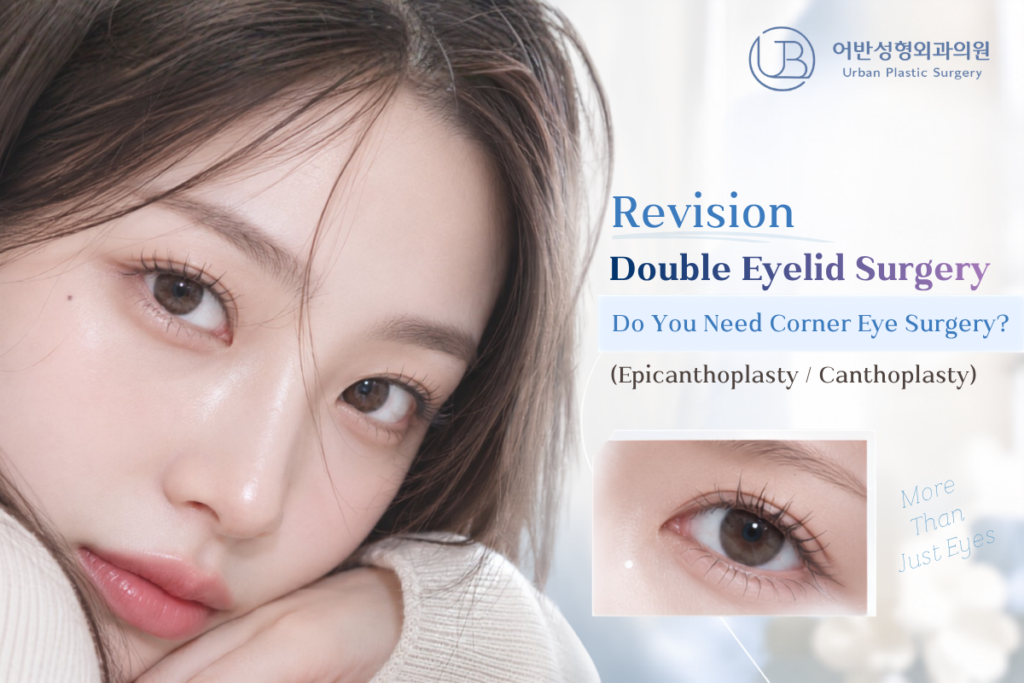
Revision Double Eyelid Surgery: Is Inner or Outer Corner Eye Surgery Really Necessary?

Revision Double Eyelid Surgery: Is Inner or Outer Corner Eye Surgery Really Necessary?Urban Plastic Surgery Hospital High Eyelid Creases, Uneven Eyes, and Small-Looking Eyes Do Not All Require the Same Correction Double Eyelid Revision vs. Ptosis Correction: What’s the Difference? Revision Double Eyelid Surgery in Korea: Do You Also Need Inner or Outer Corner Eye Surgery? Revision Eyelid Surgery: How Should the Eye Shape Be Planned When Multiple Areas Need Correction? FAQ: Common Questions About Revision Double Eyelid Surgery and Eye Corner Surgery Q. If My Double Eyelid Creases Are Uneven, Do Both Eyes Need Revision Surgery? It depends on the individual eye structure. The surgeon first needs to determine whether the asymmetry comes from the double eyelid crease, differences in eyelid-opening strength, or structural differences between the two eyes.Once the underlying cause is identified, the surgeon can decide whether revision is needed on one eye or both eyes and …

Revision Double Eyelid Surgery: Is Inner or Outer Corner Eye Surgery Really Necessary? อ่านเพิ่มเติม »

High and Well-Defined Nose: Why Nasal Height & Structural Support Both Matter

High and Well-Defined Nose: Why Nasal Height & Structural Support Both MatterUrban Plastic Surgery Hospital “The Nose Shape You Want” and “What Your Nasal Structure Can Safely Support” May Not Be the Same Assess the Internal Nasal Structure, Including the Nasal Septum When consulting about rhinoplasty, most people naturally focus on what they can see from the outside, such as a low nasal bridge, short nasal tip, or crooked nose.However, there is another important structure that may not be clearly visible externally: the nasal septum.The septum plays an important role in the internal support, alignment, and overall structure of the nose, so it should also be assessed as part of a comprehensive rhinoplasty evaluation. The nasal septum is made up of both bone and cartilage and separates the left and right nasal passages. When it is properly aligned, air can flow through both sides of the nose normally.However, if the …

High and Well-Defined Nose: Why Nasal Height & Structural Support Both Matter อ่านเพิ่มเติม »

Secondary Rhinoplasty in Korea: What Should You Check Before Reshaping and Raising the Nasal Bridge?

Secondary Rhinoplasty in Korea: What Should You Check Before Reshaping and Raising the Nasal Bridge?Urban Plastic Surgery Hospital Previous Surgical History: The First Thing to Assess Before Revision Rhinoplasty 5 Nasal Features to Assess Before Planning Revision Rhinoplasty Following the review of your previous surgical history, the next step is to assess whether the shape or condition of the nose has changed after surgery.If you notice any changes, it is important to have the nose carefully evaluated by a surgeon before deciding on any additional procedure. As an initial self-check, you can look for these 5 key signs or characteristics that may need further assessment before planning revision rhinoplasty in Korea. 1. The Nose Looks Shorter or the Nasal Tip Appears More UpturnedThe surgeon should assess whether the change is related to scar tissue from the previous surgery, tissue contracture, or structural changes that may be pulling the nasal tip …

Secondary Rhinoplasty in Korea: What Should You Check Before Reshaping and Raising the Nasal Bridge? อ่านเพิ่มเติม »

Say Goodbye to Sagging Cheeks and a Double Chin: How Should You Plan a Non-Surgical Full-Face Lifting Treatment in Korea?

Say Goodbye to Sagging Cheeks and a Double Chin: How Should You Plan a Non-Surgical Full-Face Lifting Treatment in Korea? Gangnam HERA Clinic When you look in the mirror and start to feel that your face is beginning to sag, have you noticed that the changes rarely appear in just one area?Facial sagging often develops across several connected regions, such as the cheeks, nasolabial folds, jawline, lower face, under-chin area, and neck. This is why planning a non-surgical full-face lifting treatment should consider the overall pattern of skin laxity, soft-tissue descent, and facial contour changes, rather than focusing on only one visible point. For some people, the changes may begin with sagging cheeks and deeper nasolabial folds, followed by a less-defined jawline, heavier lower-face tissue, and eventually a more noticeable double chin or under-chin fullness.When several concerns appear at the same time, it is natural to start searching for “one …

Say Goodbye to Sagging Cheeks and a Double Chin: How Should You Plan a Non-Surgical Full-Face Lifting Treatment in Korea? อ่านเพิ่มเติม »

Thread Lifting for Sagging Cheeks, Deep Nasolabial Folds, and Jawline Definition in Korea: Which Areas Respond Best to Treatment?

Thread Lifting for Sagging Cheeks, Deep Nasolabial Folds, and Jawline Definition in Korea: Which Areas Respond Best to Treatment? Gangnam HERA Clinic “Why Do Thread Lifts Make Some Faces Look Slimmer and More Defined, While Others Look Fuller or Make the Cheekbones Appear More Prominent?” The answer does not depend on the type or brand of lifting threads alone. The most important factors are the individual’s facial structure and the direction of tissue descent, which can vary significantly from one face to another.A successful thread lift treatment should therefore be planned according to facial anatomy, soft-tissue position, cheek volume, jawline structure, and the direction in which the tissues have started to sag. This is why the same thread lift technique can create very different results depending on the face. Some people begin to experience mid-cheek sagging, which can make the nasolabial folds appear deeper and more pronounced. Others may still …

Thread Lifting for Sagging Cheeks, Deep Nasolabial Folds, and Jawline Definition in Korea: Which Areas Respond Best to Treatment? อ่านเพิ่มเติม »

Scroll to Top