


Jaw Reduction Alone or 3-Point Facial Contouring? How to Choose the Right Option for You
NJH Plastic Surgery
When the face appears wide, the jawline looks prominent, or the lower face has a more angular shape, many people begin by searching for jaw reduction surgery in Korea. Along the way, they may also come across the term “3-point facial contouring surgery” and wonder:
If the goal is to achieve a slimmer, more balanced face shape, is it really necessary to undergo surgery on the cheekbones, jaw, and chin all at once?In reality, undergoing surgery on multiple areas does not necessarily mean the final face shape will look better than treating just one area.
Some people may have concerns mainly around the jaw angle, while others may also have prominent or wide cheekbones that affect the overall facial contour.The key is to identify where the facial width actually comes from and determine how many areas of the facial bone truly need to be adjusted.
The goal is to create a new facial contour that looks slimmer, softer, and more proportionate, while still preserving the individual character and natural features of the original face.
Is Your Face Wide Because of the Jaw—or Other Parts of the Facial Structure?
Before deciding on jaw reduction surgery, it is important to identify what is actually making the face appear wide—whether it comes from the facial bones, jaw muscles, or other parts of the facial structure.
Even when two faces look similarly wide, the underlying cause can be different, which means the most appropriate treatment approach may also differ.
- Wide Jaw Caused by the Jawbone
Characteristics:
The jaw angle is prominent, protrudes, or flares outward, making the lower face appear wider and more angular, especially from the area below the cheeks down to the jawline.
Treatment Approach:
The doctor will assess the shape of the jawbone and the overall jawline contour to determine whether targeted jawbone contouring or reduction is appropriate.- Wide Jaw Caused by the Masseter Muscles
Characteristics:
The masseter muscles are enlarged or bulky, making the jaw area appear wider even when the underlying jawbone itself does not flare outward significantly.
Treatment Approach:
The muscles should be assessed separately from the bone, because jaw reduction surgery does not directly reduce the size of the masseter muscles.- Wide Cheekbones
Characteristics:
The main facial width is concentrated in the midface, particularly around the cheekbones.
Treatment Approach:
If the cheekbones are wide, reducing only the jaw angle will not significantly change the width of the midface and may leave the overall facial proportions looking unbalanced.
In these cases, the doctor may need to assess whether cheekbone reduction surgery should be included as part of the overall facial contouring plan.- Disproportionate Chin
Characteristics:
A short, wide, or retruded chin can make the lower facial contour look less continuous or balanced, even when the jaw angle itself is not particularly prominent.
Treatment Approach:
The doctor will assess whether the chin may need to be advanced, reshaped, or refined at the tip as part of the overall surgical plan, with the goal of creating a smoother lower-face contour and a more balanced V-line shape.For this reason, facial contouring surgery should always be planned by evaluating both the underlying bone structure and the surrounding soft tissue before deciding which areas require surgery.
A comprehensive assessment helps create a result that looks softer, more balanced, and better targeted to the actual cause of facial width.
How Are the Different Types of Facial Contouring Surgery Different?
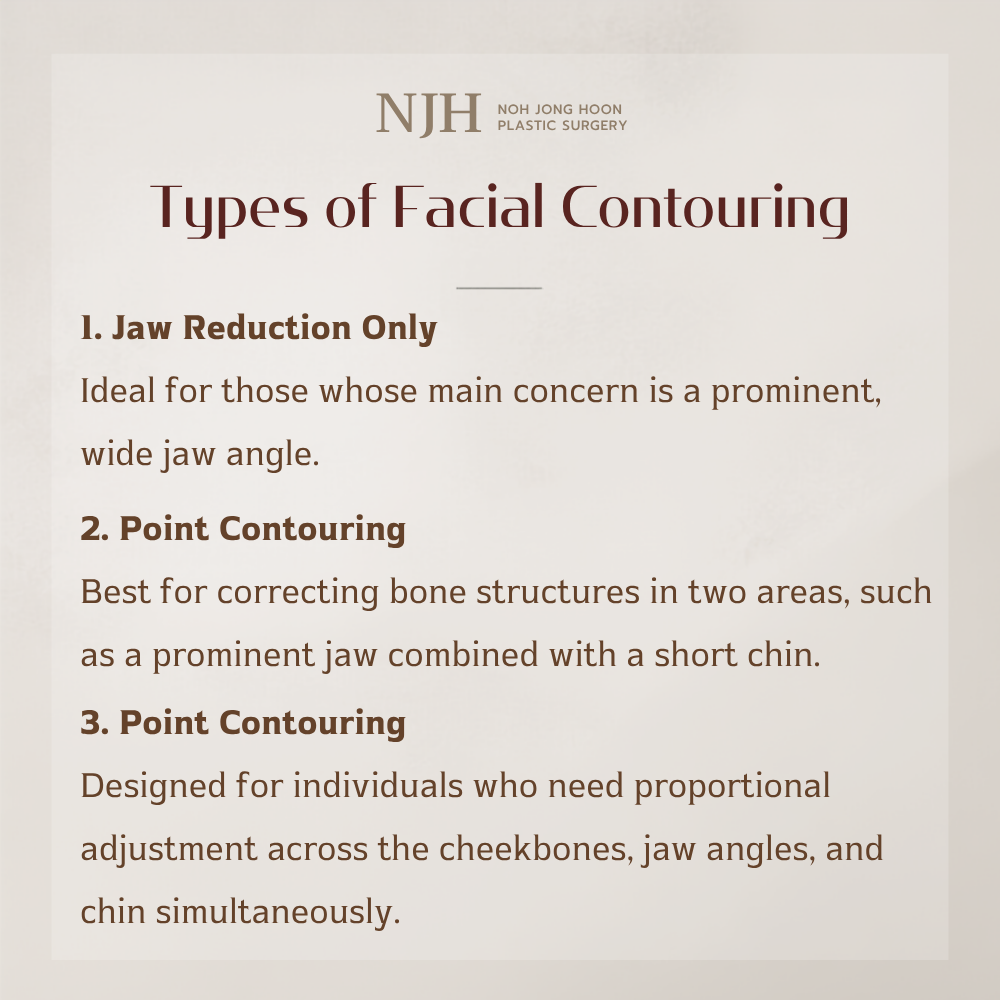
When it comes to facial contouring surgery, many people often hear the term “3-point facial contouring” and assume that treating all three areas will automatically provide the best result.
In reality, it is not always necessary to undergo surgery on all three areas. A greater number of surgical points does not guarantee a slimmer or more attractive face shape. The most appropriate plan depends primarily on your existing bone structure and individual facial goals.1. Jaw Reduction Surgery Alone
Best Suited For:
Those whose main concern is a prominent or enlarged jaw angle, while the cheekbones and chin are already well proportioned and balanced with the rest of the face.
Surgical Approach:
The procedure focuses on shaving or reducing the jaw angle to soften a square or heavy lower face and create a smoother, slimmer, and more rounded jawline, without altering other parts of the facial structure.2. Two-Point Facial Contouring Surgery
Best Suited For:
Those who have concerns involving more than one area of the facial bone structure, such as a prominent jaw angle with a short chin, or a wide jaw combined with prominent cheekbones.
Surgical Approach:
The doctor adjusts two areas of the facial bone together to create a smoother, more balanced transition—either from the jaw angle to the chin or from the cheekbones down to the jawline—while maintaining natural-looking facial proportions.3. Three-Point Facial Contouring Surgery
Best Suited For:
Those who have combined concerns involving the cheekbones, jaw angle, and chin, and whose doctor determines that multiple areas of the facial bone structure should be adjusted together.
Surgical Approach:
This approach involves several of the face’s main structural areas, so it requires careful surgical planning, including the extent of bone reduction, the location of important nerves, the surgical technique used, and the expected recovery period.The most important factor is not choosing a package with more surgical areas simply because it seems like better value, but selecting a plan based on the actual structural concerns of your face.
A well-planned facial contouring procedure should be tailored primarily to each individual’s facial bone structure, proportions, and specific concerns.
NJH Provides a Detailed 3-Point Facial Structure Analysis
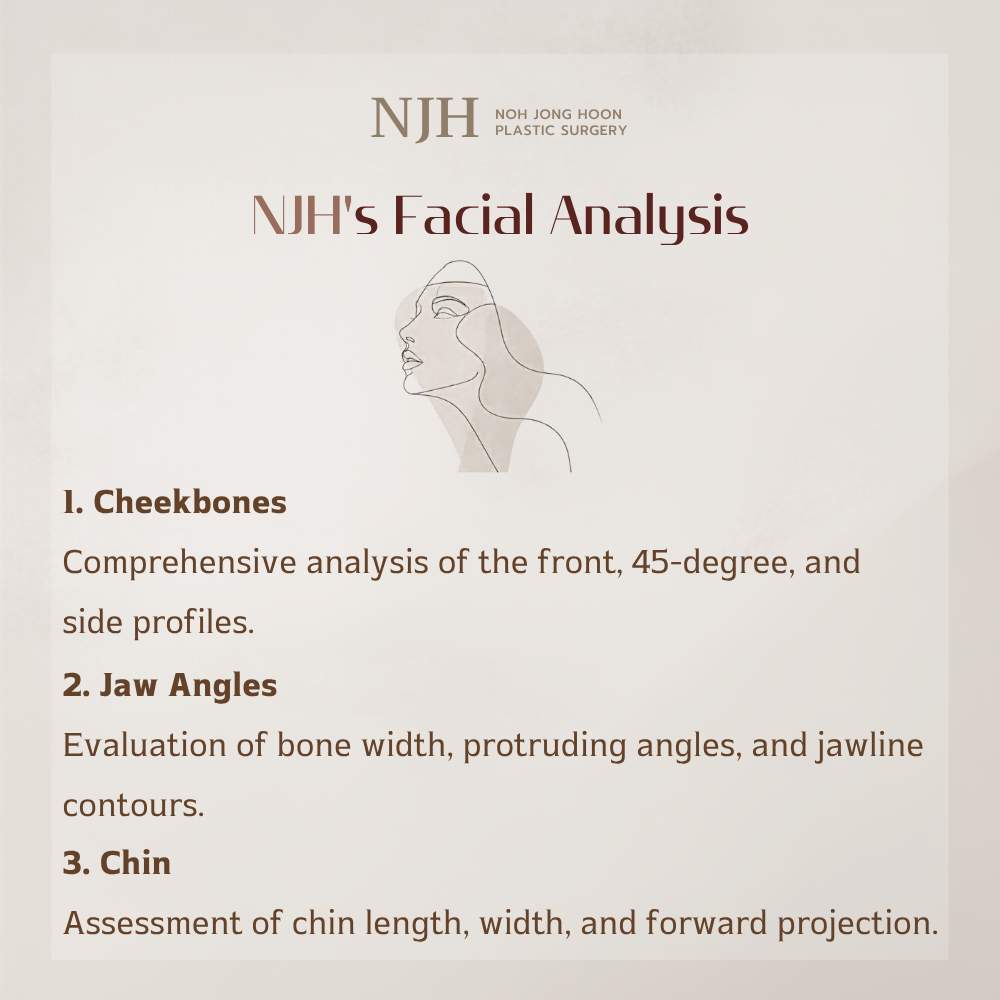
At NJH Plastic Surgery, facial contouring plans are based on a detailed assessment of the position and direction of the facial bones to identify which area is primarily responsible for facial width or angularity.
This helps the doctor design a more targeted facial contouring plan based on the actual structural cause.1. Cheekbone Area
The cheekbones are assessed separately from the front, 45-degree angle, and side profile, because forward projection and lateral width are not the same structural concern.
In some areas, bone shaving may be sufficient, while other cases may require the cheekbone to be cut and repositioned inward to achieve a more balanced contour.2. Jaw Angle Area
The doctor evaluates the width of the jawbone, the degree of outward projection, and the contour extending from the jaw angle toward the chin.
This helps determine which part of the bone should be adjusted while preserving a smooth, continuous lower facial line.3. Chin Area
The doctor assesses the length, width, and degree of chin projection, because some people may have a prominent jaw combined with a short chin, while others already have a well-proportioned chin.
In cases where the chin is already balanced with the rest of the face, additional chin surgery may not be necessary.Assessing the face from the front, 45-degree angle, and side profile, together with a detailed evaluation of the underlying bone structure, helps the doctor distinguish which areas truly need adjustment and which features should be preserved.
This allows for a more targeted and individualized facial contouring plan based on the actual structure of the face.
3 Important Things You Shouldn’t Overlook Before Facial Contouring Surgery
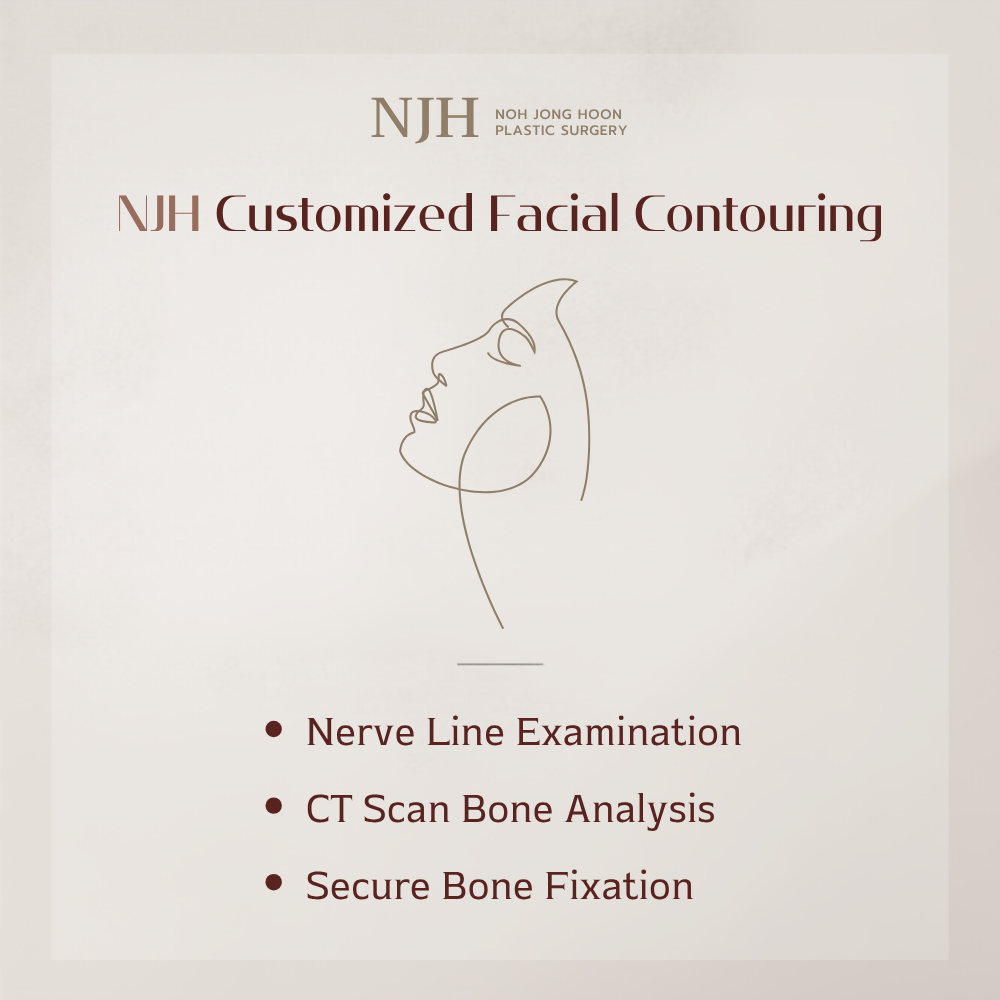
Facial contouring surgery is not only about shape and aesthetics. At NJH Plastic Surgery, equal attention is given to the safety of important nerves and internal facial structures when planning surgery.
This allows the surgical approach to be tailored more carefully to each individual’s facial anatomy and bone structure.
- Carefully Check the Position of the Lower Jaw Nerve
The lower jaw contains nerves that are associated with sensation in the lower lip and chin. For this reason, the doctor needs to assess their position carefully before determining the bone-cutting line for surgery.
- Analyze the Bone Structure with a CT Scan
Because bone thickness, shape, and position vary from person to person, CT imaging helps the doctor evaluate the facial bone structure more accurately and identify areas that require extra caution during surgical planning.
- Secure Bone Fixation After Repositioning
When the bone is cut and repositioned, such as during cheekbone reduction surgery, stable fixation is essential to keep the bone securely in its intended position.
Proper fixation helps support bone healing and stability during the recovery period.When surgery involves multiple areas of the facial structure, a thorough assessment and carefully coordinated surgical plan become even more important.
This allows the doctor to determine the most appropriate combination of procedures based on your individual facial anatomy and structural needs.
Personalized Facial Contouring with STM MATCH

When researching facial contouring surgery reviews, many people naturally start by looking at cases with results they personally find attractive. That can be a helpful first step.
But if you also want more confidence that your case is being matched with a doctor whose expertise is relevant to your specific facial structure and concerns, STM Style can help support you through that process.If you are unsure whether your case requires jaw reduction alone or whether the cheekbones and chin should also be evaluated, STM Style can help gather the key information needed for an initial assessment.
This may include details such as how many previous surgeries you have had, any existing implants or materials, the areas you would like to improve, medication allergies, underlying health conditions, and the length of your stay in Korea.
STM Style then uses this information to help match your case with a Korean plastic surgeon in its network whose area of expertise is relevant to your specific concerns, so the doctor can review your case more accurately and recommend a more targeted surgical plan.The decision on how many areas should be treated, what additional examinations may be needed, and which surgical techniques are most appropriate is not made by STM Style.
STM Style does not diagnose or replace the doctor’s medical judgment. These decisions are made directly by the qualified Korean plastic surgeon best suited to the case, who will assess the facial structure and develop the appropriate surgical plan.
FAQ: Frequently Asked Questions About Jaw Reduction and 3-Point Facial Contouring Surgery
Q. If I Have a Wide Jaw, Do I Need 3-Point Facial Contouring Surgery?
Not necessarily. If the main concern is the jaw angle, while the cheekbones and chin are already well proportioned, the doctor may recommend treating only the jaw.
Three-point facial contouring is not a requirement for everyone and should be considered only when multiple areas of the facial structure actually need adjustment.Q. Is 3-Point Facial Contouring Surgery Riskier Than Treating Just One Area?
Surgery involving multiple areas generally has a wider surgical scope and may require more complex planning and postoperative care.
The overall level of risk can also depend on factors such as the surgical technique, operation time, individual health condition, and the specific bones being adjusted. For this reason, a personalized medical assessment is essential before surgery.Q. Will Jaw Reduction Surgery Alone Make the Face Look Slimmer?
Jaw reduction surgery primarily reshapes the lower jaw structure. If facial width is also influenced by prominent cheekbones or chin proportions, treating the jaw alone may not create the degree of change you expect from every angle.
This is why the overall facial structure should be assessed before deciding whether jaw reduction alone is sufficient.
The key to facial contouring surgery is not to operate on every possible area, but to adjust only the areas that truly need correction.
The goal is to create a facial contour that looks slimmer, softer, and more balanced, while still blending naturally with the person’s original facial features.If you are concerned about a wide or prominent jaw or are unsure how many areas of the facial structure may need to be addressed, you can send your photos and basic details to STM Style.
STM Style can help organize your information and coordinate a preliminary assessment with a Korean plastic surgeon before your trip to Korea.