


Shots, Lines, and kJ: What’s the Difference? Check Your Lifting Package Before You Book
Gangnam HERA Clinic
Have you ever planned to get a lifting treatment in Korea, only to feel confused by all the numbers listed in clinic packages—such as Ultherapy 300 shots, 10THERA 600 lines, or Titanium 60 kJ?
What do these numbers actually mean, and how are they different? More importantly, if you want the best value from your treatment, does a higher number automatically mean better results?These numbers are not measured in the same way. Some devices count the number of energy pulses delivered, others measure treatment lines, while some indicate the total amount of energy used.
That means you cannot directly compare the numbers across different devices or assume that a larger number automatically means a stronger or more effective treatment.Understanding the details of a treatment package from the beginning can make it much easier to choose the right option—from the device being used and the treatment area covered to the aftercare or additional services included in the price.
Today, we’ll break down what shots, lines, and kJ actually mean, look at examples of popular lifting treatment packages, and explain what these numbers can—and cannot—tell you. We’ll also highlight the key details worth checking before booking a lifting treatment in Korea.
What Are Shots, Lines, and kJ?
When you see numbers listed in a lifting treatment package, don’t assume they all represent the same type of energy measurement.
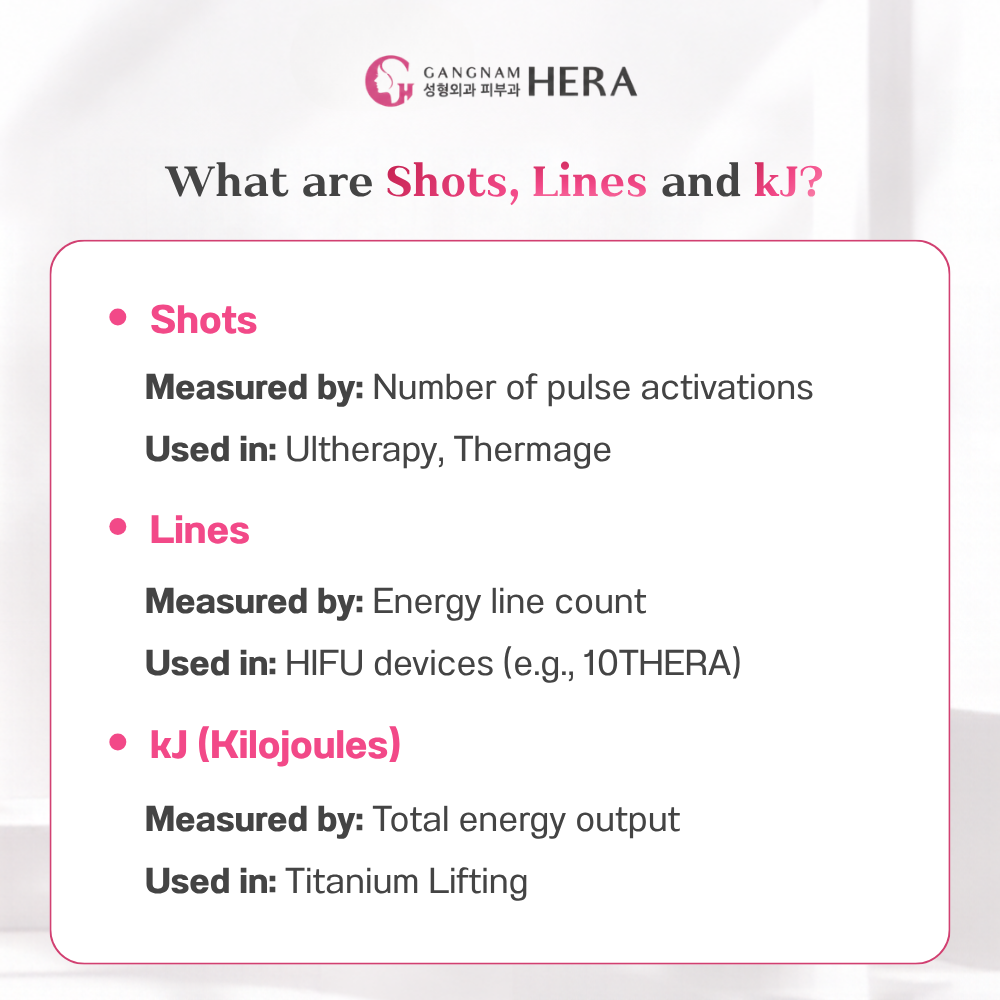
Different lifting devices use different ways to measure treatment quantity depending on how each technology delivers energy. Here’s what each unit means:1. Shots — The Number of Individual Energy Pulses Delivered
Devices That Use This Unit: Ultherapy, Thermage
How It’s Counted:
1 shot = 1 energy delivery, based on how each device records and counts its treatment pulses.
What to Know:
The number of shots cannot be compared directly across different devices. For example, Thermage 600 shots and Ultherapy 600 shots may show the same number, but the way they deliver energy and the tissue depths they target are very different.
Thermage uses radiofrequency (RF) energy, while Ultherapy uses focused ultrasound energy, so the same shot count does not mean the treatments are equivalent.
2. Lines — The Number of Energy Treatment Lines
Devices That Use This Unit: HIFU lifting devices such as 10THERA
How It’s Counted:
1 line = 1 line of energy delivery. Within each line, multiple thermal points are created in sequence beneath the skin. The line count therefore represents the number of treatment lines delivered according to the device and transducer system.
What to Know:
A higher number of lines does not necessarily mean the entire face will be covered more effectively. Treatment also depends on factors such as the target depth, spacing between thermal points, treatment area, and the doctor’s technique for mapping and placing each line.
3. kJ (Kilojoules) — The Total Amount of Energy Delivered
Device That Uses This Unit: Titanium Lifting
How It’s Measured:
1 kilojoule (kJ) = 1,000 joules (J). This unit represents the total amount of energy delivered during treatment.
For example, Titanium 60 kJ means that the treatment program delivers a total of 60 kilojoules of energy. It does not refer to the number of shots or treatment lines.
What to Know:
Even when the total energy is the same, the actual treatment plan can still vary. Titanium Lifting offers different energy-delivery modes and settings, which the doctor can adjust based on the skin condition, treatment area, and individual concerns.
Do More Shots or Lines Really Mean Better Lifting Results?
When comparing treatment packages, many people are naturally drawn to options that offer more shots or lines, especially when the prices are similar. It can feel like you are getting more treatment—and therefore better value.
But in reality, a higher number of shots, lines, or total energy does not always lead to proportionally better results.
What matters just as much is where the energy is delivered, the treatment depth, the device settings, the areas being treated, and how the doctor designs the overall treatment plan.That is because lifting results also depend on several other important factors, including:
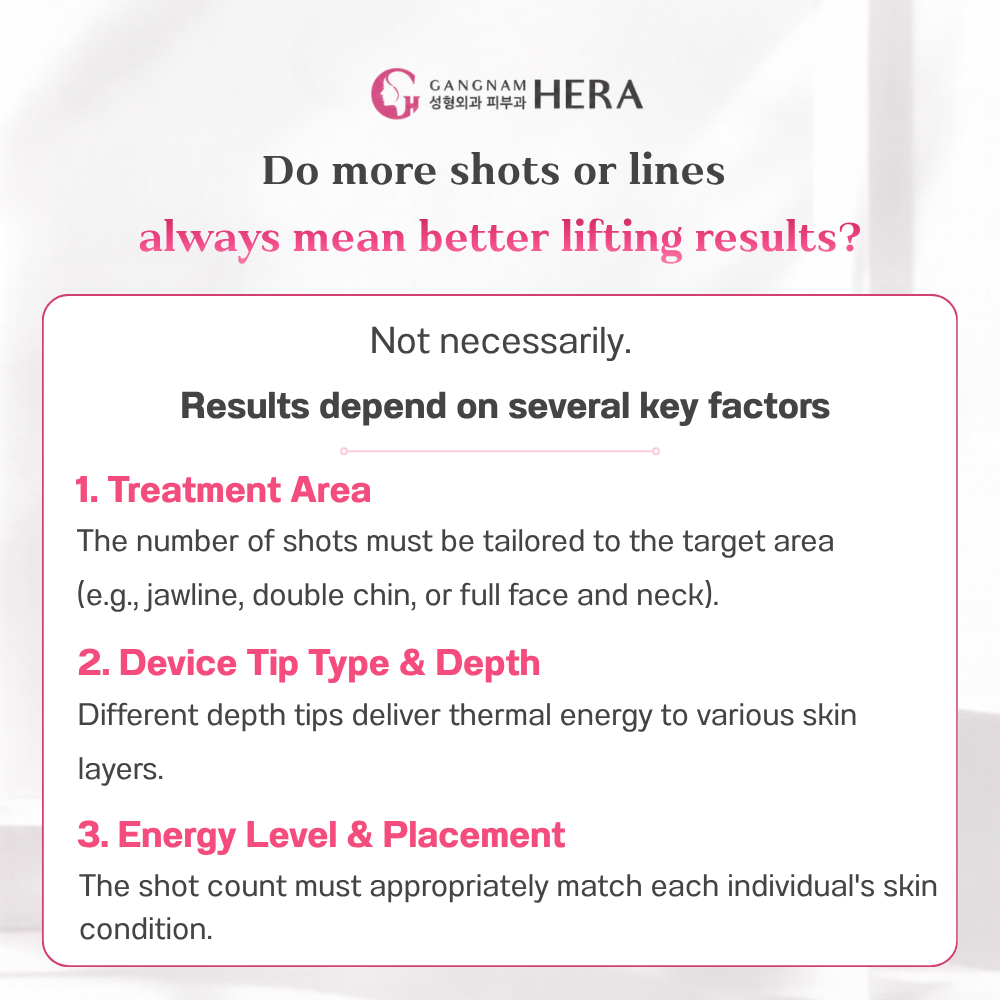
1. Treatment Area
The number of shots should match the size and scope of the area being treated—for example, whether the treatment focuses only on the jawline or under the chin, or covers the entire face and neck.2. Transducer Type and Treatment Depth
Most lifting devices offer different transducers designed to deliver energy at different tissue depths. Each depth targets a different layer of the skin and underlying tissue, so the choice of transducer plays an important role in how the treatment is planned.3. Energy Level and Treatment Placement
The number of shots should be planned according to each person’s tissue condition, degree of laxity, and specific skin concerns.
The goal is not simply to deliver as many shots as possible, but to use the right amount of energy in the right areas based on an individualized treatment plan.Using more energy than necessary does not automatically improve the results. In fact, excessive energy delivery may increase the risk of temporary side effects, discomfort, or skin irritation.
This is why the treatment should be adjusted to the individual skin condition, treatment area, and appropriate energy level, rather than focusing only on maximizing the number of shots, lines, or total kJ.That is why a higher number only has real value when the energy is used in the right areas, at the appropriate depth, and according to your actual skin concerns and treatment goals.
In other words, the most important factor is not simply how many shots, lines, or kJ are included, but how effectively they are planned and used.
Does “Full Face” Really Mean the Entire Face Is Treated?
When you see terms like “Full Face” or “whole-face treatment,” it is important to check exactly what areas are included before booking.
Many people assume that “Full Face” automatically covers everything from the forehead and eye area to the cheeks, jawline, under the chin, and even the neck—but the actual treatment area can vary depending on the clinic, device, and package.In reality, the definition of “Full Face” can vary depending on the device being used and the specific terms of each treatment package.
For example:– For Ultherapy or HIFU Programs
In some packages, “Full Face” may focus mainly on the mid and lower face, such as the cheeks, jawline, and under-chin area.
It may not automatically include the forehead, eye area, or neck, so it is important to check the exact treatment coverage before booking.– For Thermage FLX 600-Shot Programs
Even when a package is labeled “Full Face”, the eye area is usually not included.
This is because treatment around the eyelids and eyes requires a dedicated Thermage Eye Tip, which is designed specifically for this more delicate area and is typically offered separately.
3 Things to Check Before Choosing a Full-Face Treatment Package
1. Check Which Areas Are Actually Included
Ask the clinic exactly which areas the package covers, such as the cheeks, jawline, double-chin area, or under the chin.2. Check Which Areas Require an Additional Fee or Are Excluded
Confirm whether any areas fall outside the main package, such as the eye area, forehead, or neck, and whether treating them requires an additional charge.3. Check Which Treatment Tip or Transducer Is Used
For delicate areas such as around the eyes, confirm whether the treatment requires a specialized tip, such as an Eye Tip, rather than the standard treatment tip used on the rest of the face.Clarifying the exact treatment coverage from the beginning makes it much easier to compare packages accurately.
It also helps you plan your budget more effectively and avoid unexpected additional costs that may come up if certain areas, treatment tips, or add-on services are not included in the original package.
Gangnam HERA Lifting Programs: Which Option Best Fits Your Needs?
For those comparing facial lifting treatments in Korea, Gangnam HERA Clinic offers a variety of options—from standalone energy-based lifting treatments to combination programs that bring together the strengths of multiple technologies.
Each package is designed to address different skin concerns, levels of laxity, and treatment goals, making it easier to choose an approach that best fits your individual needs.
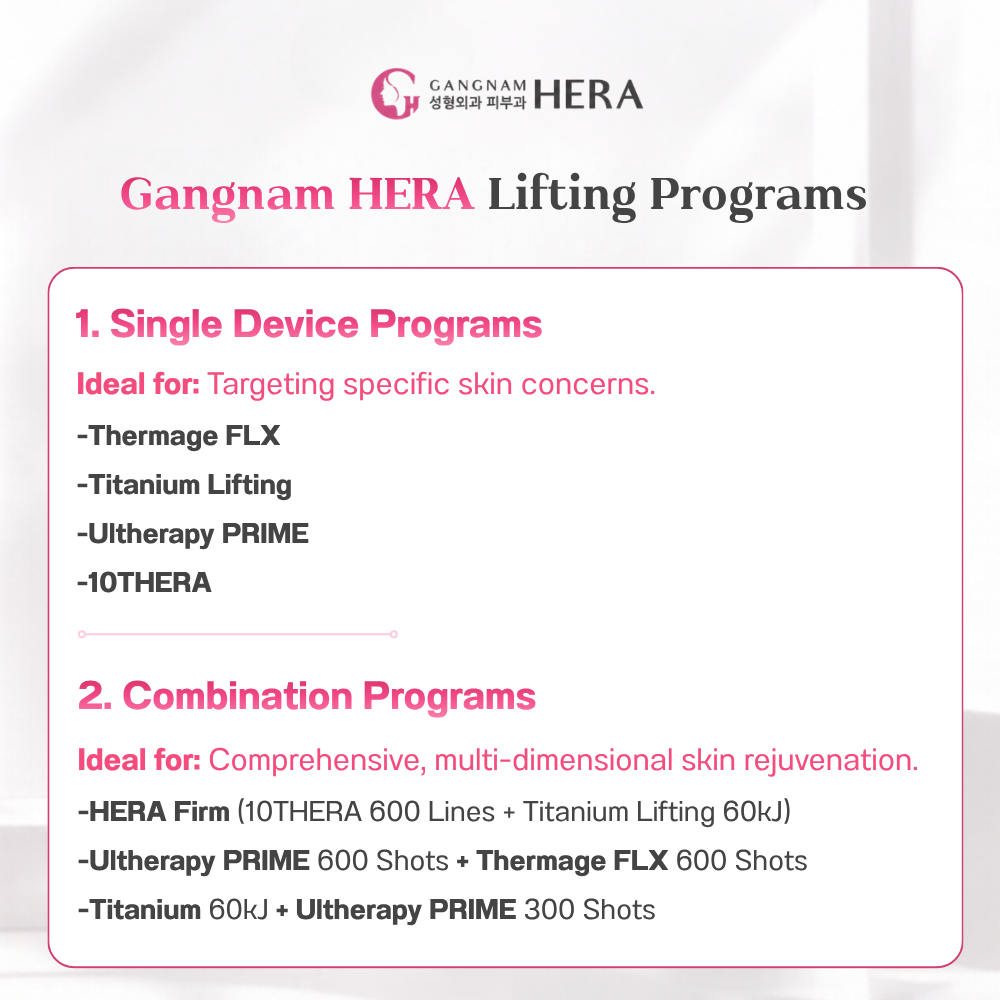
Here are some of the available options:1. Standalone Treatments — Targeting One Main Concern More Directly
Standalone treatments may be a good option for those who want to focus on one specific concern or already have a particular lifting technology in mind. The doctor can help determine which device is best suited to your skin condition and treatment goals.
– Radiofrequency treatments such as Thermage FLX, or laser-based treatments such as Titanium Lifting
Best suited for those who want to focus on skin firmness, elasticity, and a brighter-looking complexion.
– Ultrasound-based treatments such as Ultherapy PRIME or 10THERA
Best suited for those who want to focus on deeper lifting, facial contour support, and improved jawline definition.2. Combination Programs — Two Technologies in One Treatment Plan
Combination programs may be a good option for those who want a more comprehensive approach to both lifting and overall skin quality within the same trip.
– HERA Firm — 10THERA 600 Lines + Titanium Lifting 60 kJ
Designed to address jawline laxity while also improving skin firmness and brightness.
– Ultherapy PRIME 600 Shots + Thermage FLX 600 Shots
Combines deeper tissue lifting with support for overall skin firmness and elasticity.
– Titanium Lifting 60 kJ + Ultherapy PRIME 300 Shots
Combines treatment for early facial contour laxity with support for firmer, brighter-looking skin.For those planning an aesthetic treatment in Korea, having a wider range of options makes it easier to work with the doctor to create a more targeted lifting plan based on your actual skin concerns and treatment goals.
This helps ensure that the chosen treatment approach is better aligned with your facial structure, skin condition, and desired results.
Plan Your Facial Lifting Treatment in Korea with STM MATCH

If you are still unsure which lifting treatment is right for you—or whether combining two treatments would make more sense, you can start by sharing your information with STM Style.
Simply prepare a few basic details, such as the areas of your face you would like to improve, the features you would like to preserve, your previous treatment history, and how many days you plan to stay in Korea.Once we receive your information, STM Style can help match your case with a Korean doctor who specializes in the specific technique or treatment area you are interested in, using our network of experienced medical professionals.
From there, the Korean doctor will assess your facial structure, skin condition, and specific concerns to determine which lifting treatment is most suitable, which areas should be treated, and how broad the treatment plan should be.
The goal is to create a personalized approach that matches your individual needs and supports natural-looking, well-balanced results.
FAQ: Frequently Asked Questions About Shots, Lines, and kJ
Q. Is There a Big Difference Between 300 and 600 Ultherapy Shots?
Yes, the results can differ, but doubling the number of shots does not necessarily mean the results will be twice as noticeable.
The outcome also depends on factors such as the treatment area, transducer used, energy settings, and how the doctor plans and distributes the shots across the face.Q. If a Package Already Specifies the Number of Shots, Can the Doctor Still Adjust the Treatment Plan?
Yes. You can discuss adjusting the treatment area or energy allocation with the doctor, but any changes will depend on both the terms of the package and the doctor’s assessment of your actual skin condition and treatment needs.
Q. If the Energy Is Increased Beyond Titanium 60 kJ, Will the Results Be Better?
Not necessarily. kJ indicates the total amount of energy delivered, but how the skin responds also depends on factors such as the device settings, energy-delivery method, treatment area, and individual skin condition.
Using more energy than appropriate does not guarantee better results and may increase the risk of skin irritation or other unwanted reactions.
Numbers such as 600 shots, 300 lines, or 60 kJ can help you understand the basic structure of a treatment package, but they cannot tell you which device is the most suitable for your face on their own.
What you should consider alongside these numbers is the type of device, treatment area, transducer or tip used, and the steps or services included in the package.
These details are what truly help you understand what kind of treatment you are choosing and how the program is designed to address your concerns.If you are planning a lifting treatment in Korea, you can send STM Style your photos, the treatment programs you are interested in, your previous treatment history, and your travel dates.
STM Style can help organize your information and coordinate a preliminary assessment with the doctor before your trip to Korea.