



Jaw Surgery in Korea with SEOULFACE21: Comprehensive Care with Continued Orthodontic Treatment in Thailand
SEOULFACE21 Oral and Maxillofacial (OMFS) Hospital
For Thai individuals planning jaw surgery in Korea, there is more to consider than simply asking, “Which surgeon should I choose?” or “How much will my face change?”
One of the biggest factors that is often overlooked is the orthodontic treatment plan, especially in cases where braces or other orthodontic care are required alongside jaw surgery.
This means there are several additional factors to consider, including how jaw surgery and orthodontic treatment will be coordinated, how follow-up care will continue after returning to Thailand, and how the overall treatment sequence should be planned from the beginning.
- How Long Should You Stay in Korea After Jaw Surgery? How Often Are Follow-Up Visits Needed After Jaw Surgery in Korea?
- After Jaw Surgery in Korea, How Can Orthodontic Treatment Continue in Thailand?
- Who Manages Follow-Up Care If Brackets Come Loose or Teeth Shift After Jaw Surgery and Orthodontic Treatment?
Jaw surgery does more than change the external facial shape. It is directly related to the facial bone structure, dental occlusion, and long-term jaw joint function.
For this reason, the goal is not simply to achieve an attractive result on the day of surgery, but to create a seamless treatment plan that connects surgical care in Korea with continued orthodontic and follow-up care in Thailand.
Careful coordination between the surgical and orthodontic stages is essential for achieving a result that is not only aesthetically balanced, but also functionally stable and well integrated over the long term.At SEOULFACE21, this concern is taken into account through a treatment system built around detailed structural analysis and coordinated specialist care.
Each case is assessed individually so that the surgical plan, orthodontic considerations, bite alignment, and follow-up care can be connected as smoothly as possible.
The goal is to provide a safe, precise, and personalized treatment pathway, with each stage planned according to the individual jaw structure, dental occlusion, and long-term treatment needs.
Precise Jaw Surgery Planning with a 3D Diagnostic System
Concerns such as a protruding jaw, facial asymmetry, or an unusually long chin are often not caused by a single structural issue. They may be related to a combination of jawbone position, dental occlusion, and the surrounding facial soft tissues.
For this reason, SEOULFACE21 uses advanced 3D diagnostic technology throughout the treatment planning process to evaluate the face from multiple perspectives and gain a more comprehensive understanding of the underlying skeletal and dental structure.
This three-dimensional analysis helps the medical team assess the relationship between the upper and lower jaws, bite alignment, facial asymmetry, chin position, and soft-tissue profile before creating an individualized jaw surgery plan.
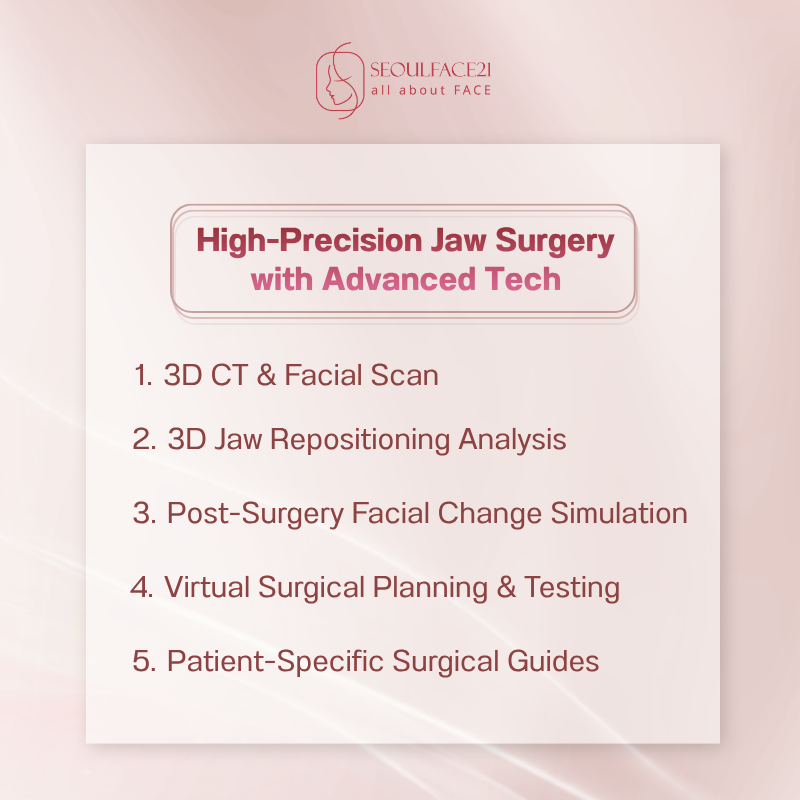
- 3D CT and Facial Scan
A 3D CT scan combined with facial scanning provides a three-dimensional view of the facial skeleton together with external facial data.
This allows the medical team to analyze the relationship between the facial bones, jaw position, dental structures, and facial soft tissues in greater detail, supporting more precise planning for orthognathic and jaw surgery.
- Digital 3D Movement Analysis
This analysis evaluates the current position of the jaws and helps determine how each segment of bone should be repositioned, including the most appropriate direction, distance, and final position.
The data is then used to support a personalized jaw surgery plan, allowing the surgical team to design bone movements according to the individual facial structure, jaw alignment, and overall treatment goals.
- Facial Simulation
The analyzed data is used to simulate potential facial changes after jaw repositioning, helping the medical team visualize how adjustments to the jaw structure may influence the overall facial appearance.
This allows the team to evaluate the relationship between the underlying skeletal structure and overall facial proportions before finalizing the individualized treatment and surgical plan.
- Surgical Simulation Test
The planned surgical steps and jawbone movements are simulated in advance before the actual procedure.
This allows the medical team to review the proposed bone repositioning, assess the surgical plan from multiple perspectives, and make necessary adjustments beforehand to support more precise and individualized orthognathic surgery planning.
- Customized Surgical Guide
Data from the 3D surgical planning process is used to create customized surgical guides and splints for each individual case.
These personalized devices help transfer the planned jaw position and bone movements from the digital simulation into the actual surgical procedure, supporting greater consistency between the virtual treatment plan and intraoperative positioning.Jaw surgery is not simply about cutting or repositioning bone to make the face appear smaller. It also involves restoring the relationship between the jaws in ways that can affect chewing, speech, dental occlusion, and overall facial balance.
For this reason, viewing the craniofacial structure in three dimensions can help the surgical team plan the position and movement of the jaws more precisely, identify important anatomical relationships, and create a more targeted surgical plan.
A detailed 3D diagnostic assessment can also support surgical risk management and help improve the precision and efficiency of orthognathic surgery planning.
How to Choose the Most Appropriate Jaw Surgery Approach for Your Facial Structure and Bite

For Thai individuals considering jaw surgery in Korea, the treatment journey involves different practical factors and limitations compared with those living locally.
In addition to travel and accommodation costs, important considerations include time off work, the recovery period, and the duration of follow-up care. This is especially relevant in cases that require orthodontic treatment alongside jaw surgery, as ongoing care may involve appropriate orthodontic appliances and regular monitoring of bite alignment and dental occlusion.
Jaw surgery should therefore be viewed as part of a continuous treatment process, rather than a procedure that ends once the surgery itself is completed.To address the concerns and practical challenges faced by international clients, SEOULFACE21 offers several treatment pathways designed to accommodate each individual’s facial structure, treatment needs, and personal circumstances.
Depending on the case, there are multiple options available, including:
- Orthodontic Treatment Alone
- Jaw Surgery Alone
- Orthodontic Treatment First, Followed by Jaw Surgery
- Jaw Surgery First, Followed by Orthodontic Treatment
For suitable cases, a “surgery-first approach”, in which jaw surgery is performed before orthodontic treatment, may be considered.
With this approach, the jaw structure and overall facial proportions are addressed first. Once the bone and surrounding tissues have reached an appropriate stage of healing and stability based on the surgeon’s assessment, orthodontic treatment can then begin to refine bite alignment and dental positioning.
This treatment sequence allows the surgical correction to be completed first, followed by detailed orthodontic adjustment during the later stages of recovery.
Treatment Planning: From Jaw Surgery in Korea to Continued Orthodontic Treatment in Thailand
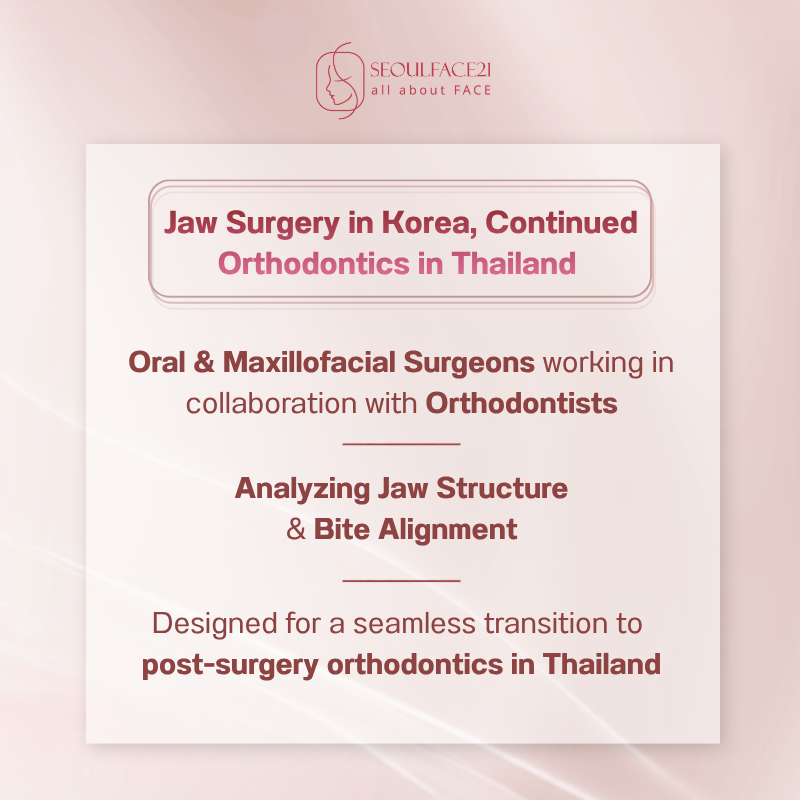
For those planning to undergo jaw surgery in Korea followed by ongoing orthodontic treatment, the key issue is not simply whether orthodontic follow-up can continue after returning to Thailand.
What matters most is that the treatment plans in Korea and Thailand are coordinated and aligned toward the same goals.
This continuity helps ensure that the surgical plan, bite correction, tooth movement, and follow-up orthodontic care work together as part of one connected treatment pathway.Orthodontic treatment associated with jaw surgery is not separate from the surgical process. Both need to be planned together as part of one coordinated treatment pathway.
Before surgery, the medical and orthodontic teams must evaluate several factors together, including the jaw position, dental occlusion, planned bone movements, and the desired final tooth position after treatment.
Coordinating these elements from the beginning helps ensure that the orthognathic surgery plan and orthodontic treatment plan are aligned toward the same functional and structural goals.At SEOULFACE21, jaw surgery is not planned based on the skeletal structure alone. Oral and maxillofacial surgeons work together with orthodontists to evaluate both the jaw structure and dental occlusion as part of a coordinated treatment plan.
Using data from 3D CT and facial scanning, the team analyzes the relationship between the jaws, bite, and overall facial structure before determining which approach is most appropriate for each individual case.
Depending on the assessment, the treatment plan may involve orthodontic treatment alone, jaw surgery alone, orthodontic treatment before surgery, or a surgery-first approach followed by orthodontic treatment.
- What Structural and Bite Problems Are Present Before Jaw Surgery?
- Where Is the Jaw Planned to Be Repositioned?
- How Should the Bite Develop After Jaw Surgery?
- What Are the Goals of Orthodontic Treatment After Jaw Surgery?
Therefore, if you plan to continue orthodontic treatment in Thailand after jaw surgery in Korea, it is important to inform the Korean medical team during the initial treatment-planning stage.
This allows the team to assess whether this approach is appropriate for your case and to determine how post-surgical orthodontic follow-up, bite monitoring, and ongoing treatment should be managed after you return to Thailand.The key question is not simply, “Can I continue orthodontic treatment in Thailand after returning home?”
What matters is ensuring that the jaw surgery and orthodontic treatment are planned as one continuous treatment process from the beginning, with the surgical team evaluating whether the overall approach is appropriate for each individual case.
This coordinated planning helps align the surgical strategy, bite correction, tooth movement, and post-operative orthodontic care toward the same treatment goals.
STM Match — Find the Right Doctor for You

When searching for a plastic surgeon, many people begin by looking through reviews and choosing a doctor whose results and approach appeal to them. That can be a useful starting point.
However, if you want greater confidence that your case is being evaluated by a specialist whose experience and area of expertise truly match your needs, STMStyle can help support you through the doctor-matching process.
Rather than focusing on reviews alone, STMStyle helps connect you with Korean specialists based on the type of procedure, facial structure, treatment goals, and the specific concerns involved in your case.STMStyle begins by gathering essential background information, such as the number of previous surgeries, the concerns you would like to address, medication allergies, underlying medical conditions, and the length of your planned stay in Korea.
This information is then used to match your case with Korean surgeons in the STMStyle network whose specialized expertise aligns with your specific concerns and treatment needs.
The goal is to help connect you with an appropriate specialist who can review your case in detail and provide a more targeted medical assessment based on your individual circumstances.When it comes to deciding which areas should be treated, whether surgery is necessary, and which surgical techniques may be appropriate, STMStyle does not make medical decisions on behalf of the surgeon.
These clinical decisions are made directly by a qualified Korean surgeon whose expertise is appropriate for the individual case. The surgeon is responsible for conducting the medical assessment, reviewing the relevant structural and clinical information, and developing the most suitable treatment plan based on the person’s specific needs and condition.
FAQ: Frequently Asked Questions About Jaw Surgery in Korea
Q. Why Do an Oral and Maxillofacial Surgeon and an Orthodontist Need to Plan Jaw Surgery Together?
Because the goal is not only to create a more balanced facial appearance, but also to consider the final jaw position and dental occlusion after the bones are repositioned.
At SEOULFACE21, jaw surgery and orthodontic treatment are therefore evaluated together so that the planned jaw movements and the direction of orthodontic tooth movement are coordinated from the beginning.
This integrated approach helps ensure that the surgical and orthodontic plans work toward the same structural, functional, and bite-related goals.Q. Why Is Orthodontic Treatment Still Needed After Jaw Surgery?
Jaw surgery is responsible for repositioning the underlying jawbone structure, while orthodontic treatment focuses on aligning the teeth and refining the bite so that it corresponds appropriately with the new jaw position after surgery.
Therefore, in cases that require both orthognathic surgery and orthodontic treatment, completing the surgery does not mean that the entire treatment process is finished.
Ongoing follow-up is still needed to monitor dental occlusion and bite alignment, with orthodontic treatment continuing according to the individualized treatment plan.Q. If I Plan to Continue Orthodontic Treatment in Thailand, Should I Tell the Korean Medical Team Before Surgery?
Yes. This should be discussed during the initial treatment-planning stage, because orthodontic treatment and jaw surgery are closely connected through factors such as tooth position, dental occlusion, and the planned direction and extent of jaw movement.
If the medical team knows from the beginning that the person undergoing treatment has limitations on how long they can stay in Korea, they can evaluate before surgery whether the individual case is suitable for part of the follow-up and orthodontic treatment to continue in Thailand.