


Hollow Cheeks and a Sagging Jawline: Will Ultherapy Make Your Face Look Even More Sunken?
Gangnam HERA Clinic
Many people with slim faces experience a seemingly contradictory concern: they have limited cheek volume or naturally hollow cheeks, yet the jawline begins to sag. When considering Ultherapy for jawline lifting and facial contouring, they often worry that the treatment could make the face look even more hollow or sunken.
Having naturally low cheek volume does not automatically mean that Ultherapy is unsuitable for hollow cheeks. The key is to identify why the face appears sunken and determine which areas are experiencing skin laxity. A customized Ultherapy treatment plan and facial contour design can then target the sagging areas more precisely while helping preserve natural cheek volume.
This is because skin laxity and facial volume loss are two different concerns, and they often require different treatment approaches. In this guide, we explain how to distinguish between sagging skin and hollow cheeks, what to assess before choosing Ultherapy PRIME, how Ultherapy may affect facial fat, what people with naturally sunken cheeks should consider, and how to create a customized lifting plan that preserves the face’s natural contours.
Hollow Cheeks with a Sagging Jawline
Many people assume that a sagging face must be caused by excess facial fat or full cheeks. In reality, facial sagging and skin laxity are not determined by fat volume alone.
As we age, several facial structures change, including the skin, facial fat compartments, supporting tissues, and underlying bone structure. These layers do not age or change at the same rate, which can lead to hollow cheeks, loose skin, and a sagging or poorly defined jawline at the same time.
For example, some people experience mid-cheek volume loss, making the cheekbones appear more prominent and creating hollowness beneath them. At the same time, the lower cheek tissues may begin to descend, causing an uneven or less-defined jawline. This combination is often described as “hollow upper cheeks with sagging lower cheeks.”
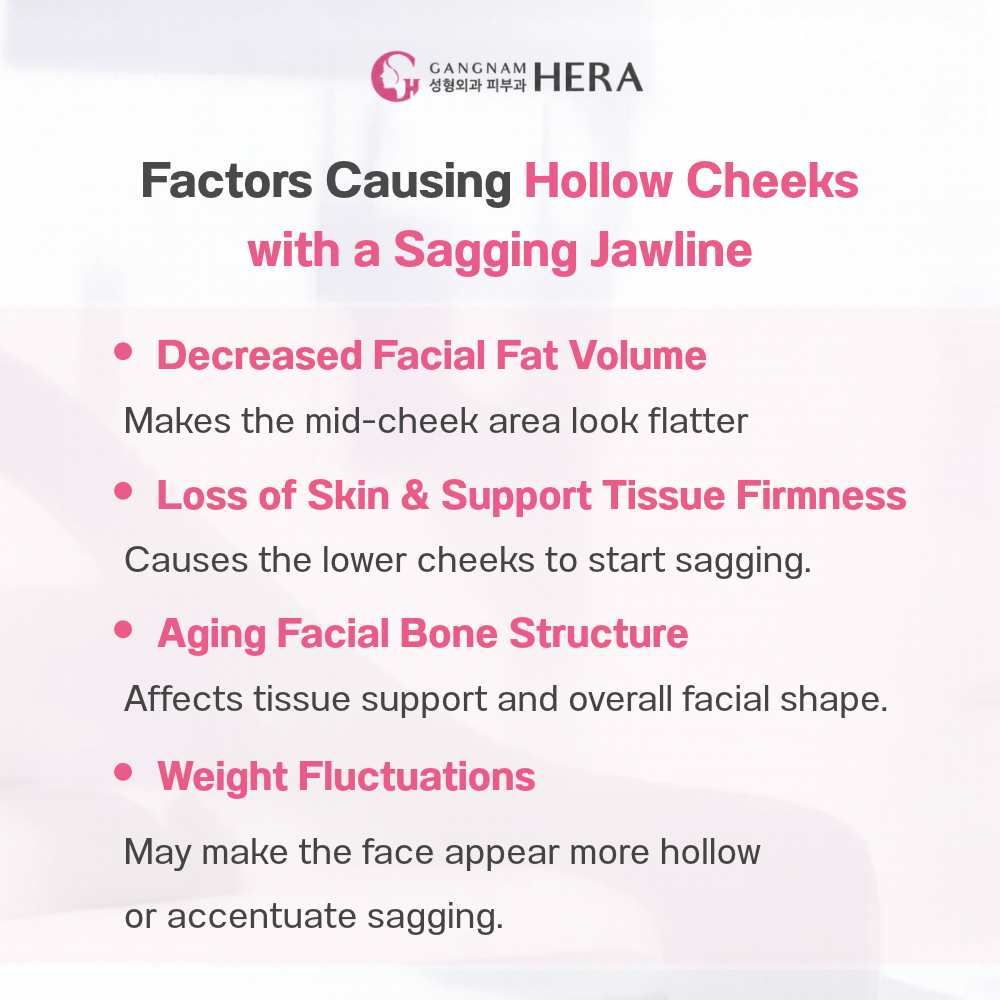
This combination of hollow cheeks and a sagging jawline may be associated with several factors, including:
- Loss of Facial Fat Volume
Reduced facial fat can make the mid-cheek area appear flatter and create more noticeable hollows or facial folds.
- Loss of Skin Elasticity and Facial Tissue Support
As the skin and supporting tissues lose firmness, the lower cheeks may begin to descend and contribute to a sagging jawline.
- Age-Related Changes in Facial Bone Structure
Changes in the underlying facial bones can reduce tissue support and affect the overall facial contour.
- Weight Changes or Fluctuations
Weight loss or repeated weight changes may make hollow cheeks, facial volume loss, and skin sagging appear more noticeable.
Common Causes of a Sagging Jawline
Before undergoing Ultherapy for hollow cheeks and a sagging jawline, it is important to identify what is actually making the face look tired or older. In people with naturally sunken cheeks or facial volume loss, the underlying concern generally falls into three main categories:
1. Insufficient Facial Volume
Common signs include flat or hollow cheeks, sunken temples, and under-eye hollows. If there is minimal skin sagging, a lifting treatment alone may not make the face appear fuller or more youthful. In this situation, facial volume restoration may also need to be considered.
2. Sagging Skin and Facial Tissues
The tissues beside the chin or under the chin may begin to sag, causing a blurred or poorly defined jawline. If an assessment confirms that skin and tissue laxity are the main concerns, a skin-tightening and jawline-lifting treatment may address the problem more directly.
3. Facial Bone Structure
Another important factor is the underlying facial bone structure. The cheekbones, jaw angles, and chin all contribute to supporting the facial tissues. If the natural bone structure provides limited support, skin-lifting treatments alone may produce limited improvement.
People with prominent cheekbones or a more defined, angular facial skeleton may also develop more noticeable hollowness beneath the cheekbones, also known as submalar hollowing, compared with those who have a different facial structure.For Ultherapy PRIME at Gangnam HERA Clinic, the process begins with an AI-powered 3D facial scan using EVE V MUSE AI Mapping to analyze facial structure and skin condition in detail. The doctor then creates a customized Ultherapy treatment plan, determining which areas to treat, which transducer depths to use, and where to focus the ultrasound energy.
The treatment plan is customized to each person’s facial anatomy rather than following a one-size-fits-all Ultherapy protocol. This personalized approach is designed to reduce facial sagging and improve jawline definition while helping the skin maintain a firm, naturally plump appearance.
Can You Get Ultherapy If You Have Hollow Cheeks or Low Cheek Volume?
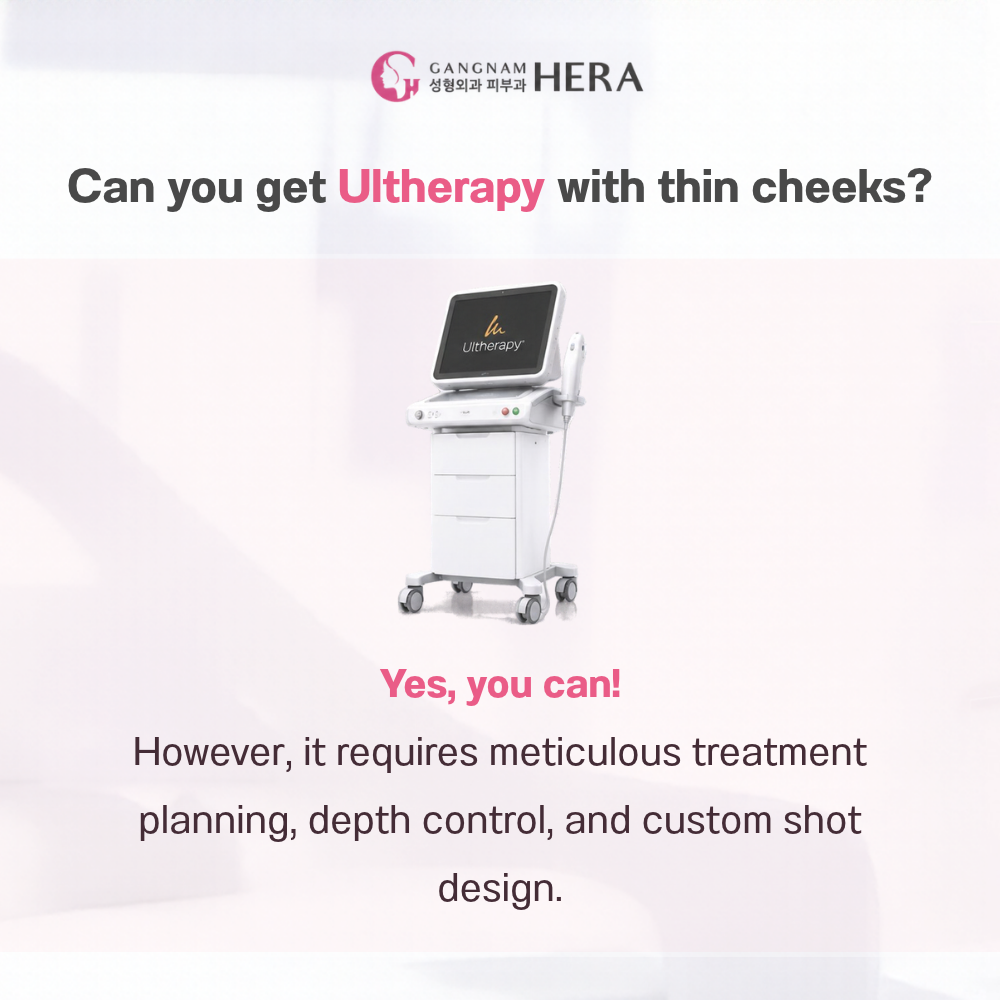
When considering Ultherapy for a sagging jawline, many people with hollow cheeks worry, “Will Ultherapy make my face look even more sunken?” To answer this question, it is important to understand how Ultherapy works.
Ultherapy uses microfocused ultrasound energy to create controlled thermal points beneath the skin and stimulate collagen production. Its primary purpose is skin tightening and facial lifting, not facial volume restoration. If the treatment depth or energy placement is not appropriate for a face with limited fat, the subcutaneous fat may potentially become thinner, making existing facial hollowness appear more noticeable.
Having naturally hollow cheeks does not mean that Ultherapy is completely unsuitable. However, the treatment areas, ultrasound depth, and shot design must be planned with particular care. A detailed facial assessment by the doctor is essential to create a customized Ultherapy treatment for hollow cheeks, with the goal of lifting and defining the jawline while preserving natural facial fullness.
Aesthetic Treatment Options for People with Hollow Cheeks
People with hollow cheeks do not necessarily need to rule out Ultherapy immediately. In some cases, the main concern may be limited to a sagging jawline or double chin, while the mid-cheek area requires little or no additional lifting. A customized treatment plan can therefore focus on selected areas based on the individual facial structure, degree of skin laxity, and desired facial contour.
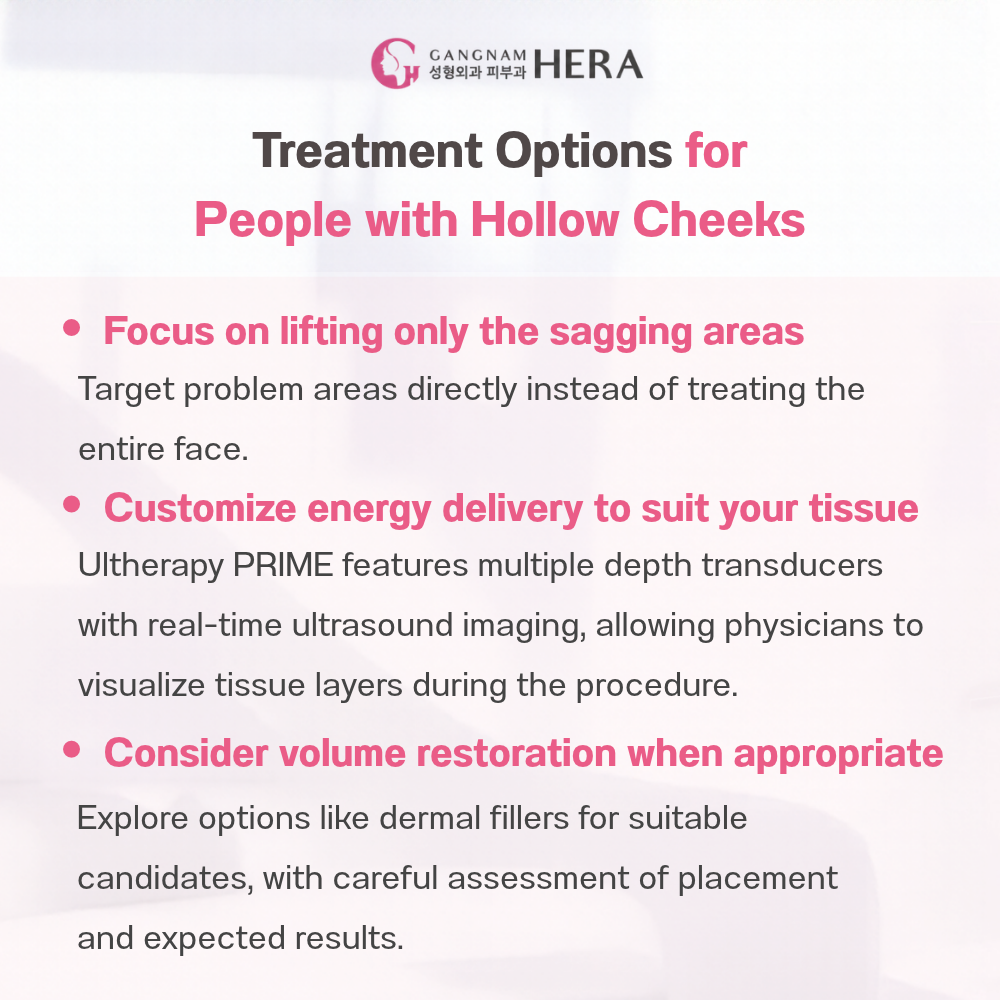
- Targeted Lifting for Specific Areas of Facial Sagging
If the mid-cheek area already has limited volume but the lower face and jawline are beginning to sag, the doctor may consider focusing Ultherapy treatment only on the areas with actual skin laxity rather than treating the entire face. Each treatment zone must still be evaluated carefully to determine whether it is suitable.
- Customize Ultrasound Energy Delivery for the Facial Tissues
Ultherapy PRIME offers transducers with different treatment depths and ultrasound imaging that allows the doctor to view the tissue layers during the procedure. This information helps guide treatment-area selection, energy placement, and the overall Ultherapy plan.
- Consider Facial Volume Restoration When Appropriate
If hollow cheeks are caused by tissue volume loss, the doctor may consider a volume-restoring treatment, such as dermal fillers, for suitable individuals. The treatment area, amount of correction, and expected result should be carefully evaluated before proceeding.Treating hollow cheeks and lifting a sagging jawline do not necessarily require the same procedure. Some people may benefit from targeted skin tightening only in selected areas, while others may need to address facial volume loss first or consider a different treatment better suited to their facial anatomy.
At Gangnam HERA Clinic, treatment options include various thread-lifting techniques, such as APTOS, Silhouette Soft, and MINT threads, as well as dermal fillers, collagen-stimulating injectables, 3D facial fat grafting, and customized programs combining a thread lift with Ultherapy.
The doctor carefully plans the treatment sequence and appropriate intervals between procedures after an in-person facial assessment.
What Should You Monitor After Ultherapy?
After an Ultherapy treatment, proper aftercare and monitoring any changes are important. Some common, temporary side effects may occur and often improve gradually during the natural recovery process, including:
- Temporary skin redness
- Mild swelling
- Tenderness or soreness beneath the skin when pressing the treated area during the early recovery period
- Tingling sensations or temporary numbness in certain areas
However, if you notice any of the following unusual symptoms after Ultherapy, contact the clinic and inform the doctor immediately:
- Facial asymmetry when smiling or moving the mouth
- Swelling that does not improve or pain that continues to worsen
- A palpable lump or raised linear area in the treated region
- A clearly sunken or indented area after the swelling has subsided
It is also important to understand that the full Ultherapy results are not visible immediately. The jawline may gradually appear firmer, smoother, and more defined over approximately two to three months as new collagen production and tissue remodeling continue beneath the skin.
Plan Your Ultherapy Treatment in Korea with STM MATCH

If you are unsure whether to begin with Ultherapy for facial lifting or address facial volume loss first, you can send your information to STM Style for initial treatment planning. Simply prepare the areas you want to improve, the facial features you want to preserve, your previous aesthetic treatment history, and the number of days you plan to stay in Korea.
Once we receive your information, STM Style can help match your case with a Korean doctor who specializes in the specific technique or treatment area you are interested in, using our network of experienced medical professionals.
The doctor will then evaluate whether Ultherapy is suitable for your facial structure, identify which areas should be treated, and determine the appropriate treatment scope. This personalized assessment helps create a natural-looking Ultherapy plan that addresses your concerns while prioritizing facial balance and safety.
FAQ: Frequently Asked Questions About Ultherapy for Hollow Cheeks
Q. Can Ultherapy Make the Face Look More Hollow?
It does not happen to everyone, but facial hollowing has been reported in some cases, particularly among people who already have limited facial fat. A detailed assessment of facial structure, fat volume, treatment areas, and ultrasound depth is therefore important when planning Ultherapy for hollow cheeks.
Q. Can I Have Ultherapy After Dermal Fillers?
Yes, Ultherapy may be performed after dermal filler injections. However, inform the doctor where the filler was injected, which product was used, and when the treatment was performed. This information helps the doctor determine the appropriate Ultherapy treatment areas and timing.
Q. What Are the Alternatives If Ultherapy Is Not Suitable?
The most suitable treatment depends on each person’s facial concerns. For facial volume loss, options may include dermal fillers, collagen biostimulators, or facial fat grafting. For sagging facial tissues, a thread lift may be considered. Some people may benefit from a combination treatment performed in a carefully planned sequence determined by the doctor.
With hollow cheeks and a sagging jawline, it is important to determine whether the main concern is facial volume loss, tissue laxity, or a combination of both. Once the underlying cause is clear, the doctor can decide where Ultherapy should be applied, how extensive the treatment should be, or whether another facial contouring treatment should be performed first.
If you are planning Ultherapy treatment in Korea, you can send your photos, facial concerns, previous dermal filler, thread lift, or energy-based lifting treatment history, and travel dates to STM Style. Our team can organize your information, help find a suitable Korean doctor, and coordinate a preliminary facial assessment before you travel.