Revision Double Eyelid Surgery: Is Inner or Outer Corner Eye Surgery Really Necessary? Urban Plastic Surgery Hospital
Some people may have already undergone double eyelid surgery, but when they look in the mirror, they still feel that the eyelid crease is too high, the two eyes look uneven, or the eyes still appear small and not fully open. At that point, a common question is: “If I revise the double eyelid crease and add inner or outer corner eye surgery at the same time, will the result look better?”
However, if the eyes still look unbalanced after surgery, that does not necessarily mean that every area needs additional correction. For some people, the main issue may be the double eyelid crease itself. In other cases, the crease may be acceptable, but the eyes still look uneven because of differences in eyelid-opening strength or ptosis-related muscle imbalance. Others may have limitations related to the natural shape of the inner or outer eye corners. This is why revision double eyelid surgery should begin with a detailed assessment of the actual cause before deciding whether procedures such as epicanthoplasty, lateral canthoplasty, or ptosis correction are truly necessary.
Before planning revision double eyelid surgery, it is important to identify these causes separately first. The surgeon can then determine whether revising the eyelid crease alone is sufficient, or whether additional procedures—such as ptosis correction, epicanthoplasty, or lateral canthoplasty—should be considered to improve the overall eye shape and balance.
High Eyelid Creases, Uneven Eyes, and Small-Looking Eyes Do Not All Require the Same Correction
When considering revision double eyelid surgery, it helps to look more closely at what exactly you are dissatisfied with about your eyes. Even if the overall feeling is simply that “my eyes still don’t look the way I expected,” the underlying cause may come from very different areas. One person may have an issue with the eyelid crease, another with eye-opening strength or asymmetry, while someone else may be more concerned about the inner or outer eye corners. Because the cause can vary, the appropriate correction also needs to be planned differently for each concern.
Eyelid Crease That Looks Too High or Too Thick
The surgeon should assess the crease height, fold line, and overall shape of the existing double eyelid crease to determine which part is making the crease appear too thick, too high, or out of balance with the eye shape. This helps identify whether the main issue comes from the position of the crease, the way the fold is formed, or the relationship between the eyelid crease and the individual eye structure.
Uneven or Asymmetrical Eyes
The surgeon should determine whether the difference between the two eyes comes from the double eyelid crease, the overall eye shape, or differences in eyelid-opening strength between each side. Identifying the true cause of the asymmetry is important because uneven eyes do not always require the same type of correction on both sides.
Eyes That Look Small or Not Fully Open
In addition to evaluating the double eyelid crease, the surgeon may also need to assess the inner and outer eye corners to determine whether the natural eye shape is contributing to a smaller or less open appearance. This helps clarify whether the concern can be improved through revision double eyelid surgery alone, or whether procedures such as epicanthoplasty or lateral canthoplasty may also need to be considered.
The Double Eyelid Crease Is Present, but the Eyes Still Look Tired or Not Fully Open
The surgeon should assess whether the concern is caused by the double eyelid crease alone or whether reduced eyelid-opening strength is also contributing to the appearance. This distinction is important because some cases may require evaluation for ptosis or eyelid-opening muscle imbalance, rather than simply revising the eyelid crease.
At Urban Plastic Surgery, revision eyelid surgery begins with an individual assessment of the eye structure. Even when two people appear to have a similar eye shape externally, factors such as eyelid thickness, fat volume, skin laxity, and eyelid-opening strength can be very different. For this reason, planning revision double eyelid surgery should start by identifying exactly which part of the eye structure is causing the remaining imbalance or dissatisfaction before deciding which correction is truly necessary.
Double Eyelid Revision vs. Ptosis Correction: What’s the Difference?
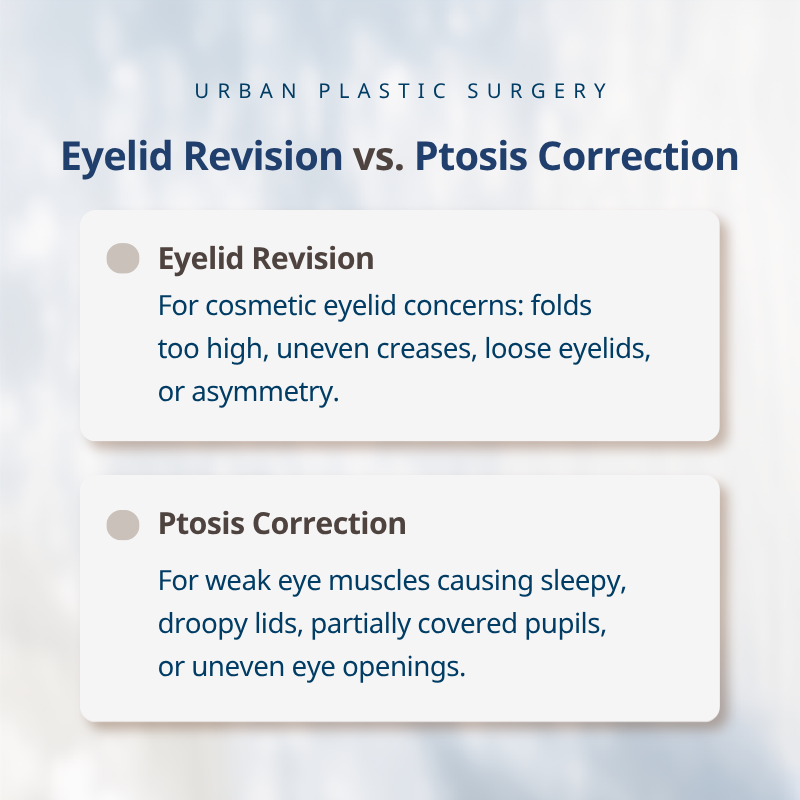
Many people who have already undergone double eyelid surgery but still feel that their eyes look tired or uneven may assume that the problem comes only from an unsatisfactory eyelid crease. As a result, they may immediately consider revising the crease again. However, the underlying issue may actually involve ptosis or weak eyelid-opening muscles, which can reduce the strength needed to fully open the eyes. This is why it is important to understand the difference between the two. Double eyelid revision focuses on correcting the crease height, fold shape, and eyelid line, while ptosis correction focuses on improving eyelid-opening strength and muscle function. Because these procedures address different causes, the surgeon should first determine whether the concern comes from the eyelid crease, eyelid-opening muscle strength, or a combination of both before planning revision surgery.
Double Eyelid Revision (Eyelid Crease Correction)
This approach is suitable when eyelid-opening muscle function is normal, but the concern is mainly related to the external shape or fold of the eyelid. Examples include a crease that is too high, an uneven or irregular fold, loss of the previous double eyelid crease, or asymmetry between the two crease lines. In these cases, revising the double eyelid crease itself may be enough to address the concern without needing to alter the eyelid-opening muscles.
This approach may be appropriate when the double eyelid crease itself is not the main problem, but the upper eyelid does not open fully. As a result, part of the iris may remain covered, making the eyes look tired, sleepy, less bright, or uneven in height. When this is related to weak eyelid-opening muscles or ptosis, surgery may need to focus on adjusting the eyelid-opening strength rather than simply revising the crease. By improving the way the eyelid opens, the eyes may appear more open, balanced, and refreshed, depending on the underlying muscle function and individual eye structure.
This is especially important for people who want to correct uneven or asymmetrical eyes. The surgeon needs to determine whether the difference comes from uneven double eyelid crease lines or from unequal eyelid-opening strength between the two eyes. These two concerns have different underlying causes and require different surgical approaches, so accurately identifying the source of the asymmetry is essential before planning revision eyelid surgery.
Revision Double Eyelid Surgery in Korea: Do You Also Need Inner or Outer Corner Eye Surgery?
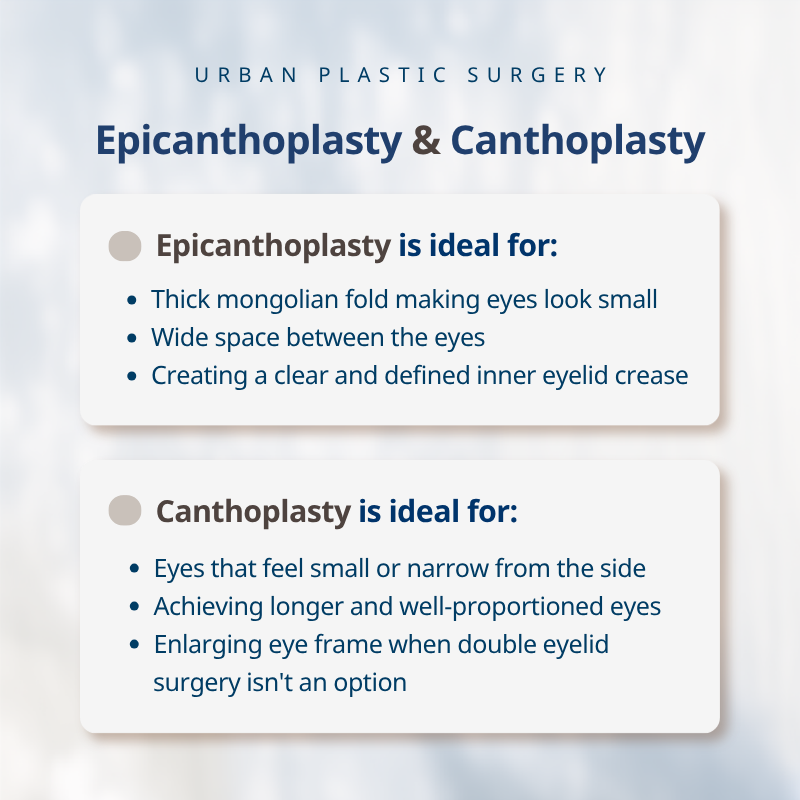
For the question, “If I have revision eyelid surgery, do I also need epicanthoplasty or lateral canthoplasty?” the answer depends on the individual eye structure. Epicanthoplasty and lateral canthoplasty do not directly correct the double eyelid crease. Instead, these procedures are used to adjust different aspects of the eye shape, horizontal length, and direction of the eye corners. For this reason, the surgeon should evaluate each case individually to determine whether inner or outer corner eye surgery should be combined with revision double eyelid surgery, based on the existing eye shape, proportions, and the specific concern that needs correction.
Epicanthoplasty May Be Suitable For:
-People with a prominent epicanthal fold covering the inner corner of the eye, which can make the eyes appear smaller -People with a wider-than-desired distance between the eyes -People who want the inner portion of the double eyelid crease to look more open and defined
Lateral Canthoplasty May Be Suitable For:
-People who feel their eyes look small or narrow from the outer side -People who want the eyes to appear longer, more elongated, and better balanced with overall facial proportions -People who want to increase the visible eye width and make the eyes appear larger, especially when further enlargement through double eyelid surgery alone may be limited
Therefore, if the main problem from the previous eyelid surgery is limited to the double eyelid crease itself, it does not automatically mean that epicanthoplasty or lateral canthoplasty is also necessary. However, if the evaluation shows that the concern also involves the horizontal length of the eyes, a more closed-looking inner corner, or the direction of the outer eye corners, the surgeon may then consider whether additional eye-corner surgery should be combined with the double eyelid revision. The key is to correct only the areas that are actually contributing to the overall eye shape and balance.
Revision Eyelid Surgery: How Should the Eye Shape Be Planned When Multiple Areas Need Correction?
When revision double eyelid surgery is combined with inner or outer corner eye surgery, the most important goal is to make sure that every element works together in harmony and remains balanced with the overall facial proportions. The eyelid crease, inner eye corner, outer eye corner, eye-opening strength, and overall eye shape should be planned as a connected design rather than treated as separate procedures.
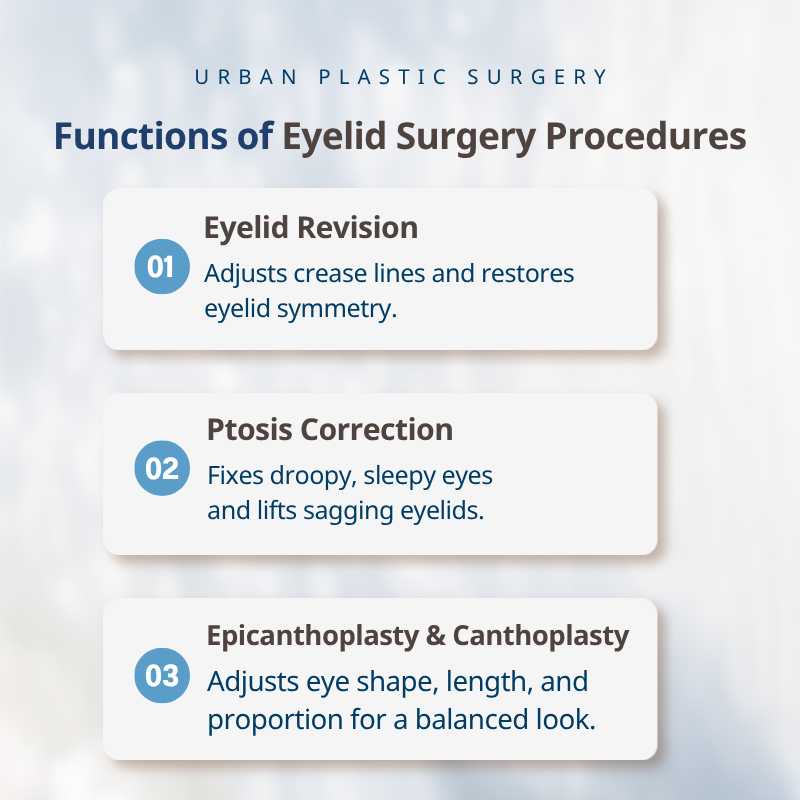
Therefore, accurate revision eyelid surgery planning should begin by clearly understanding the specific role of each eye procedure. Each procedure addresses a different concern—whether it involves the double eyelid crease, eyelid-opening strength, inner eye corner, outer eye corner, or overall eye shape—so identifying the function of each correction first helps create a more balanced and precise surgical plan.
Double Eyelid Revision / Eyelid Crease Correction
Helps correct the eyelid fold line and refine the shape and balance of the double eyelid crease.
Helps address concerns such as droopy eyelids, sleepy-looking eyes, or eyelids that do not open fully, by improving eyelid-opening strength and function.
Epicanthoplasty / Lateral Canthoplasty
Helps adjust the visible eye area, horizontal length, and direction of the eye shape to create more balanced and proportionate eyes.
At Urban Plastic Surgery, the concept of Customized Design is based on a detailed assessment of the individual eye structure, including eyelid shape, skin thickness, fat volume, degree of laxity, and personal aesthetic goals. By evaluating these factors together, the surgeon can determine which procedures should be combined and which may not be necessary, allowing the treatment plan to remain appropriate, targeted, and balanced. The goal is to create an eye shape that looks refined, harmonious, and as natural as possible, while remaining suited to the individual facial structure.
STM MATCH — Find a Doctor Matched to Your Needs and Treatment Goals
When searching for a plastic surgeon, many people begin by looking through reviews and choosing a doctor whose aesthetic style matches the results they like. That can be a good starting point. However, if you want greater confidence that your case is being handled by a doctor with expertise that closely matches your specific concerns and surgical needs, STMStyle can help with the matching process. Through STM MATCH, we help connect each case with a Korean plastic surgeon whose experience and specialty are more closely aligned with the actual problem that needs correction, rather than choosing based on visual preference alone.
STMStyle first gathers key background information, such as how many previous surgeries you have had, which materials were used, the areas you would like to improve, medication allergies, underlying medical conditions, and your planned length of stay in Korea. This information is then used as part of the STM MATCH process to connect your case with a Korean plastic surgeon in our network whose expertise is closely aligned with your specific nasal concerns and surgical needs. By organizing these details in advance, the doctor can review the case more accurately and provide a more focused rhinoplasty assessment and personalized treatment plan based on your actual surgical history, nasal structure, and goals.
For decisions such as whether the double eyelid crease needs revision, eyelid-opening strength requires correction, or additional inner or outer eye corner surgery should be considered, STMStyle does not make these medical decisions on behalf of the surgeon. These assessments should be made directly by a qualified Korean plastic surgeon whose expertise is appropriate for the individual case. The surgeon will evaluate the eyelid crease, eye-opening strength, inner and outer eye corners, and overall eye structure before determining which procedures are necessary and creating a personalized surgical plan.
FAQ: Common Questions About Revision Double Eyelid Surgery and Eye Corner Surgery
Q. If My Double Eyelid Creases Are Uneven, Do Both Eyes Need Revision Surgery?
It depends on the individual eye structure. The surgeon first needs to determine whether the asymmetry comes from the double eyelid crease, differences in eyelid-opening strength, or structural differences between the two eyes. Once the underlying cause is identified, the surgeon can decide whether revision is needed on one eye or both eyes and determine the most appropriate extent of correction.
Q. Can Revision Double Eyelid Surgery and Lateral Canthoplasty Be Performed at the Same Time?
Yes, the two procedures can be considered together if both areas need correction. However, lateral canthoplasty is not necessary for every revision double eyelid surgery case. The surgeon should first evaluate the shape and direction of the outer eye corner, as well as the surrounding anatomy and how much the area can be safely adjusted, before deciding whether lateral canthoplasty should be included in the surgical plan.
Q. If My Eyes Still Look Tired After Double Eyelid Surgery, Does That Mean I Need Ptosis Correction?
Not necessarily. The surgeon first needs to determine whether the tired-looking appearance is caused by the double eyelid crease, the eyelid itself, or reduced eyelid-opening strength. Ptosis correction should only be considered when the doctor confirms that weak eyelid-opening muscles or insufficient eyelid-opening strength are actually contributing to the problem.
Because revision eyelid surgery is not about adding more procedures—it is about correcting the right problem from the beginning. Understanding the true underlying cause can help create more natural-looking, balanced eyes while avoiding unnecessary surgery, recovery, and additional costs.
If you are planning to travel to Korea for revision eyelid surgery, you can send photos of your eyes, the areas you are concerned about, and your previous surgical or treatment history to STMStyle. We can help organize the information needed for your case, identify Korean plastic surgeons with relevant expertise in revision double eyelid surgery, and coordinate a preliminary case assessment with the doctor before you travel to Korea. This can help you better understand the possible surgical direction in advance and prepare for your revision eyelid surgery in Korea more efficiently.