



Forehead Augmentation Surgery for a Smooth, Fuller, and More Naturally Contoured Forehead
By NJH Plastic Surgery (Noh Jong Hoon Plastic Surgery)
As the seasons change, many people start looking for ways to refresh their appearance and create a brighter, more youthful look. One popular choice is the high bun hairstyle, often known as a top knot or Korean-style bun.
In addition to creating a fresh, friendly, and stylish appearance, this hairstyle can also visually enhance the facial contour, making the face appear slimmer, more defined, and better proportioned. By pulling the hair upward and exposing more of the forehead, a high bun can also draw attention to the forehead shape, facial profile, and overall facial balance.However, one of the key features that can make you feel more confident wearing an open-forehead hairstyle is having a smooth, naturally rounded, and well-proportioned forehead.
A forehead with the right amount of projection, fullness, and volume can enhance overall facial balance and three-dimensional facial contour, helping the face look more harmonious from different angles. A well-shaped forehead can also create a smoother transition between the forehead and nasal bridge, which may make the nose appear more defined and prominent in a natural-looking way.This article will take a closer look at the different types of forehead shape and structural concerns, as well as the forehead surgery techniques used to address each problem more precisely.
By understanding issues such as a flat forehead, uneven forehead contour, insufficient forehead projection, or facial imbalance, patients can better determine which type of forehead augmentation, forehead contouring, or forehead reshaping surgery may be most appropriate for their individual facial structure and aesthetic goals.
Why Forehead Shape Matters for Facial Balance, Proportion, and Overall Facial Harmony
In ideal facial proportions, the forehead typically accounts for approximately one-third of the overall face. Because of this, the shape, height, projection, and contour of the forehead can have a significant influence on the overall facial impression, balance, and harmony.
When planning forehead surgery, forehead augmentation, or forehead contouring, one of the most important considerations is achieving a natural-looking result that complements each patient’s unique facial features. Rather than creating an exaggerated or overly prominent forehead, the goal is to design a forehead shape that blends naturally with the eyes, nose, cheekbones, and overall facial profile.A sunken, flat, or hollow forehead can sometimes make the overall face appear tired, harsh, or less vibrant. Enhancing the forehead contour and volume can help create a smoother, more balanced facial profile, making the face look softer, fresher, and more youthful.
Through forehead augmentation or forehead contouring, the goal is to restore appropriate projection and fullness while maintaining natural proportions that harmonize with the rest of the face.
Forehead Augmentation Techniques for Flat or Sunken Forehead Correction

For individuals with a flat, sunken, or hollow forehead, there are currently three main forehead augmentation and contouring techniques that can be used to improve the underlying forehead structure and restore a smoother, more balanced facial profile, as follows:
1. Forehead Augmentation with a Silicone Implant
The procedure is performed through a surgical incision placed approximately 4–5 cm behind the hairline. The surgeon then carefully dissects the skin and soft tissue layers above the eyebrows to create a pocket for placement of the silicone forehead implant.
Before surgery, a custom-made silicone implant is designed and molded to match the patient’s individual forehead bone structure and contour. This personalized approach allows the implant to fit closely against the existing frontal bone, helping create a smoother and more natural forehead shape while potentially reducing complications such as fluid accumulation, seroma formation, inflammation, or infection.
- Advantages: The surgical incision is typically placed within or behind the hairline, helping keep the scar discreet and less visible. Bone substitute materials used for forehead augmentation and forehead contouring can provide stable, long-lasting structural enhancement while creating a firm, natural feel that closely resembles the underlying forehead bone. Hydroxyapatite-based materials, for example, can be molded to achieve precise craniofacial contouring.
Another advantage is that these materials can provide a more defined and noticeable correction for flat, sunken, or uneven forehead contours compared with temporary volume-enhancement methods. However, whether the material can be easily removed later depends on the specific bone substitute used, the degree of tissue or bone integration, and the surgical technique, so this should be discussed with the surgeon before treatment.- Recovery: Depending on the surgical technique and individual healing process, patients may be able to resume light daily activities relatively soon after forehead augmentation surgery. Returning to work or social activities may be possible once the initial swelling and discomfort have improved, although recovery time varies from person to person. Published postoperative guidance for forehead augmentation often places return to work closer to 1–2 weeks, so the original “next day / 5 days” timeline is best presented as clinic-specific rather than universal.
Recovery: Patients can usually return to normal daily activities the day after surgery and may be able to resume work or social activities approximately 5 days after forehead augmentation surgery, depending on their individual recovery and the surgeon’s assessment.2. Forehead Fat Grafting for Volume Enhancement and Forehead Contouring
Forehead Fat Grafting: This procedure involves harvesting excess fat from the patient’s own body, commonly from areas such as the abdomen or thighs. The collected fat is then processed and purified to isolate high-quality fat cells, which are carefully injected into the forehead to restore volume and create a smoother, fuller, and more naturally contoured forehead.
Because autologous fat grafting uses the patient’s own fat, it can be customized according to the individual’s forehead shape, volume deficiency, and overall facial proportions.
- Advantages: Because forehead fat grafting uses the patient’s own autologous fat tissue, the risk of immune rejection, allergic reactions, or adverse responses to foreign materials is generally low. When combined with other facial contouring or facial rejuvenation procedures, autologous fat grafting can also help create a softer, smoother, and more harmonious overall facial appearance.
- Limitations: Because the transferred fat can be naturally reabsorbed by the body over time, the results of forehead fat grafting may not be as permanent as those achieved with a silicone forehead implant. Some patients may require additional fat grafting sessions or touch-up injections to maintain the desired forehead volume.
For this reason, autologous forehead fat grafting is generally more suitable for individuals with mild forehead volume loss, a slightly sunken forehead, or localized contour irregularities, rather than those requiring a major structural change.3. Forehead Augmentation with Bone Substitute Materials for Forehead Contouring
Bone Substitute Materials for Forehead Augmentation: These materials have a chemical composition similar to that of human bone and are designed for medical use with a high level of biocompatibility. One of their key advantages is that they can be shaped and customized to match the patient’s individual forehead bone structure, allowing the surgeon to create the desired forehead projection, volume, and contour with greater flexibility.
When appropriately selected and used, bone substitute materials for forehead contouring can offer advantages and aesthetic outcomes comparable to silicone forehead implants, making them another option for correcting a flat, sunken, or uneven forehead and creating a smoother, more naturally contoured facial profile.
Forehead Contouring Solutions for a Narrow Forehead and a Wide Forehead
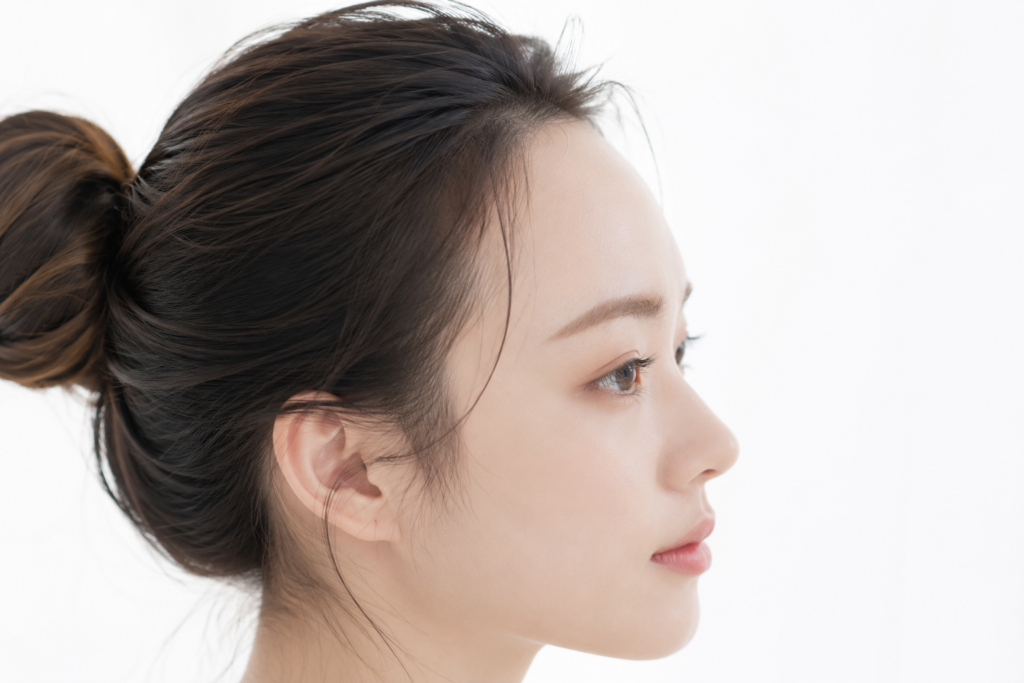
Beyond concerns about a flat or sunken forehead, the width and overall proportions of the forehead can also affect facial balance and self-confidence. A narrow forehead or wide forehead may create a different overall facial impression, so the appropriate treatment approach should be selected according to each individual’s forehead shape, hairline, facial proportions, and underlying bone structure.
- For an Overly Narrow Forehead: Many people try to make the forehead appear wider by plucking or shaving the hairline. However, repeated hair removal can cause significant skin irritation and may lead to problems such as rough or bumpy skin, ingrown hairs, post-inflammatory hyperpigmentation, and folliculitis around the hairline.
Treatment Approach: A doctor may recommend laser hair removal along the hairline to gradually reduce unwanted hair and create a cleaner, wider-looking forehead contour. Laser energy selectively targets melanin in the hair follicle, helping damage the follicle and reduce future hair growth while minimizing injury to the surrounding skin when performed appropriately.
This is generally a quick, minimally invasive hairline treatment with relatively low discomfort and little downtime, although multiple sessions are usually required for optimal hair reduction.- For an Overly Wide Forehead: In men, a very wide or high forehead can sometimes create the appearance of a receding hairline or hair loss, while in women it may make the face appear larger, longer, or wider than its natural proportions.
Treatment Approach: One effective option is permanent hair transplantation for hairline lowering and forehead reduction. This procedure involves harvesting healthy hair follicles from the donor area at the back of the scalp, where the hair is generally more resistant to shedding, and transplanting them to the front hairline.
By carefully redesigning and lowering the hairline, hair transplant surgery can help reduce the visible height and width of the forehead, improve forehead-to-face proportions, and create a more balanced and natural-looking facial frame.
Source: Column by Noh Jong Hoon Plastic Surgery (NJH Plastic Surgery)