



Ptosis Correction & Eyelid Adjustment Techniques for Droopy Eyes
By URBAN Plastic Surgery
Eyelid surgery is one of the first cosmetic procedures many people consider when they want to enhance their overall facial appearance. This is because the eyes play an important role in shaping the impression of the entire face, influencing how bright, soft, defined, and natural a person’s overall look appears.
For this reason, procedures such as double eyelid surgery, ptosis correction, and eyelid muscle adjustment are often planned not only to improve the eye area itself, but also to create better facial balance and harmony.Although everyone’s eyes may look similar from certain angles, the underlying eye and eyelid anatomy can vary significantly from person to person. Factors such as eyelid thickness, the amount and distribution of eyelid fat, and the degree of eyelid ptosis can all influence the appearance of the eyes.
Other facial features—including face shape, the nose, and the lips—also affect how the eyes are perceived and contribute to the overall facial balance, harmony, and expression. For this reason, planning procedures such as ptosis correction or eyelid surgery should consider the entire face rather than focusing on the eyes alone.For this reason, ptosis correction, also commonly known as droopy eyelid correction surgery, is not simply about making the eyes look larger. The goal is to design and adjust the eye shape so that it complements each individual’s facial proportions, overall appearance, and personal features as naturally as possible.
In this article, we will take a closer look at the differences between incisional and non-incisional ptosis correction, including who each technique is suitable for, their key advantages, and how to choose the most appropriate method based on your eyelid anatomy and individual eye concerns.
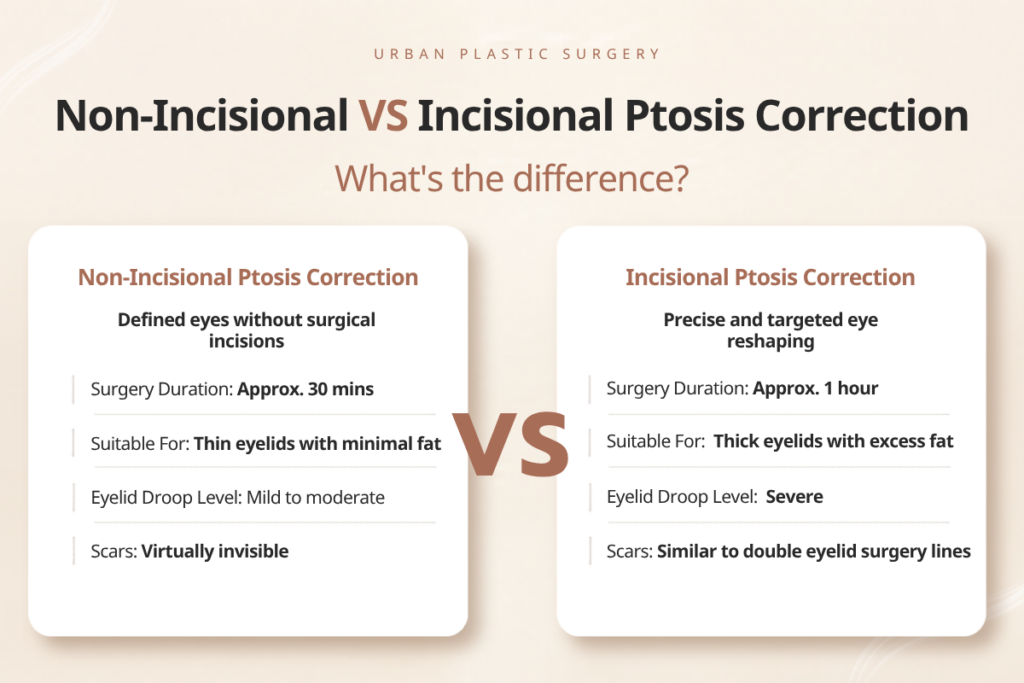
What Is Non-Incisional Ptosis Correction?
Non-incisional ptosis correction is a technique that does not require a long incision across the upper eyelid. Instead, the surgeon uses sutures to support and adjust the eyelid tissues, helping the muscles responsible for opening the eyes function more effectively.
This method is generally suitable for people with thin upper eyelid skin, minimal eyelid fat, and mild ptosis or droopy eyelids. It can help improve a tired or sleepy-looking eye appearance while maintaining a natural-looking result.Key Benefits of Non-Incisional Ptosis Correction
- The procedure takes a relatively short time, approximately 30 minutes.
- The incision is very small and barely noticeable.
- Quick Recovery
- Suitable for those who want to return to their daily routine quickly.
- Suitable for patients with thin eyelid skin and mild ptosis.
However, non-incisional ptosis correction may provide less fixation strength than the incisional technique in some cases, particularly for patients with thicker eyelid skin, a larger amount of eyelid fat, or more pronounced ptosis.
In these cases, there may be a greater possibility of needing additional correction or revision eyelid surgery in the future. Therefore, choosing between non-incisional and incisional ptosis correction should be based on a detailed evaluation of the individual’s eyelid anatomy and severity of ptosis.
What Is Incisional Ptosis Correction?
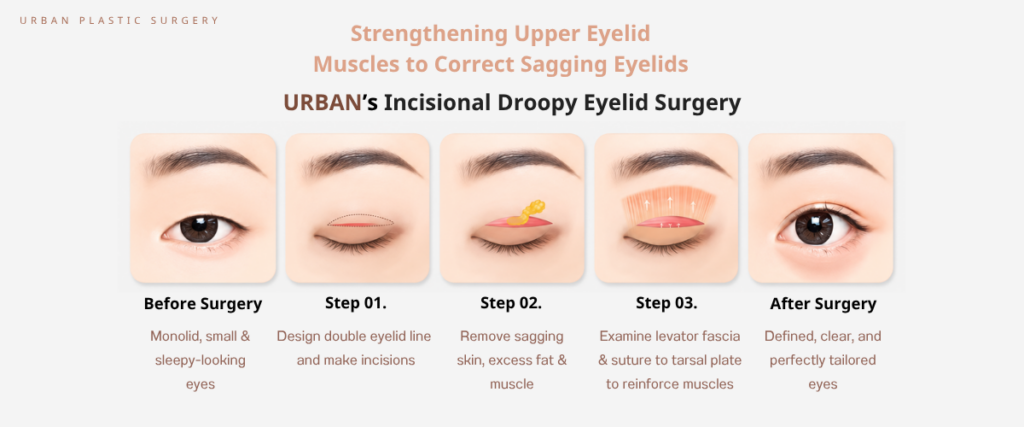
Incisional ptosis correction is a surgical technique in which the surgeon makes an incision along the upper eyelid to directly access and adjust the skin, fat, eyelid muscles, and underlying tissues. The internal structures are then repositioned and secured to improve the eye-opening function.
This method is generally more suitable for patients with thicker eyelid skin, a larger amount of eyelid fat, more severe droopy eyelids, or weakened eyelid-opening muscles that require more precise structural correction.Key Benefits of Incisional Ptosis Correction
- Allows excess upper eyelid skin to be removed.
- Allows direct adjustment of eyelid fat and underlying tissues.
- Suitable for patients with severe droopy eyelids or more pronounced ptosis.
- Provides stronger and more stable fixation in many cases.
- Suitable for patients seeking more noticeable and long-lasting results.
In general, incisional ptosis correction takes approximately 1 hour, depending on the individual case and the extent of correction required. The incision is usually placed along the double eyelid crease, and the recovery period may be slightly longer than with non-incisional ptosis correction.
Proper postoperative eyelid surgery care is therefore important, and patients should follow their surgeon’s instructions carefully to support healing and recovery.
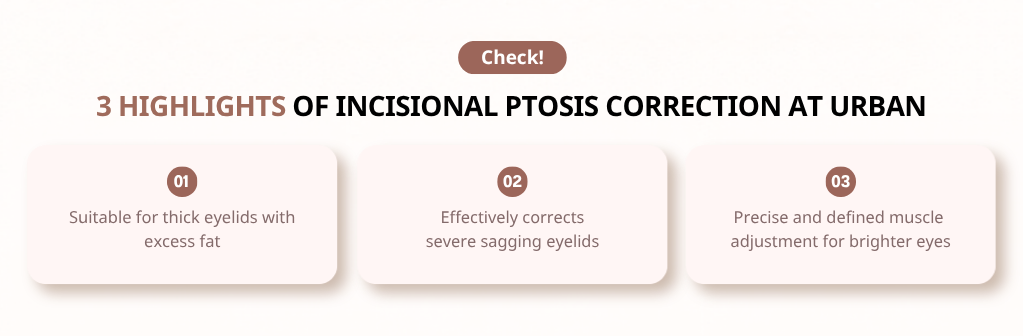
Who Is a Good Candidate for Incisional Ptosis Correction?
Incisional ptosis correction is generally suitable for patients with the following characteristics:
1. Thick Upper Eyelids with Excess Eyelid Fat
For patients with thick upper eyelid skin or a significant amount of eyelid fat, a non-incisional technique may not provide enough access to correct the underlying eyelid structure effectively.
In these cases, incisional ptosis correction allows the surgeon to directly adjust the skin, excess eyelid fat, eyelid muscles, and deeper tissues in greater detail, making it more suitable for more complex eyelid concerns.2. Pronounced Ptosis or Weak Eyelid-Opening Muscles
Patients with tired-looking or sleepy eyes, difficulty opening the eyes fully, noticeable droopy eyelids, or a tendency to raise the eyebrows and use the forehead muscles to help open the eyes may be suitable candidates for incisional ptosis correction.
Because this technique allows the surgeon to directly access and adjust the eyelid-opening muscles, it can provide more precise correction for patients with moderate to severe ptosis or weakened eyelid muscles.3. Seeking More Noticeable Results and a More Open-Eyed Appearance
For patients who want their eyes to look brighter, more defined, and naturally more open, incisional ptosis correction allows for more detailed adjustment of both the eyelid crease and droopy eyelid concerns.
Because the surgeon can directly access the underlying eyelid structures, this approach can provide more precise customization of the eye-opening function and double eyelid design, helping create a clearer and more balanced overall eye shape.
Choosing the Right Hospital for Eyelid Surgery Is an Important Decision
Ptosis correction surgery is performed at many plastic surgery hospitals, but because it involves delicate structures around the eyes and directly affects facial appearance, choosing the right surgical provider is important.
Rather than selecting a clinic based on price alone, patients should also consider the surgeon’s experience in eyelid surgery and ptosis correction, the hospital’s surgical and safety standards, and whether there are verifiable patient reviews and before-and-after cases available for reference. A thorough consultation and personalized evaluation can also help determine whether the recommended technique is appropriate for your eyelid anatomy and individual concerns.Both incisional and non-incisional ptosis correction have their own advantages and limitations. The best technique is not necessarily the one that is currently most popular, but the one that is most appropriate for your individual eyelid anatomy, degree of ptosis, and eye-opening function.
A personalized evaluation by an experienced eyelid surgeon can help determine which ptosis correction technique is best suited to your eyes and overall facial balance.If you have ptosis, droopy or tired-looking eyes, unclear double eyelid creases, or are considering double eyelid surgery in Korea, a consultation with an experienced eyelid surgeon can help identify the underlying cause of your concerns more accurately.
A personalized evaluation of your eyelid anatomy, eye-opening function, and facial balance can also help determine whether incisional or non-incisional ptosis correction, double eyelid surgery, or another eyelid procedure is the most appropriate option for your individual needs.For those interested in Korean eyelid surgery, incisional ptosis correction, or non-incisional ptosis correction, you can request more information for an initial evaluation and a personalized treatment plan based on your eyelid anatomy, degree of ptosis, and individual eye concerns.
Source: Column by URBAN Plastic Surgery