



How Long Does a Thread Lift Last? If the Results Fade Quickly, Is a Thread Lift in Korea Worth It?
Gangnam HERA Clinic
Many people have heard that thread lift results fade quickly, or they may have previously experienced facial sagging returning sooner than expected after a thread lift. This can make traveling to Korea for treatment feel like a major decision: after investing in flights, accommodation, time, and treatment costs, will a Korean thread lift last long enough to be worth it?
The truth is that a thread lift delivers the most effective and natural-looking results when the treatment is carefully planned for the right concerns. Thread lift longevity depends on several factors, including the degree of facial sagging, the type of lifting threads used, thread placement technique, and your expected results from the non-surgical facelift.
This guide explains why thread lift results last longer for some people than others, who may be a suitable candidate for a thread lift, when other facial lifting treatments may be needed, and when to evaluate the results. It also covers what to consider before booking a thread lift in Korea, helping you make a more informed decision about treatment planning, recovery time, cost, and long-term value.
Do Thread Lift Results Really Fade Quickly?
Before answering that question, it is important to understand how a thread lift works. Thread lift treatment generally relies on two main mechanisms that work together:
- Repositioning and Lifting Facial Tissues
Threads with barbs or cones grip and support the tissues beneath the skin, repositioning them toward the intended lifting direction. This creates the immediate facial lifting effect commonly visible after a thread lift.
- Stimulating Collagen and New Tissue Around the Threads
Over time, the body responds by producing collagen and new supportive tissue around the lifting threads. This collagen-stimulating process may help maintain firmer, more supported skin for a period of time, even as the absorbable threads gradually dissolve.Most modern thread lift procedures use absorbable lifting threads, such as PDO, PLLA, or PCL threads. The body gradually absorbs each material at a different rate. As the threads begin to dissolve, their mechanical lifting support gradually decreases, while the face continues to change naturally with age. These factors influence how long thread lift results last.
This is why thread lift longevity varies from person to person, with results lasting anywhere from several months to more than a year. Therefore, the idea that a thread lift “loosens quickly” does not apply to everyone. However, it is also important to understand that a single thread lift is not a permanent facial lifting solution.
Factors That Can Make Thread Lift Results Fade Quickly
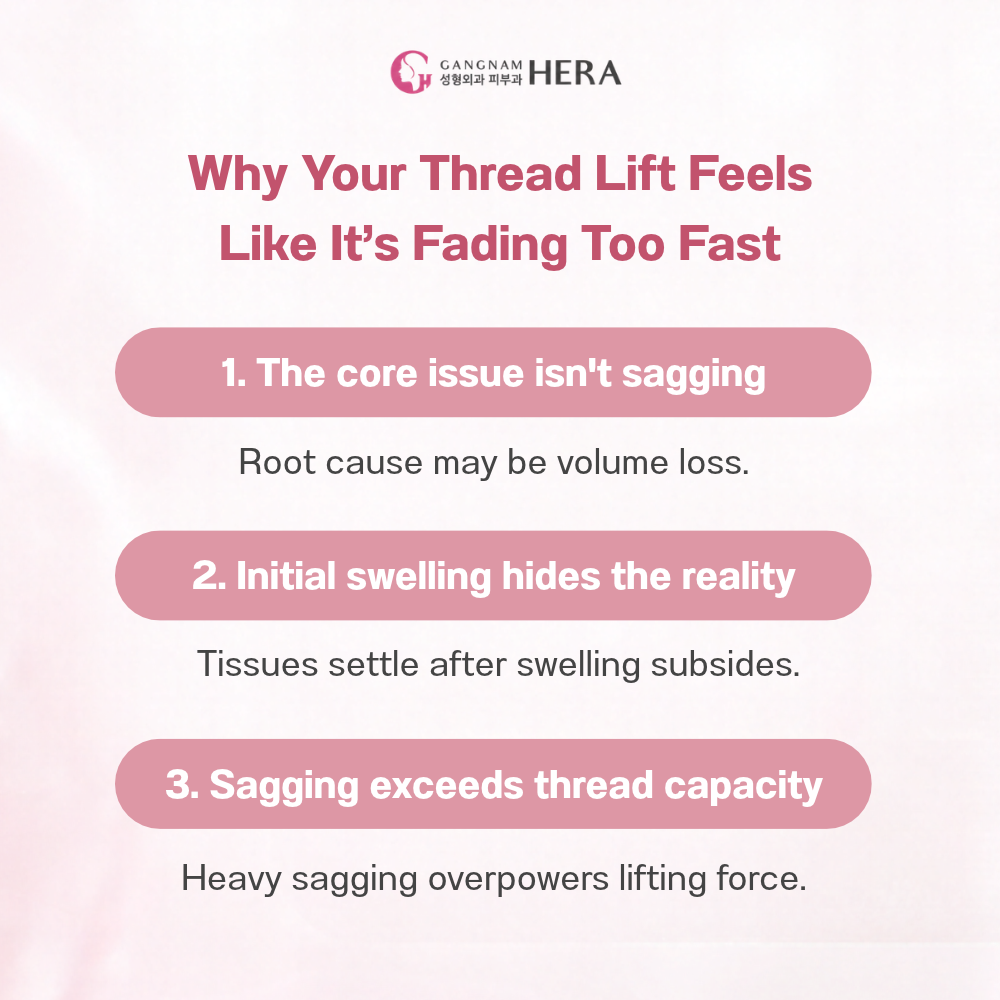
For some people who feel that their thread lift did not provide enough lift or did not last as expected, the cause is not always the lifting threads themselves. Several factors may affect thread lift results and longevity, including the following:
1. The Main Concern Is Not Facial Sagging
Some people notice a tired-looking face, deep nasolabial folds, or a less-defined jawline and assume that facial sagging is the cause. However, the underlying issue may actually be facial volume loss, such as flatter or hollow cheeks, or reduced skin elasticity rather than significantly descended facial tissues.
In this situation, lifting threads can reposition sagging facial tissues, but they cannot replace lost facial volume or immediately improve overall skin quality. If facial volume loss or poor skin elasticity is the main concern, the face may still look tired or less refreshed after a thread lift. This can make it seem as though the thread lift did not work, when the real issue is that the treatment did not address the underlying cause.
2. Early Swelling Can Make the Initial Lift Look More Dramatic
Immediately after a thread lift, mild facial swelling and newly repositioned tissues can make the face appear tighter and more lifted than it will after recovery. Many people remember this early appearance as the expected thread lift result.
As the swelling gradually subsides and the tissues settle naturally, the face will begin to look softer and less tightly lifted. This is a normal part of thread lift recovery and does not necessarily mean that the threads have loosened. Comparing photos after the swelling has resolved provides a more accurate view of the true thread lift results.
3. Facial Sagging Is Too Advanced for a Thread Lift Alone
Each lifting thread has a limited capacity to support facial tissue. If the tissues have descended significantly or there is substantial excess skin, the threads must carry more weight than intended. As a result, their lifting support may decrease sooner than it would for someone with mild to moderate facial sagging.
In these cases, using more threads does not always overcome the limitation. The issue may not be an insufficient number of threads, but rather advanced skin laxity that cannot be fully corrected with a non-surgical thread lift alone.
Targeted Treatment for Facial Sagging and Skin Laxity
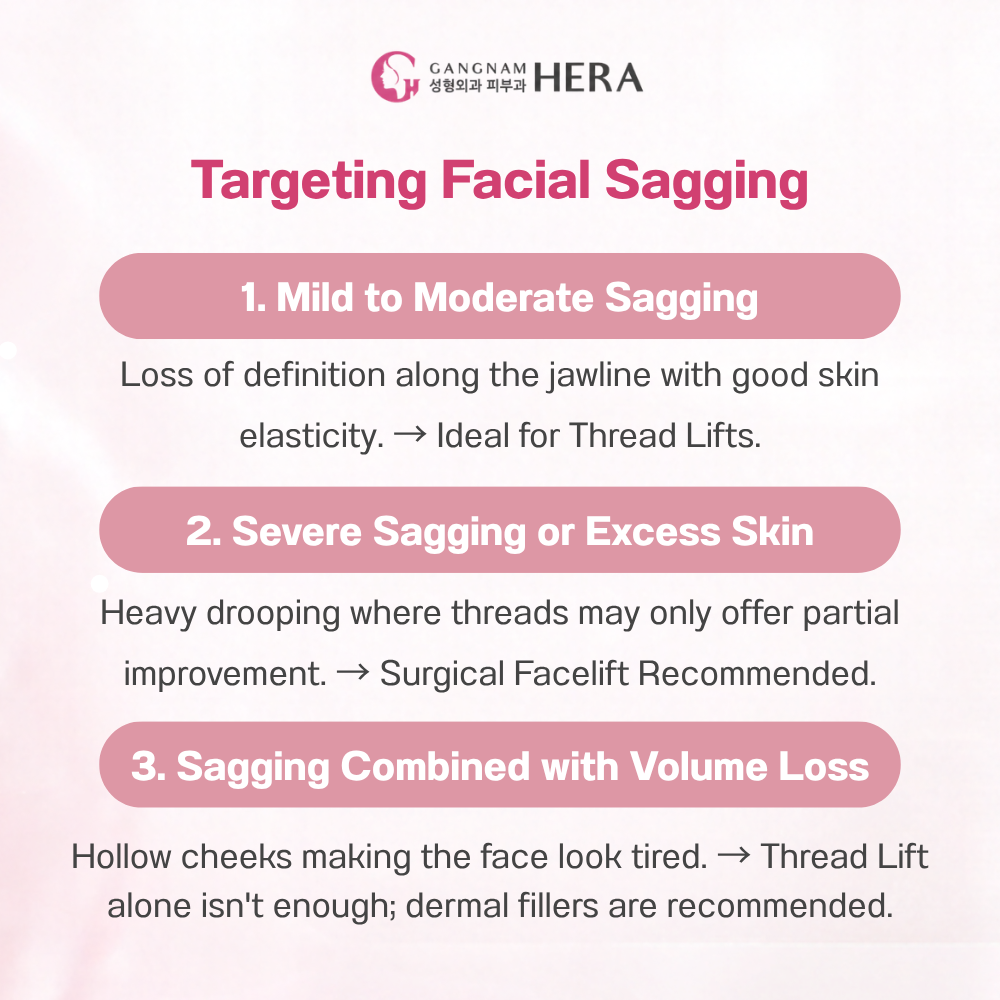
Choosing the most appropriate thread lift treatment begins with assessing two factors: the degree of facial sagging and the type of change you want to achieve. These should always be considered together.
1. Mild to Moderate Facial Sagging
This may include a jawline that is beginning to lose definition or cheeks that have started to descend slightly, while the skin still has good elasticity and is neither excessively thick nor thin. This group may achieve the clearest and most natural-looking thread lift results because the threads are not required to support excessive tissue weight.
2. Severe Facial Sagging or Excess Skin
If the facial tissues have descended significantly or there is substantial excess skin, a thread lift may provide only limited improvement and may not meet your expectations. In this situation, the doctor may recommend a consultation for facelift surgery, which remains a standard treatment option for more advanced facial sagging and skin laxity.
3. Facial Sagging Combined with Volume Loss
If the face appears saggy partly because the cheeks have lost volume, a thread lift alone may not be sufficient. The doctor may consider combining the procedure with a facial volume restoration treatment, as lifting threads reposition tissues but do not replace lost facial fullness.
A key benefit of a non-surgical thread lift is its ability to create a subtle, natural-looking facial lift with generally less recovery time than facelift surgery. If you have clear goals, discussing your preferred lifting areas, expected results, and concerns openly during the consultation can help the doctor design a personalized thread lift treatment plan that better suits your facial structure and needs.
Facial Sagging and Skin Laxity Treatment at Gangnam HERA Clinic
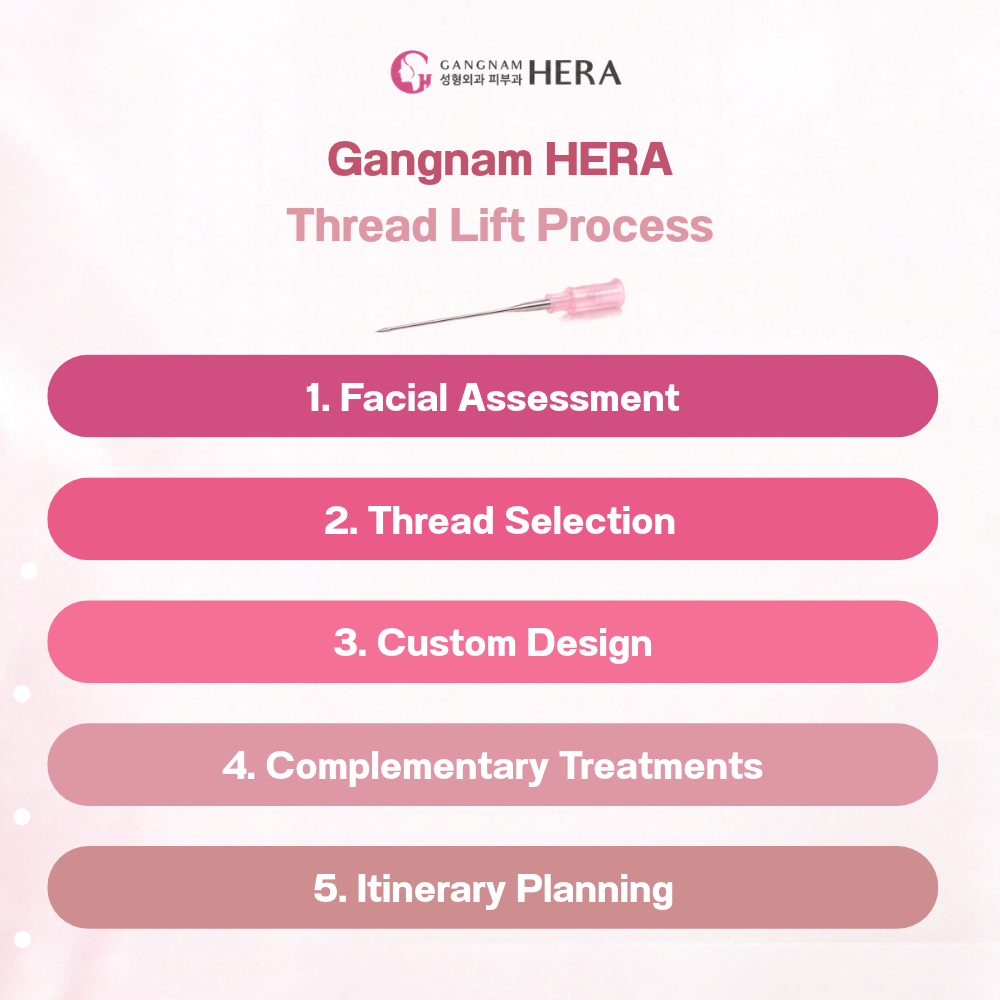
The key to treating facial sagging and skin laxity is a thorough assessment before treatment. Before choosing a thread lift, the doctor should evaluate the degree of skin laxity and determine whether other concerns—such as facial volume loss, excess fat, or reduced skin elasticity—are also contributing to the problem.
At Gangnam HERA Clinic, thread lift planning does not begin with the question, “How many lifting threads are needed?” Instead, the process starts with an in-depth facial assessment to determine which facial lifting treatment is most appropriate for each individual. A personalized treatment plan is then created based on the following key principles:
1. Assess Whether a Thread Lift Is Suitable for Your Face
The doctor first evaluates whether a thread lift should be the primary treatment or whether other facial lifting and anti-aging procedures should be included. If the degree of sagging can be effectively addressed with lifting threads, the thread lift becomes the main treatment. If facial volume loss, reduced skin elasticity, excess fat, or other concerns are also present, these may be incorporated into a personalized treatment plan to address the actual cause.
2. Select the Right Type of Thread for Its Intended Lifting Function
Each type of lifting thread differs in its material, barb or cone design, and intended function. Some threads are designed for stronger tissue lifting, while others provide additional support or collagen stimulation. The right thread should be selected according to facial structure, skin thickness, tissue weight, and the desired lifting direction.
The strongest thread is not always the best or most suitable choice. Some faces may achieve softer, more balanced, and natural-looking thread lift results by combining different thread types, allowing each thread to perform its specific function effectively.
3. Customize the Lifting Direction, Anchoring Points, and Number of Threads
Precise thread placement, lifting direction, and anchoring points can support a natural-looking facial lift and help the results settle more effectively. The number of threads should be based on the actual degree of sagging in each treatment area, including the cheeks, nasolabial folds, jawline, double chin, under-chin area, and brows.
Using more threads does not necessarily create longer-lasting thread lift results. Placing more lifting threads than needed may make the face look overly tight or unnatural and can increase the risk of unnecessary pulling, puckering, or skin dimpling.
4. Plan Complementary Treatments When Necessary
If the assessment shows that a thread lift should be combined with energy-based skin tightening treatments or facial volume restoration, the doctor will plan the appropriate order and timing of each procedure. Some treatments may require a waiting period between sessions. The goal is to create natural, balanced facial rejuvenation—not to pull the face excessively tight or change its original character.
5. Plan Thread Lift Treatment and Follow-Up Around Your Travel Schedule
Planning begins before you travel to Korea with a preliminary facial assessment using photographs. This helps identify visible skin concerns and organize an appropriate treatment and recovery schedule. Once you arrive in Korea, the doctor will perform a detailed in-person facial and skin assessment and adjust the personalized thread lift plan according to your actual facial structure, tissue condition, and degree of skin laxity.
Gangnam HERA Clinic offers several types of lifting threads to suit different facial structures and treatment goals, including APTOS threads, Silhouette Soft, MINT PDO threads, and PDO mono threads. Rather than selecting threads based only on their lifting strength, the clinic focuses on matching the thread material, design, and function to the individual facial anatomy and desired lifting effect.
When Should You Evaluate Thread Lift Results?
Immediately after a thread lift, the face may appear noticeably lifted and more defined. However, early recovery may also involve swelling, tightness, or a pulling sensation when moving the mouth. For this reason, photos taken during the first few days should not be used to judge the final thread lift results.
To evaluate facial changes more accurately, consider the following comparison methods:
- Take Before-and-After Photos for Comparison
Before your thread lift, take clear photos from the front, at a 45-degree angle, and from the side. Use consistent lighting, camera distance, and facial angles to evaluate thread lift results more accurately over time.
- Wait for Swelling to Subside and the Tissues to Settle
Evaluate your thread lift after the initial swelling has decreased and the facial tissues have settled. Avoid comparing long-term results with photos taken immediately after treatment, as early swelling and temporary tissue tension can make the face appear more lifted than the final result.
- Monitor Long-Term Changes
Observe how your thread lift results gradually change over time. Tracking facial lifting, skin firmness, and returning laxity can provide useful information for planning future maintenance treatments.
Plan Your Thread Lift in Korea with STM MATCH

If you are unsure whether a thread lift is suitable for your degree of facial sagging, or how to plan your treatment trip to Korea, STM Style can help you get started. Prepare essential information, including the facial areas you want to improve, the features you want to preserve, your previous aesthetic treatment history, and the number of days you plan to stay in Korea.
Once your information has been reviewed, STM Style will help match you with a Korean doctor who specializes in thread lifts, facial lifting, and skin-tightening treatments, using its network and database of experienced medical specialists.
The doctor will then perform a focused facial assessment to determine whether a thread lift is suitable for your facial structure and degree of skin laxity, which areas should be treated, and whether other lifting or volume-restoration treatments should be considered. This helps create a personalized plan aligned with your expectations, allowing you to make a more informed and confident decision.
FAQ: Frequently Asked Questions About Thread Lifts
Q. Does Using More Threads Make Thread Lift Results Last Longer?
Not necessarily. Thread lift results and longevity depend more on the type of thread, lifting direction, anchoring points, and degree of skin laxity than on the number of threads used. Placing more threads than necessary may not make the results last longer and could make the face appear overly tight or unnatural.
Q. Can You Get Another Thread Lift If You Have Had One Before?
A repeat thread lift may be possible because most modern lifting threads are designed to dissolve naturally over time, while facial tissues continue to change with age. Many people choose maintenance thread lift treatments to help preserve facial firmness and definition. However, there is no fixed schedule for everyone—the appropriate timing depends on your previous thread lift results, remaining threads, current facial anatomy, and the doctor’s assessment.
Q. Can Combining a Thread Lift with Ultherapy or Dermal Fillers Improve the Results?
In many cases, combining treatments may enhance facial rejuvenation because each procedure addresses a different concern. Thread lifts reposition and support sagging tissues, Ultherapy and other energy-based lifting treatments improve skin firmness and quality, while dermal fillers restore lost facial volume.
However, combined thread lift, Ultherapy, and filler treatments are not necessary for everyone. A doctor should first assess whether each treatment is appropriate and determine the safest sequence and timing for natural-looking, balanced results.
Whether a thread lift is worth it depends on more than the number of threads used or the country where the treatment is performed. The decision should begin with understanding your degree of facial sagging, the type of improvement you expect, and how future maintenance will be planned.
If you are planning a thread lift in Korea, send STM Style your facial photos, areas of concern, previous aesthetic treatment history, and travel dates. STM Style can organize your information, help find a suitable Korean doctor, and coordinate a preliminary medical assessment before your trip.