Revision Rhinoplasty: Can Donor Rib Cartilage Replace Your Own Rib Cartilage? Urban Plastic Surgery
When researching revision rhinoplasty in Korea, you’ll often come across the term autologous rib cartilage, which means cartilage taken from your own ribs. That often raises two questions. Will I have a scar on my chest? How much will it hurt? These concerns lead many people to consider donor rib cartilage for revision rhinoplasty, since it avoids the need to harvest cartilage from their own ribs.
However, there are several important factors to consider before choosing a graft material for revision rhinoplasty.
In this guide to revision rhinoplasty, we’ll cover what your surgeon evaluates before recommending autologous rib cartilage or donor rib cartilage, the pros and cons of each option, and how to prepare for surgery and care for yourself during recovery to support your desired results.
Can You Use Donor Rib Cartilage Instead of Your Own for Revision Rhinoplasty?
Yes, donor rib cartilage can be used in some revision rhinoplasty cases. This cartilage comes from a donor, is processed for medical use, and is one of the graft options surgeons may consider for revision rhinoplasty.
People who consider donor rib cartilage for revision rhinoplasty often share similar reasons. They want to keep surgical incisions limited to the nose and avoid pain at the rib cartilage harvest site during recovery.
Those preferences are only half of the decision. Equally important are your existing nasal structure and the condition of your nasal tissue. Your surgeon will examine both carefully to determine whether donor rib cartilage can provide the structural support needed for your revision rhinoplasty.
If you have concerns about using your own rib cartilage, bring them up during your revision rhinoplasty consultation. Your surgeon can weigh your preferences alongside your nasal anatomy when planning the procedure and recommend the most suitable graft material for your case.
What Does Your Surgeon Evaluate Before Choosing a Graft Material for Revision Rhinoplasty?
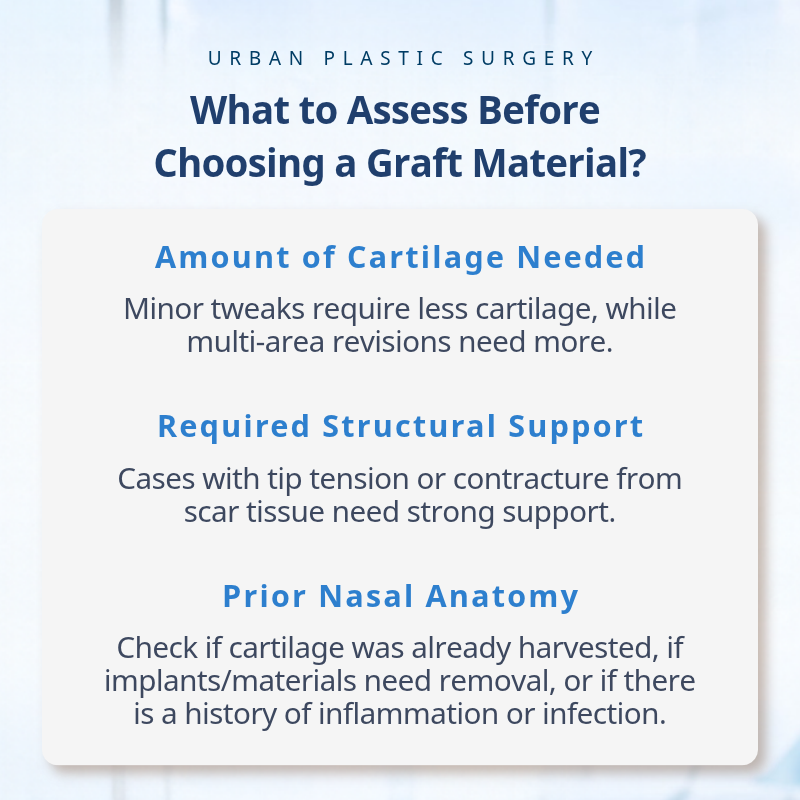
Before recommending a graft material for revision rhinoplasty, your surgeon needs to carefully assess the remaining nasal structure. The choice of graft material depends mainly on three key factors.
How Much Cartilage Is Needed A targeted correction may require only a small amount of cartilage. If several parts of the nasal tip need to be taken apart and rebuilt, more cartilage will be needed. The amount required directly affects the choice of graft material for revision rhinoplasty.
How Much Structural Support the Nose Needs A tight, retracted nasal tip or a nose shortened by scar tissue contracture often requires a strong, stable cartilage graft. The graft needs to provide enough long-term nasal tip support to resist the pull of the surrounding tissue.
Nasal Structure After Previous Rhinoplasty Your surgeon will carefully review whether septal cartilage or cartilage from another site was used in your previous surgery, whether a silicone implant or other graft material needs to be removed, and whether you have a history of inflammation or infection.
Autologous Rib Cartilage vs. Donor Rib Cartilage
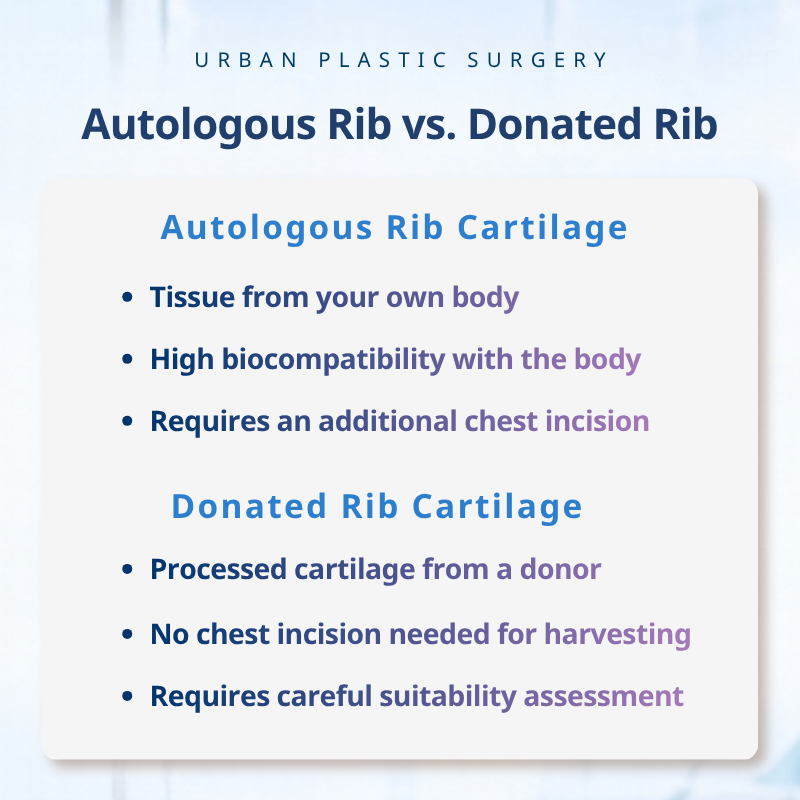
Autologous rib cartilage and donor rib cartilage are both graft options for revision rhinoplasty. They differ in where they come from and in their properties, giving each option its own advantages and limitations to weigh.
Autologous Rib Cartilage Autologous rib cartilage comes from your own body, making it naturally compatible with your tissues. It can also provide a relatively large amount of graft material. Surgeons often consider it for complex revision rhinoplasty or when several parts of the nasal structure need to be rebuilt. Harvesting the cartilage requires an additional chest incision that leaves a scar, and you may feel soreness and tightness at the harvest site during early recovery.
Donor Rib Cartilage A key advantage of using donor rib cartilage for revision rhinoplasty is that it avoids a chest incision to harvest your own cartilage. Because the graft comes from a donor, your surgeon will assess its suitability for your case, including where it would be placed, how it would fit with your existing nasal structure, and what risks to consider before planning how to use it alongside your own tissue.
Autologous rib cartilage and donor rib cartilage each have their own advantages and limitations. The right graft material for revision rhinoplasty depends on your nasal anatomy and the specific concerns you want to address. A thorough consultation with your surgeon gives you time to understand each option and plan the procedure together before deciding whether to proceed.
Urban Plastic Surgery’s Approach to Revision Rhinoplasty
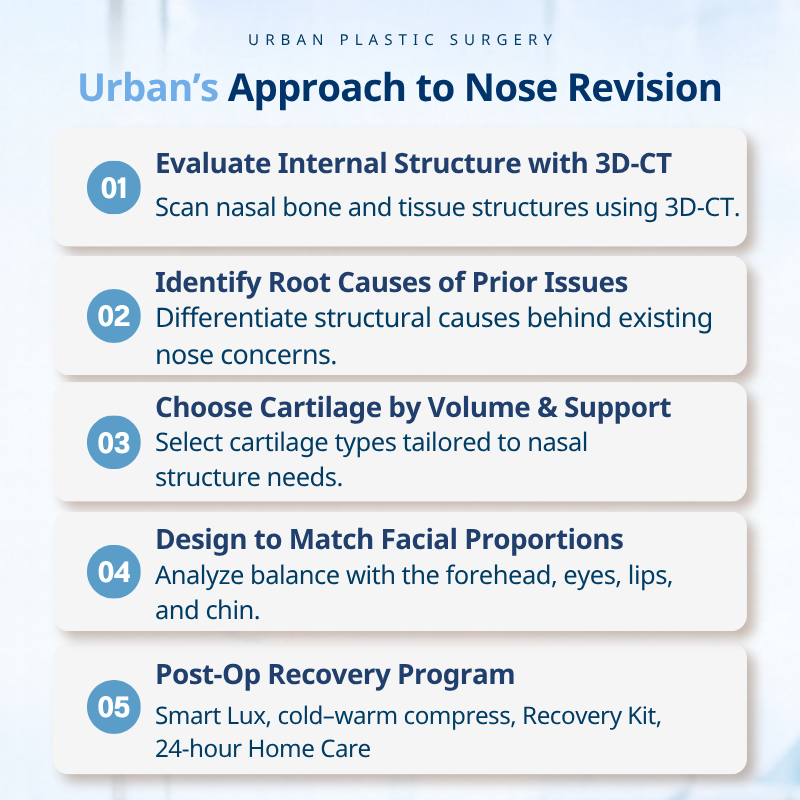
At Urban Plastic Surgery, we begin revision rhinoplasty planning by carefully examining your existing nasal structure to identify exactly where the problems lie. Those findings guide each step of the surgical plan, including the choice of graft material.
1. Assessing Internal Nasal Structure with a 3D CT Scan A 3D CT scan helps your surgeon visualize the bones and tissues inside your nose that are hidden from view during an external examination. These detailed images of your nasal anatomy allow your surgeon to plan your revision rhinoplasty more precisely.
2. Identifying the Cause of Nasal Problems Before Revision Rhinoplasty A shortened nose caused by scar tissue contracture, a tight or retracted nasal tip, and a nose shape that does not suit your facial proportions can each stem from different structural issues. Your surgeon identifies the underlying cause so the revision rhinoplasty plan addresses the specific issue.
3. Choosing a Cartilage Graft Based on Volume and Structural Support During your revision rhinoplasty consultation, your surgeon will assess how much cartilage is needed and how much support the graft must provide. They’ll recommend a graft that fits your nasal anatomy and explain the reasoning behind each option.
4. Designing a Nose Shape That Complements Your Facial Proportions When planning your revision rhinoplasty, your surgeon looks beyond trending nose shapes and assesses how your nose fits with your forehead, eyes, lips, and chin. The goal is a softer, natural-looking nose with balanced contours and definition from both the front and the side.
5. Postoperative Care and Recovery Program Urban Plastic Surgery offers a postoperative recovery program for eyelid surgery and rhinoplasty. Care options include Smart Lux light therapy to help reduce swelling, cold and warm compresses, a postoperative self-care kit, and 24-hour Home Care. The care team tailors the recovery plan to each person’s symptoms.
How Graft Material Affects Wound Care and Recovery Time After Revision Rhinoplasty
If you’re planning revision rhinoplasty in Korea, your choice of graft material directly affects your recovery plan and when you can travel home.
Recovery After Revision Rhinoplasty with Autologous Rib Cartilage You’ll need to care for both the nasal incisions and the chest incision where the rib cartilage was harvested. During early recovery, you may feel soreness or tightness around the chest incision when you move, cough, or take a deep breath. Avoid heavy lifting and strenuous activity during this period. Your surgeon may schedule a separate appointment to check the chest incision in addition to your rhinoplasty follow-up.
Recovery After Revision Rhinoplasty with Donor Rib Cartilage Using donor rib cartilage avoids the chest incision and the associated soreness and tightness from harvesting your own cartilage. You still need to follow your surgeon’s postoperative care instructions closely, including how to care for your nasal incisions and what activities to avoid during recovery.
If you’re planning revision rhinoplasty in Korea, generally allow at least a week for recovery and follow-up. Depending on the procedure, you may need an additional appointment for stitch removal around day 14 after surgery. Confirm your follow-up schedule with your clinic before booking your return flight so you can stay through any required appointments.
STM MATCH — Find a Doctor Matched to Your Needs and Treatment Goals
If you’re deciding between autologous rib cartilage and donor rib cartilage for revision rhinoplasty in Korea, STM Style can help connect you with a specialist experienced in cases like yours.
STMStyle begins by gathering essential background information, such as the number of previous surgeries, the concerns you would like to address, medication allergies, underlying medical conditions, and the length of your planned stay in Korea. This information is then used to match your case with Korean surgeons in the STMStyle network whose specialized expertise aligns with your specific concerns and treatment needs. The goal is to help connect you with an appropriate specialist who can review your case in detail and provide a more targeted medical assessment based on your individual circumstances.
STM Style helps connect you with a certified Korean surgeon suited to your revision rhinoplasty case. Your surgeon will assess your nasal anatomy, determine the type and amount of cartilage needed, and develop your care plan.
Frequently Asked Questions About Revision Rhinoplasty with Rib Cartilage
Q. Is donor rib cartilage suitable for everyone undergoing revision rhinoplasty?
Donor rib cartilage is suitable for some revision rhinoplasty cases. Your surgeon will assess where the graft would be placed, how much cartilage is needed, the condition of your nasal tissue, and your previous nasal surgeries before determining whether it’s right for you.
Q. Can I Use My Own Cartilage for Revision Rhinoplasty If It Was Already Used in a Previous Nose Surgery?
Yes, your own cartilage may still be an option for revision rhinoplasty. Your surgeon will first check whether enough usable cartilage remains after your previous surgery. If more cartilage is needed, your surgeon will discuss other graft sources with you. That’s why it’s important to share your complete nasal surgery history during your consultation.
Q. What Should I Check When Reviewing a Revision Rhinoplasty Cost Estimate?
Revision rhinoplasty costs vary depending on the surgical plan and the graft material used. Ask which items are included in the quote and which are billed separately, such as the type of cartilage graft, removal of an existing implant or graft, anesthesia, preoperative testing, and postoperative care. An itemized quote makes it easier to compare your options.
Choosing between autologous rib cartilage and donor rib cartilage for revision rhinoplasty depends on the structural support your nose needs and the type of recovery you’re prepared for. Gather your complete nasal surgery history and allow enough time for recovery so you can coordinate your surgery and travel plans.
If you’re planning revision rhinoplasty in Korea, send your current photos and previous nasal surgery history to STM Style. We can help arrange a preliminary assessment with a Korean plastic surgeon experienced in cases like yours before you make travel plans.