



Facial Contouring in Korea: Balancing Facial Bone Reduction and Augmentation for a Slimmer, Softer Face
By NJH Plastic Surgery
When it comes to facial contouring surgery, many people initially think about making the jaw narrower, reducing prominent cheekbones, or removing as much bone as possible to create a smaller-looking face.
However, the beauty and balance of the facial structure are not determined simply by how much bone is removed. The overall result depends on how the cheekbones, jawline, chin, facial width, projection, and proportions work together as a whole.A soft, well-proportioned facial contour comes from the relationship between the cheekbones, jaw, chin, and other facial structures, all of which should look balanced from both the front and side profile.
This means facial contouring is not only about reducing areas that appear too prominent. In some cases, certain areas may also need structural augmentation or added projection to create better overall harmony and proportion.
The goal is therefore to balance bone reduction and augmentation according to the individual facial structure, rather than simply removing as much bone as possible.At NJH Plastic Surgery, effective facial contouring planning involves both reducing areas that are too prominent and augmenting areas that lack sufficient structural support or projection.
In suitable cases, autologous bone grafting may be used to reshape and reinforce specific areas of the facial skeleton. By using the individual’s own bone to add structure where needed, the surgeon can create a more balanced facial contour that appears slimmer, softer, and more harmonious with the original facial proportions.
This approach focuses on building overall facial balance rather than simply reducing bone, helping achieve a more refined and natural-looking contour from multiple angles.
Creating Balance: “Reduce What’s Excessive, Augment What’s Lacking”
To create balance by “reducing what is excessive and augmenting what is lacking,” the surgeon carefully evaluates how moving or reshaping bone in each area may affect the facial width, projection, contour, and overall three-dimensional balance.
At NJH Plastic Surgery, this planning approach can be divided into three key principles:
- Areas That May Need Reduction
The focus is on areas where the bone is too prominent or too wide, such as laterally projecting cheekbones that make the face appear broader, or prominent jaw angles that can make the lower facial contour look more angular or strong.
- Areas That Should Be Preserved
Not every prominent-looking bone needs to be reduced. Certain facial bones play an important role in creating facial dimension, projection, and structural support.
Removing too much bone can make the face appear flat, hollow, or out of proportion, disrupting the natural balance of the facial structure. Careful planning is therefore needed to preserve the areas that contribute to a harmonious and three-dimensional facial contour.
- Areas That May Need Augmentation
If certain areas of the facial skeleton appear too flat, recessed, or lacking in projection, the surgeon may consider adding structural volume where appropriate.
In suitable cases, autologous bone grafting can be used, with the person’s own bone carefully shaped and refined to augment areas that need additional support or projection.
This can help improve facial dimension, balance, and contour, while maintaining harmony with the existing facial structure.Careful preoperative planning is essential to determine which areas should be reduced, which structures should be preserved, and which areas may need augmentation.
This helps create a slimmer facial contour without sacrificing the natural dimension, projection, and balance of the face, allowing the final result to remain refined, harmonious, and proportionate from multiple angles.
Why Is Detailed Facial Structure Analysis Important Before Facial Contouring Surgery?Why Different Parts of the Cheekbone Should Be Evaluated SeparatelyWhy Should the Cheekbones Be Analyzed in 3 Dimensions?
The concern of “prominent cheekbones” does not come from the same area in every person.
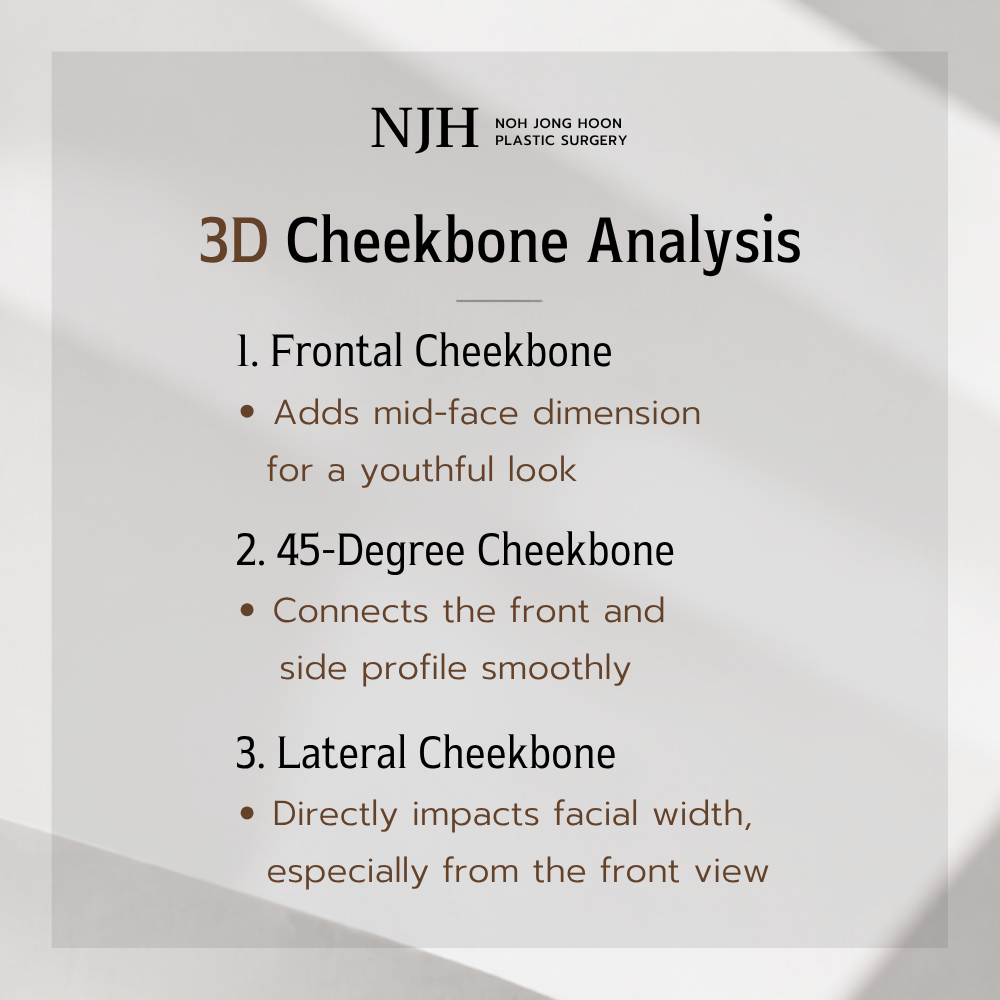
At NJH Plastic Surgery, the cheekbones are not treated as a single block of bone to be reduced in the same way for every case. Instead, the surgeon performs a detailed 3D cheekbone analysis, assessing the front cheekbone, the 45-degree cheekbone area, and the lateral cheekbone separately.
This three-dimensional evaluation helps determine which part of the cheekbone is contributing most to facial width or prominence, allowing the surgeon to design a more precise cheekbone reduction plan that suits the individual facial structure and overall proportions.1. Front Cheekbone
The front cheekbone plays an important role in giving the midface natural projection, dimension, and a youthful appearance.
If reduction is needed in this area, the key is to preserve an appropriate amount of anterior cheekbone projection rather than removing too much bone. Excessive reduction can make the face appear flat, hollow, or less proportionate.
For this reason, front cheekbone reduction should focus on creating a slimmer contour while maintaining enough structure to preserve facial depth, softness, and three-dimensional balance.2. 45-Degree Cheekbone
The 45-degree cheekbone is most noticeable when the face is viewed from an oblique angle. It acts as an important transition point between the front and side of the face.
If this area projects too prominently, the face may appear more angular, sharp, or structurally strong, even when it does not look especially wide from the front.
For this reason, the 45-degree cheekbone should be assessed separately to determine how much projection needs to be reduced while preserving a smooth, balanced transition between the front and side facial contours.3. Lateral Cheekbone
The lateral cheekbone has a direct influence on the overall width of the face, especially when viewed from the front.
Reducing prominence in this area therefore focuses mainly on creating a narrower, slimmer facial outline, while maintaining balance with the front and 45-degree cheekbone areas.Because the cheekbones differ in shape and prominence across each dimension, the surgical technique also needs to be selected differently for each area.
Some areas may require only bone shaving or contouring, while others may need an osteotomy with inward repositioning of the cheekbone to create a more three-dimensional and balanced facial contour. The repositioned bone is then securely fixed in its new position to maintain structural stability.In addition, the surgeon also needs to evaluate the jaw and chin, which play a major role in defining the lower facial contour.
Once the width of the midface is reduced, the line from the cheekbones down through the jawline and chin should still connect smoothly and naturally. This is why facial contouring planning is not simply about deciding “how many millimeters of bone should be removed.”
The more important question is how the newly adjusted bone structure will create a slimmer, softer, and more harmonious facial outline that flows naturally from the cheekbones to the jaw and chin when viewed from every angle.
Autologous Bone Grafting in Facial Contouring Surgery: How Bone Is Positioned Securely and Safely
For cases that are considered suitable for autologous bone grafting as part of facial contouring surgery, the key is not simply whether there is “enough bone available to use.”
Successful planning requires careful evaluation from the quality and condition of the harvested bone to the way it is shaped, positioned, and securely fixed in the new area.
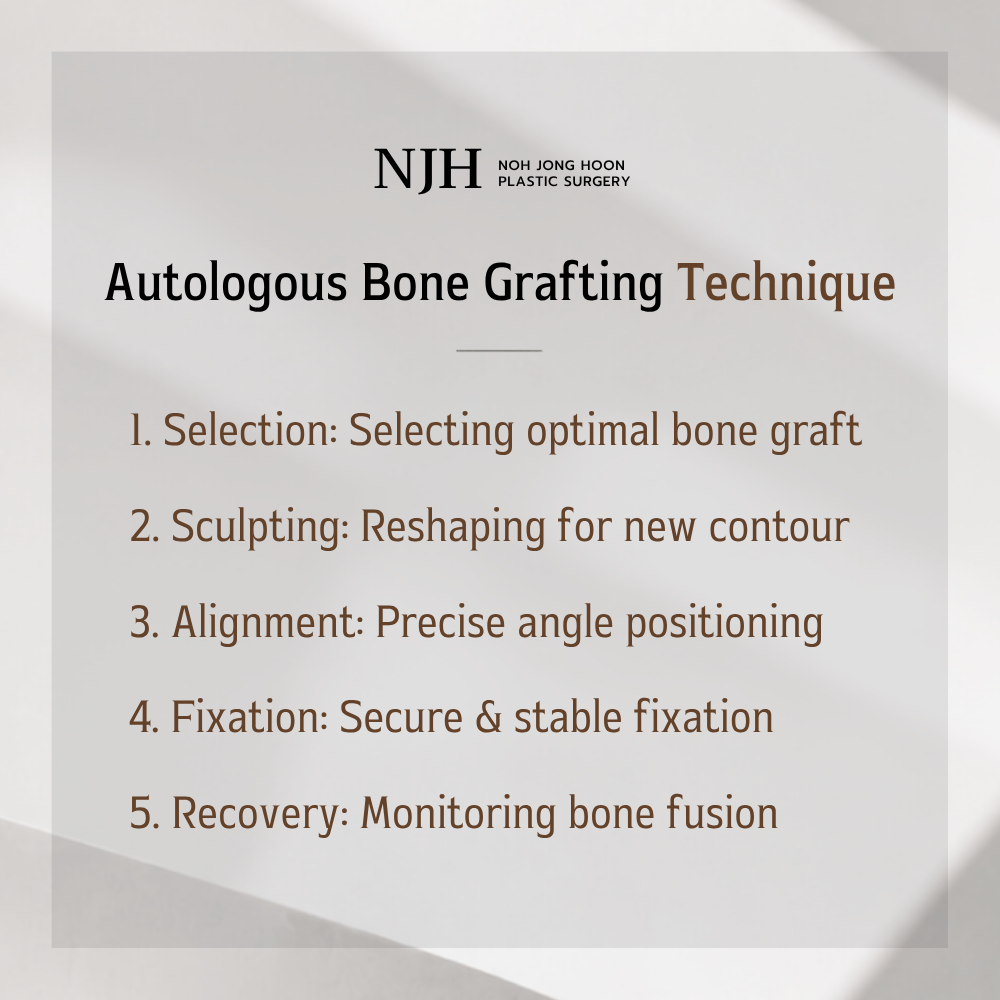
The process can be divided into five main steps:1. Selecting the Most Suitable Bone Graft
Not every piece of bone removed during facial contouring surgery is suitable for reuse. The surgeon carefully evaluates the bone quality, density, thickness, and size to determine whether it is appropriate for grafting in the area that needs additional structural support or projection.2. Shaping the Bone Graft to Fit the New Position
The bone graft is carefully trimmed, contoured, and reshaped to match the surrounding facial structure at its new location.
The goal is for the graft to blend naturally with the existing bone, creating a smooth and balanced contour rather than appearing as a noticeable or unnatural-looking projection.3. Precise Placement and Angle Positioning
The bone graft must be positioned so that it aligns precisely with the existing facial bone structure.
Even small differences in placement, direction, or angle can directly affect the visible facial contour from the outside. Precise positioning is therefore essential for creating a smooth transition, natural projection, and balanced facial line.4. Secure Fixation for Structural Stability
Similar to cheekbone repositioning, the transplanted bone graft needs to be securely fixed in place so that it remains in the intended position throughout the healing and recovery period.
Stable fixation helps maintain the planned bone position, facial contour, and structural alignment while the graft integrates with the surrounding bone.5. Monitor Bone Graft Integration During Recovery
After surgery, the surgeon will schedule regular follow-up appointments to monitor recovery.
These check-ups are not only for assessing visible swelling, but also for evaluating the position and stability of the bone graft, as well as how well it is integrating and healing with the surrounding bone structure over time.Therefore, autologous bone grafting is not simply about reusing bone that has been removed during facial contouring surgery.
It is a precise reconstructive technique that requires careful bone selection, reshaping, positioning, fixation, and follow-up at every stage. The goal is to use the individual’s own bone strategically to help rebuild and refine the facial framework in a way that looks balanced, natural, and structurally harmonious.
Autologous Bone Grafting vs. Synthetic Implants in Facial Contouring: How Do They Differ?
Both autologous bone grafts and synthetic implants can be used to augment and restore facial structure effectively. However, their key differences lie in their source, biological integration, material characteristics, and the amount available for augmentation.
The main differences can be summarized as follows:
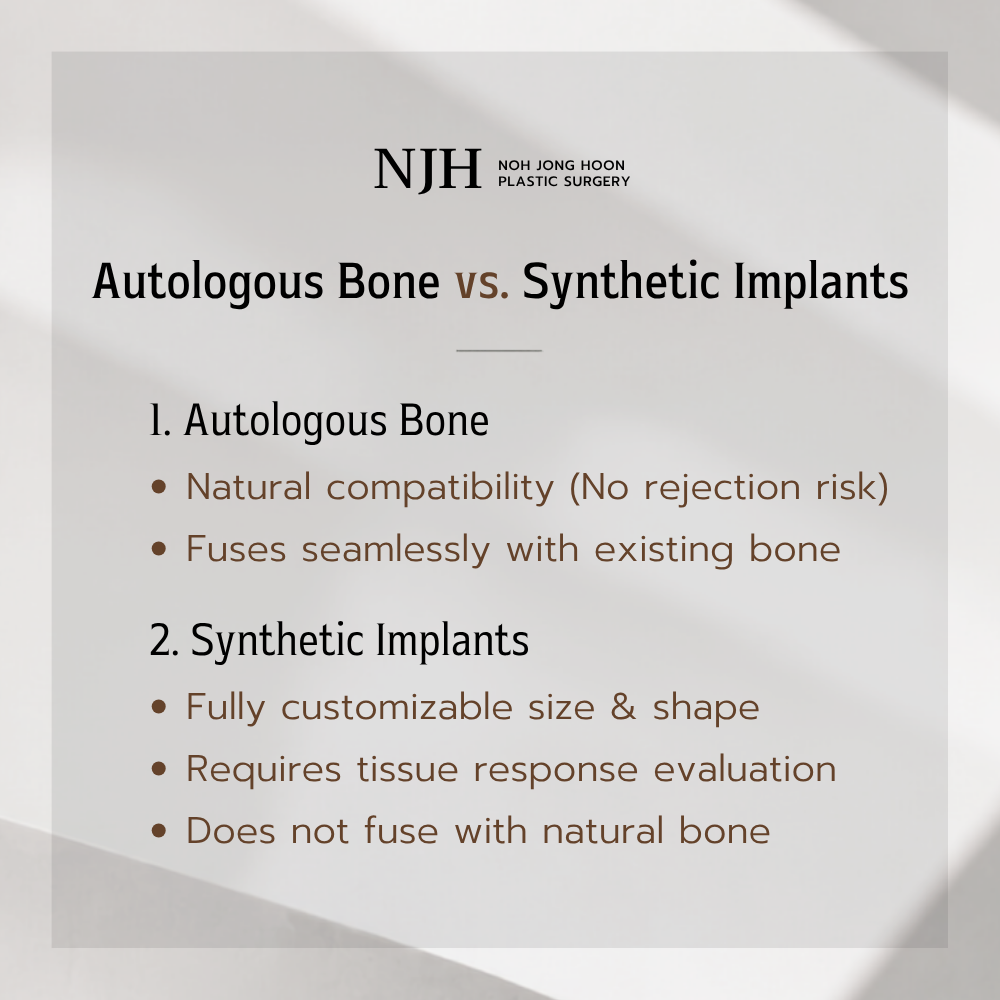
- Autologous Bone
Autologous bone is natural bone tissue taken from the individual’s own body. Because it comes from the same person, it retains the biological properties of natural bone and is not treated by the body as a foreign material in the same way as a synthetic implant.
Over time, the grafted bone can integrate with the surrounding facial bone structure as healing progresses.
In facial contouring surgery, surgeons may reshape bone that has already been removed during the procedure and reuse it to augment areas that lack projection or structural support. This allows suitable bone to be repurposed strategically rather than discarded, helping improve facial balance with the individual’s own tissue.
- Synthetic Implants
Synthetic implants are medical-grade materials manufactured for facial augmentation and reconstruction. One of their main advantages is that the size, shape, and amount can be selected according to the structural needs of the face, without requiring bone to be harvested from the individual’s own body.
Because these materials are foreign to the body, however, the surgeon needs to consider tissue response, implant position, surrounding soft tissue, and long-term compatibility when planning surgery.
Unlike autologous bone grafts, synthetic implants do not biologically integrate and become natural bone tissue. For this reason, the choice between synthetic materials and the individual’s own bone should be based on the specific facial structure, augmentation area, and surgical goals.The choice between autologous bone and synthetic implants depends on several factors, including which area needs augmentation, how much additional volume or projection is required, and which option best matches the individual facial anatomy.
In facial contouring surgery, where bone reshaping or reduction is already being performed, reusing suitable, high-quality autologous bone to augment areas that lack projection or structural support can be an important option for improving overall facial balance and creating a softer, more harmonious contour.
Whether autologous bone grafting is appropriate should still be determined according to the specific anatomical needs and surgical indications of each case.
Personalized Facial Contouring with STM MATCH

When searching for a plastic surgeon, many people begin by looking through reviews and choosing a doctor whose aesthetic style matches the results they like. That can be a good starting point.
However, if you want greater confidence that your case is being handled by a doctor with expertise that closely matches your specific concerns and surgical needs, STMStyle can help with the matching process.
Through STM MATCH, we help connect each case with a Korean plastic surgeon whose experience and specialty are more closely aligned with the actual problem that needs correction, rather than choosing based on visual preference alone.STMStyle first gathers key background information, such as how many previous surgeries you have had, which materials were used, the areas you would like to improve, medication allergies, underlying medical conditions, and your planned length of stay in Korea.
This information is then used as part of the STM MATCH process to connect your case with a Korean plastic surgeon in our network whose expertise is closely aligned with your specific nasal concerns and surgical needs.
By organizing these details in advance, the doctor can review the case more accurately and provide a more focused rhinoplasty assessment and personalized treatment plan based on your actual surgical history, nasal structure, and goals.For more detailed decisions about how your facial structure should be corrected or reshaped, STMStyle does not make these medical decisions on behalf of the surgeon.
These assessments should be made directly by a qualified Korean plastic surgeon whose expertise is appropriate for the individual case. The surgeon will evaluate the facial bone structure, proportions, areas of excess or deficiency, and overall balance before determining the most suitable surgical plan.
FAQ: Frequently Asked Questions About Facial Contouring Surgery
Q. Can Bone Removed During Facial Contouring Surgery Be Reused in Every Case?
Not in every case. The surgeon needs to evaluate the quality and amount of bone available for reuse, the area that requires augmentation, and whether the graft’s shape is suitable for the overall surgical plan.
For this reason, not every piece of bone removed during facial contouring surgery can automatically be reused for autologous bone grafting. The decision depends on whether the harvested bone is appropriate for the specific structural correction and augmentation needs of the case.Q. Why Should Facial Structure Be Analyzed from Multiple Angles?
Because the bone that makes the face look wide or prominent may be located in different areas. The front cheekbone, 45-degree cheekbone, and lateral cheekbone each contribute differently to facial width, projection, and three-dimensional contour.
Analyzing the face from multiple angles therefore helps the surgeon identify which area is creating the prominence and in which direction it should be adjusted, providing a more precise plan than evaluating the face from the front view alone.Q. Does Everyone Who Has Facial Contouring Surgery Need Autologous Bone Grafting?
Not necessarily. Autologous bone grafting is an option used only when there is a specific indication for it.
If the facial structure can be adequately improved through bone reduction or repositioning alone, there may be no need to add a bone graft.
The decision depends on the existing facial bone structure, areas that require correction or augmentation, and the individual surgical goals of each case.
The key to facial contouring surgery is creating precise structural balance by reducing areas that are too prominent, preserving important facial structures, and augmenting areas that lack projection or support.
The goal is to create a new facial contour that looks slimmer, softer, well-proportioned, and naturally harmonious with the individual facial structure.If you are concerned about your facial shape and want to understand whether your case may require bone reduction, repositioning, or structural augmentation, you can send photos, the areas you are concerned about, and your previous treatment or surgical history to STMStyle.
We can help organize the information needed for your case, identify Korean plastic surgeons with relevant expertise in facial contouring surgery, and coordinate a preliminary assessment with the doctor before you travel to Korea.
This can help you better understand which facial structures may need to be reduced, repositioned, preserved, or augmented before planning your facial contouring surgery in Korea.
#FacialContouringSurgery #KoreanFacialContouring #FacialContouringKorea #FacialBoneSurgery #FacialBoneContouring #AutologousBoneGrafting #AutologousBoneGraft #FacialBoneAugmentation #FacialBoneReconstruction #CheekboneReduction #CheekboneReductionKorea #ZygomaReduction #ZygomaReductionKorea #JawReduction #JawReductionKorea #MandibleReduction #JawContouring #VLineSurgery #VLineKorea #KoreanVLine #SlimFaceSurgery #SlimFaceKorea #FacialSlimming #KoreanPlasticSurgery #PlasticSurgeryKorea #KoreanPlasticSurgeon #KoreanPlasticSurgeryHospital #KoreanAestheticClinic #KoreanClinic #KoreanBeautyReview #KBeauty #KoreaMedicalAgency #KoreanAestheticTreatments #MedicalTourismKorea #PlasticSurgeryConsultationKorea #NJHPlasticSurgery #NohJongHoonPlasticSurgery #STMStyle